Anudeep Durishetty Answer Copy — AIR 1, UPSC CSE 2017
Anudeep Durishetty secured All India Rank 1 in UPSC CSE 2017.
The archive contains his GS Paper 2 and GS Paper 3 answer copies plus three ForumIAS GS test copies.
We read 3 of these booklets page by page — below is exactly what’s inside: the questions Anudeep attempted, the examples and quotations used, and how each answer was structured. Every copy is a free PDF.
AIR 1 · CSE 20175 free PDFsUpdated 29 Jun 2026
Inside Anudeep Durishetty’s answer copies
Anudeep Durishetty — GS Paper 2 answer copy
GS Paper 2PDF · 8.2 MB
What’s inside this copy
▸Anchors almost every answer to a specific Constitutional Article in the opening line (Art 312 for civil services, Art 153 for Governor, Art 324 for EC, Art 47 for health) before defining the term.
▸Turns each 200-word answer into a scannable mini-essay using boxed sub-headings — 'Checks', 'Analysis', 'Evaluation', 'Way Forward', 'Challenges', 'Reforms needed'.
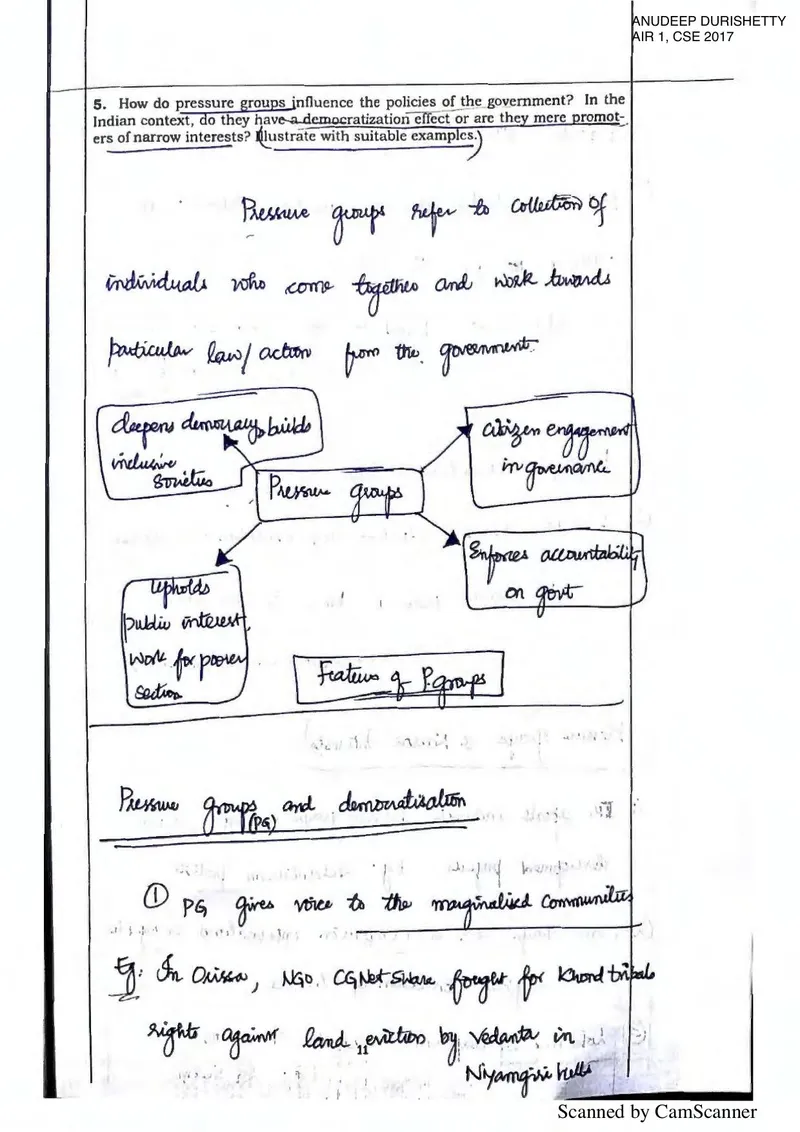
▸Relies on hand-drawn mind-maps (central bubble + radiating arrows) to unpack multi-dimensional questions like pressure groups, NAM objectives and EC functions.
▸Carries every international-relations answer with a labelled sketch-map — Israel-Palestine, the OBOR-vs-AAGC world map, and the India-Bhutan-China Chumbi Valley / Chicken's Neck map.
▸Backs claims with crisp data and named reports: DAKSH (12-15 yr delays), Lancet (0.7 doctors/1000 vs WHO's 2), 1.5% vs Thailand's 3.5% health spend, ADR's 33% MPs with criminal records.
▸Closes arguments with balance and a memorable line — ending Q1 on Palkhivala's 'alarm clock not a time keeper' and opening Q6 with Nehru's 'organic entity that evolves'.
What to learn from this copy
★Anudeep opens nearly every answer by naming the exact Constitutional provision the question hinges on before defining anything — Art 312 for the civil-services question (Q9), Art 153 for the Governor (Q11), Art 324 for the Election Commission (Q13), Art 47 for health (Q8). -> Lead your GS2 answer with the precise Article, not a vague intro: it instantly signals constitutional literacy and frames the whole answer in the examiner's first 10 seconds.
★He converts each ~200-word answer into a scannable mini-essay with boxed/underlined sub-headings he reuses across the paper — 'Checks', 'Features', 'Analysis', 'Evaluation', 'Challenges', 'Way Forward', 'Reforms needed'. -> Build a small fixed kit of labelled sub-heads and stamp them on every answer; the examiner can see your structure (issue -> analysis -> way forward) at a glance without reading line-by-line.
★Claims are pinned to named reports with hard numbers, not adjectives: DAKSH on 12-15 year adjudication delays (Q7), Lancet on 0.7 doctors per 1000 vs WHO's 2 and 1.5%-of-GDP health spend vs Thailand's 3.5% (Q8), ADR's 33% of MPs with criminal antecedents (Q2/Q13), World Bank's Rs 80,000 cr Aadhaar saving (Q4). -> Memorise 2-3 source-attributed statistics per static topic; 'DAKSH report' or 'per Lancet' is far more convincing than 'huge delays' and is what separates a 6 from a 10.
★He carries every international-relations answer with a labelled sketch-map — the OBOR-vs-AAGC world map (Q15), Israel-Palestine (Q16), and the India-Bhutan-China map marking Chumbi Valley and the Chicken's Neck (Q20). -> For IR questions, a quick annotated map naming the actual chokepoints/corridors (Chabahar, Gwadar, Chumbi Valley) earns value-addition marks that pure prose cannot.
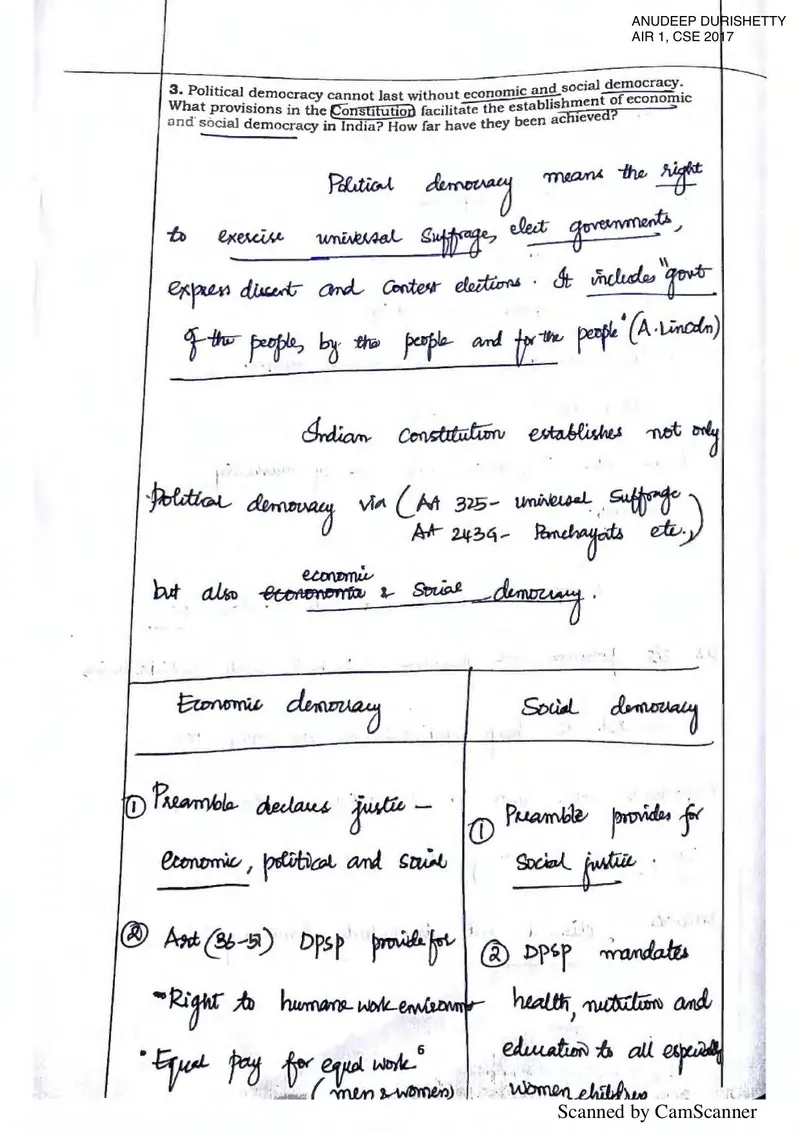
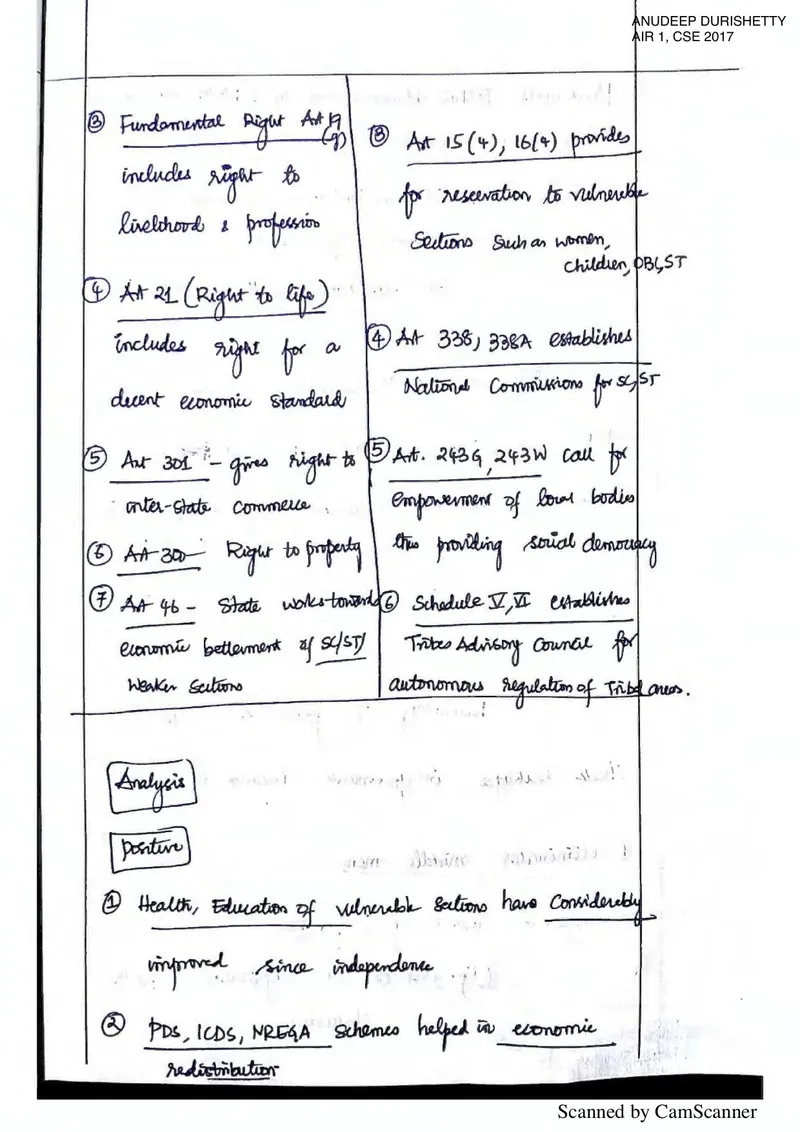
★Two-sided questions get two-column comparison tables — Economic vs Social democracy (Q3), Positive vs Negative impact of amendments (Q6), Civil society For vs Against democracy (Q14), India vs China approach to Africa (Q15) — and the health answer adds a 'Poor Health -> Poor GDP' vicious-cycle diagram (Q8). -> When a question says 'critically examine' or pits two ideas, draw the comparison as a table or cycle so balance is visible structurally, then write the verdict beneath it.
★He bookends arguments with a memorable, attributed line — closing Q1 on Palkhivala's 'judiciary must be an alarm clock not a time keeper' and opening Q6 with Nehru's Constitution as 'an organic entity that evolves over time'. -> Keep a handful of precise, sourced quotations tied to specific themes (judicial activism, constitutional change) and deploy one at the open or close; a relevant attributed line lifts an otherwise standard answer.
Questions attempted: Checks on Parliamentary sovereignty in India; does judicial activism threaten free working of Parliament — justify; Anti-defection law sanctions party tyranny and curbs legislator's right to dissent — critically examine; Political democracy cannot last without economic & social democracy; constitutional provisions facilitating them and how far achieved, and 17 more below.
Questions attempted in this booklet (20)+
1.Checks on Parliamentary sovereignty in India; does judicial activism threaten free working of Parliament — justify
2.Anti-defection law sanctions party tyranny and curbs legislator's right to dissent — critically examine
3.Political democracy cannot last without economic & social democracy; constitutional provisions facilitating them and how far achieved
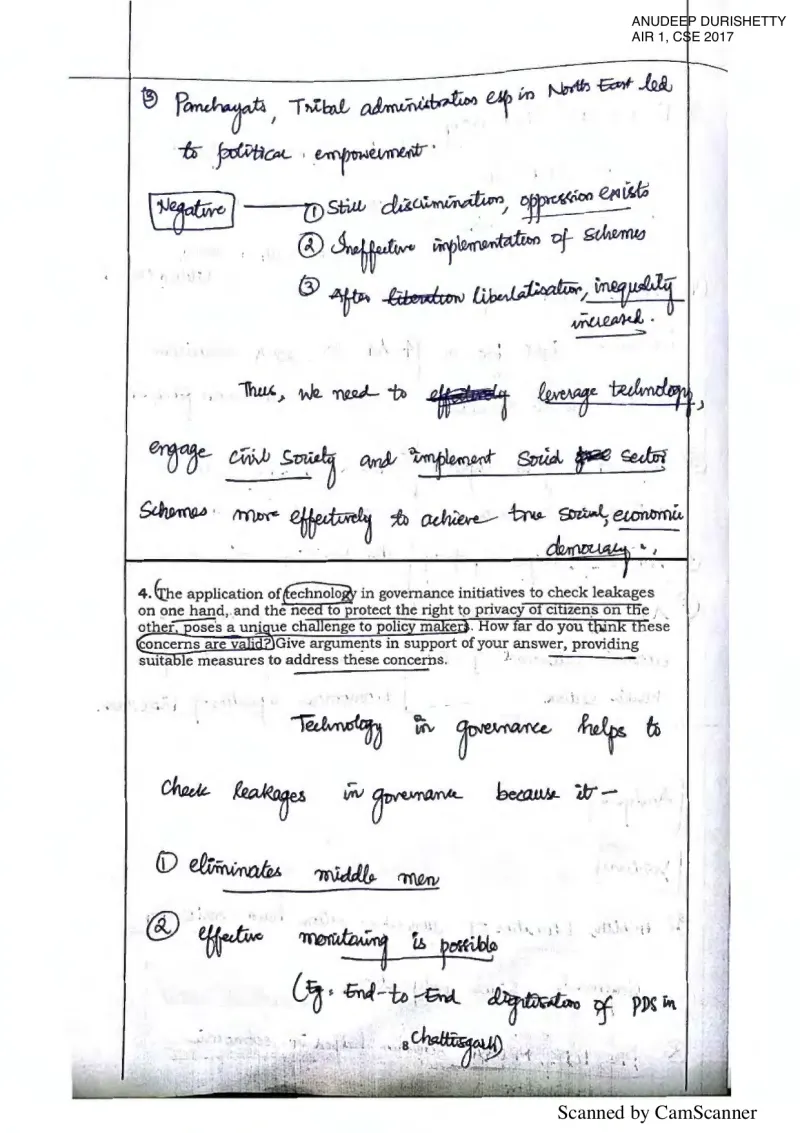
4.Technology in governance to check leakages vs right to privacy — validity of concerns and measures
5.How pressure groups influence govt policy; democratization effect or promoters of narrow interests
6.Reasons behind multiplicity of amendments to the Constitution; has it served its purpose — critically examine
7.Judicial delays and backlogs; account of ADR mechanisms and their suitability/efficacy
8.Status of primary, secondary and tertiary healthcare; lopsided focus on tertiary care
9.Changing demands from civil services since Independence and roles that stayed constant
10.Rajya Sabha member holding office of PM — does it go against the spirit of democracy
11.Should CM consent be essential for Governor appointment; Sarkaria Commission; civil servants as Governors
12.The 'Citizen' in Citizen Charter is a misnomer — comment
13.Election Commission & RPA as cornerstone of free & fair elections; amendments proposed to RPA
14.Civil society as vital partner in democracy; does it always serve the cause of democracy
15.AAGC is not an answer to China's OBOR — India and China approaches to Africa essentially different
16.PM visit to Israel as tectonic shift in India's Israel-Palestine policy; have India-Israel ties reached climax
17.How far India's foreign policy has travelled from NAM heydays and contributing factors
18.Iran as gateway for India's Central & West Asia policy; key challenges to closer India-Iran ties
19.Brexit offers India new opportunities of engaging in trade with Europe — examine
20.Evolution of India-Bhutan Friendship Treaty; significance of Bhutan to India
Schedules: 7th (subject lists), 10th (anti-defection), 9th (DPSP over FR), 5th & 6th (Tribes Advisory Council / autonomous regulation)
Court / judgements: SC scrapping NJAC Act, Vishaka guidelines on sexual harassment, Right to Privacy judgement (via PUCL), SR Bommai guidelines on Art 356
Committees/Commissions: NCRWC under Venkatachaliah, A.P. Shah Committee (privacy law), Hota Committee (civil services), Sarkaria Commission, Punchhi Commission, 2nd ARC, Law Commission, Parliamentary Standing Committee (on MCI corruption)
Reports/data: DAKSH report (12-15 yr adjudication delay), Law Commission (4.5 cr pending cases in lower courts), 65,000 cases in SC, 20% judicial vacancy in lower courts, World Bank report (Aadhaar saved Rs 80,000 cr), ADR (33% of MPs with criminal antecedents; 80% of LS members crorepatis)
Health data: doctors 0.7/1000 vs WHO-recommended 2/1000 (Lancet), immunisation 75% vs Bangladesh 93%, out-of-pocket expenditure 69%, health spend 1.5% of GDP vs Thailand 3.5%, National Health Policy target 2.5% of GDP
Schemes/initiatives: PDS, ICDS, NREGA/MGNREGA, End-to-End digitisation of PDS in Chhattisgarh, eVIN (Electronic Vaccine Network), CPGRAMS, RTI, Citizen Charter (IT/tax dept, Bangalore Metro)
Thinkers/persons: Jean Dreze, Usha Ramanathan, Amartya Sen, Aruna Roy (MKSS), Manmohan Singh (Rajya Sabha PM example)
Civil society / pressure groups: CGNet Swara (Khond tribals vs Vedanta, Niyamgiri Hills), PUCL, MKSS (social audit of NREGA, Rajasthan), Samatha (tribal forest rights), Compassion International (religious conversion), ADR
IR specifics: AAGC (India-Japan), OBOR / SREB / MSR, Chabahar port, Gwadar, CPEC, String of Pearls, INSTC corridor, Farzad gas field, Iran-Pak-India peace pipeline, Delaram-Zaranj highway, EEU FTA, Israel defence deals (Barak, AWACS, Phalcon radar), India-Israel Innovation Fund, RAW-MOSSAD intelligence sharing, two-state solution, Chumbi Valley, Chicken's Neck, EU FTA & Bilateral Investment Treaty, Parsi community / Silk Road ties
Quotes the candidate used
"Role of judiciary must be of an alarm clock not a time keeper" — N.N. Palkhivala (closing Q1)
"govt of the people, by the people and for the people" — A. Lincoln (opening Q3)
"Constitution is not a monolithic entity but an organic entity that evolves over time" — attributed to J. Nehru in the Constituent Assembly (opening Q6)
How it’s written: Highly templated, scannable structure. Each answer opens with a one-line definition that typically anchors to the governing Constitutional Article (e.g., Q9 opens with Art 312, Q11 with Art 153, Q13 with Art 324). Body is built from boxed/underlined sub-headings — recurring labels are "Checks", "Features", "Analysis…
Diagrams & visuals: Mind-maps / flowcharts with a central bubble and radiating arrows: anti-defection 'Features', 'Pressure groups', judiciary 'Other problems', 'ADR mechanisms', 'Changes in Civil Service Role', 'EC & free/fair elections', 'Reforms needed', 'Civil society includes', 'Citizen Charter features' (spider), 'NAM objectives', 'Factors that led to Change', Iran 'Challenges'; Two-column comparison tables: Economic vs Social democracy; Positive vs Negative impact of amendments; Civil society For vs Against democracy; India vs China approach to Africa; Vicious-cycle / cyclical diagram: 'Poor Health - Poor GDP' (poor primary care -> morbidity -> unhealthy workforce -> low growth -> low tax revenue); Pyramid diagrams: healthcare tiers (Tertiary/Secondary/Primary); 'Ideal Model of Governance' triangle (Govt-Citizen-Civil society-Private); Process/schematic: Aadhaar device -> encrypted data -> UIDAI server with 'snooping not possible' (privacy answer); Transition-arrow boxes: 'Change in NAM' (Non-alignment->Multi-alignment, Bipolar->Multipolar, Idealism->Realpolitik, International peace->National interest, Internationalism->Neighbourhood First)
Evaluator: No examiner marks or comments are filled in on this copy.
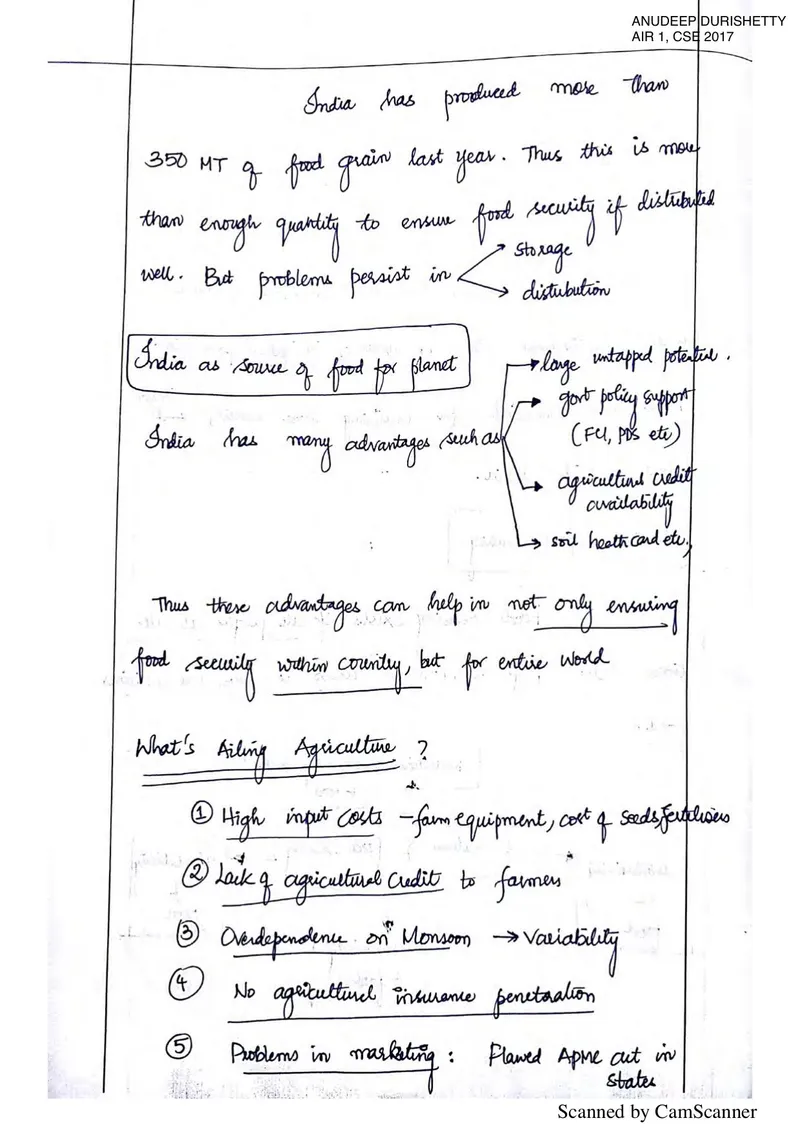
▸Opens nearly every answer with a one-line textbook definition before any analysis (e.g. 'Food security exists if all people at all times have physical, economic access to safe and nutritious food').
▸Almost entirely visual/structured rather than paragraph-heavy: boxed and underlined sub-headings plus arrow flowcharts or spider mind-maps appear in virtually every 200-word answer.
▸Draws clean labelled India maps to localise issues — solar-irradiance potential zones, the Maoist 'Red Corridor' (Bastar, Gadchiroli, Nallamala hills), neighbour-wise security threats, freight corridors and mangrove sites.
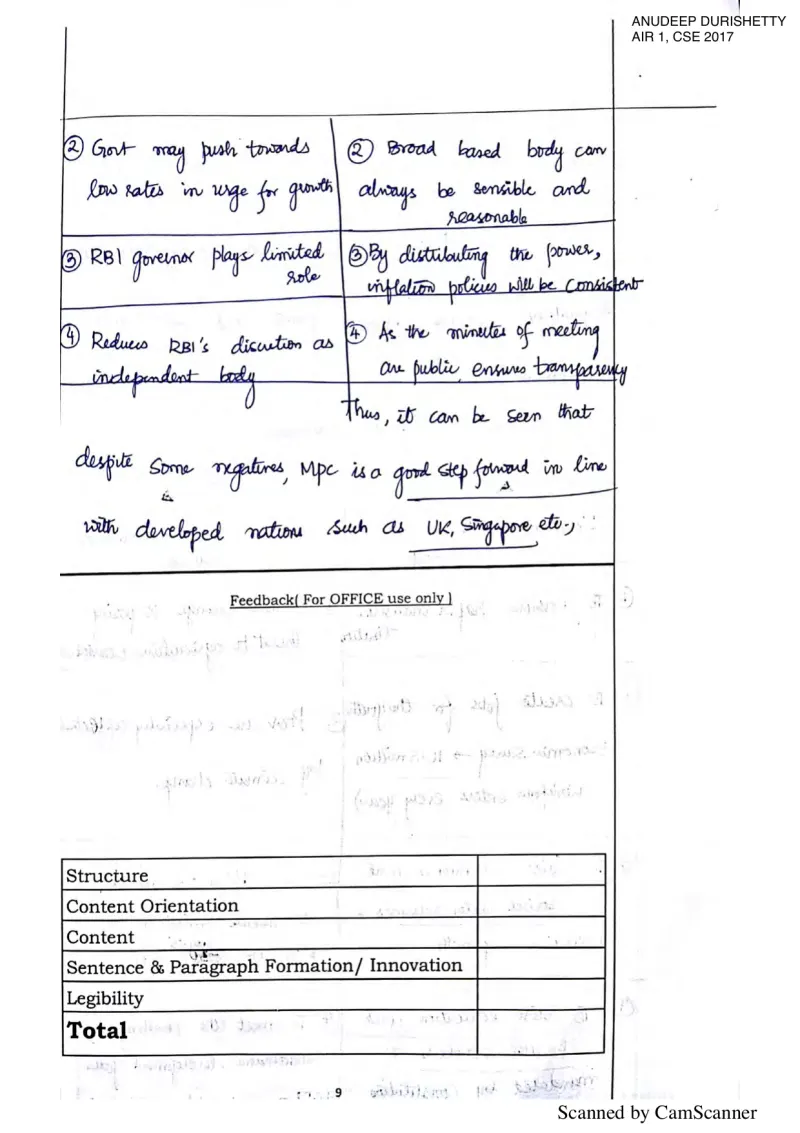
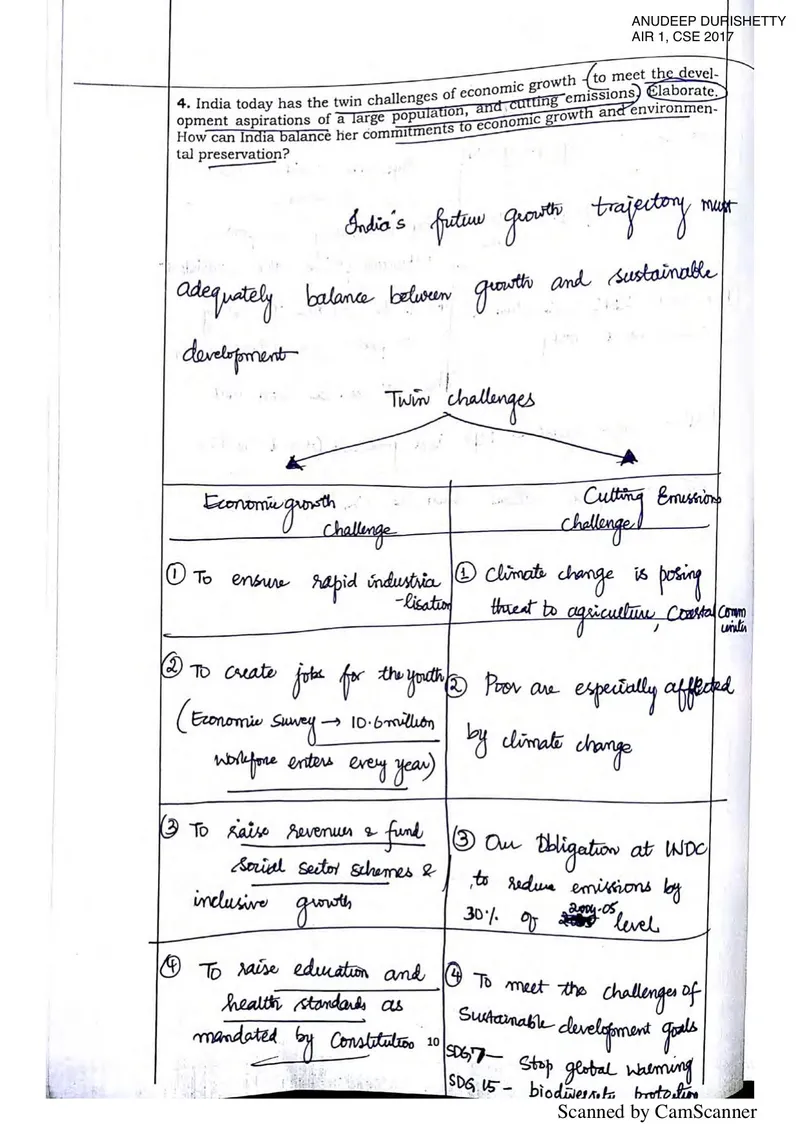
▸Uses crisp two-column 'for vs against' tables for comment/critically-examine questions (MPC vs RBI independence, DBT beneficial vs harmful, growth vs emissions).
▸Anchors arguments in specific named data and reports — Economic Survey (10.6 mn youth/yr), R&D spend India 0.7% vs China 1.7% vs S Korea 3%, roads = 2% of network but 40% of goods, ISA solar 175 W/m², EoDB rank 130/189.
▸Cites committees, acts and cases precisely (Ashok Dalwai, Xaxa committee, Vedanta/Dongria Kondh case, PESA & FRA, SAMADHAN, UAPA) instead of vague generalities.
What to learn from this copy
★He opens nearly every answer with a one-line textbook definition before any analysis — e.g. 'Food security exists if all people at all times have physical, economic access to safe and nutritious food' (Q1) — establishing the concept in the very first line. -> In a 200-word answer, spend your first sentence pinning down the key term precisely; it signals conceptual clarity and earns the easy 'context' marks before you start arguing.
★For every 'comment' / 'critically examine' question he splits the page into a two-column for-vs-against table — MPC violates vs does not violate RBI independence (Q3b), DBT beneficial vs harmful (Q18), growth challenge vs emissions challenge (Q4), land reforms positives vs negatives (Q17). -> When the directive demands balance, physically structure the answer as two columns/sides rather than a paragraph; it forces a genuinely two-sided treatment and is instantly visible to the examiner.
★He draws clean labelled India maps to localise the issue — the Maoist 'Red Corridor' marking Bastar, Gadchiroli and Nallamala hills (Q14), solar-irradiance zones with a very-high/high/moderate/low legend (Q6), neighbour-wise security threats (Q13), and dedicated freight corridors WDFC/EDFC (Q15). -> For any spatially-rooted GS3 topic (internal security, energy, infrastructure, environment), a small labelled map with named locations adds value-content a paragraph can't, and shows real subject knowledge.
★He anchors claims in specific named data and reports rather than adjectives — R&D spend 'India 0.7% vs China 1.7% vs S Korea 3%' (NITI Aayog, Q11), 'roads = 2% of network but 40% of goods' (Q15), Economic Survey '10.6 million youth enter workforce every year' (Q4/Q8), EoDB rank '130/189' (Q8), ISA solar '175 W/m²' (Q6). -> Replace vague phrases like 'low spending' or 'huge workforce' with a sourced figure; one precise comparative statistic per argument lifts an answer from generic to authoritative.
★He names committees, acts and landmark cases with precision instead of generalities — Ashok Dalwai committee and 'double farm income by 2022-23' (Q1/Q16), Xaxa committee and the Vedanta/Dongria Kondh case alongside PESA, FRA, SAMADHAN and UAPA (Q14). -> Build a stock of the exact committee/act/case attached to each GS3 theme and deploy it as evidence; specific institutional references demonstrate you've engaged the syllabus, not just opinions.
★Despite a strict ~200-word limit he keeps a consistent visual template in almost every answer — a boxed/underlined sub-heading ('Way Ahead', 'Reasons for GST', 'self policing') followed by numbered points and arrow-led spider mind-maps or process box-chains (e.g. Farm loan waiver -> fiscal burden -> more borrowing -> inflation/low growth, Q16). -> Use sub-headings and arrow chains to compress cause-effect logic into minimal words; structure itself becomes the time-saver that lets you cover more dimensions within the word limit.
Questions attempted: Agriculture: food security, what is ailing Indian agriculture, remedial measures; Antibiotic resistance as a crisis on the level of climate change (comment); Black money as a 'steroid' for growth (critically examine), and 19 more below.
Questions attempted in this booklet (22)+
1.Agriculture: food security, what is ailing Indian agriculture, remedial measures
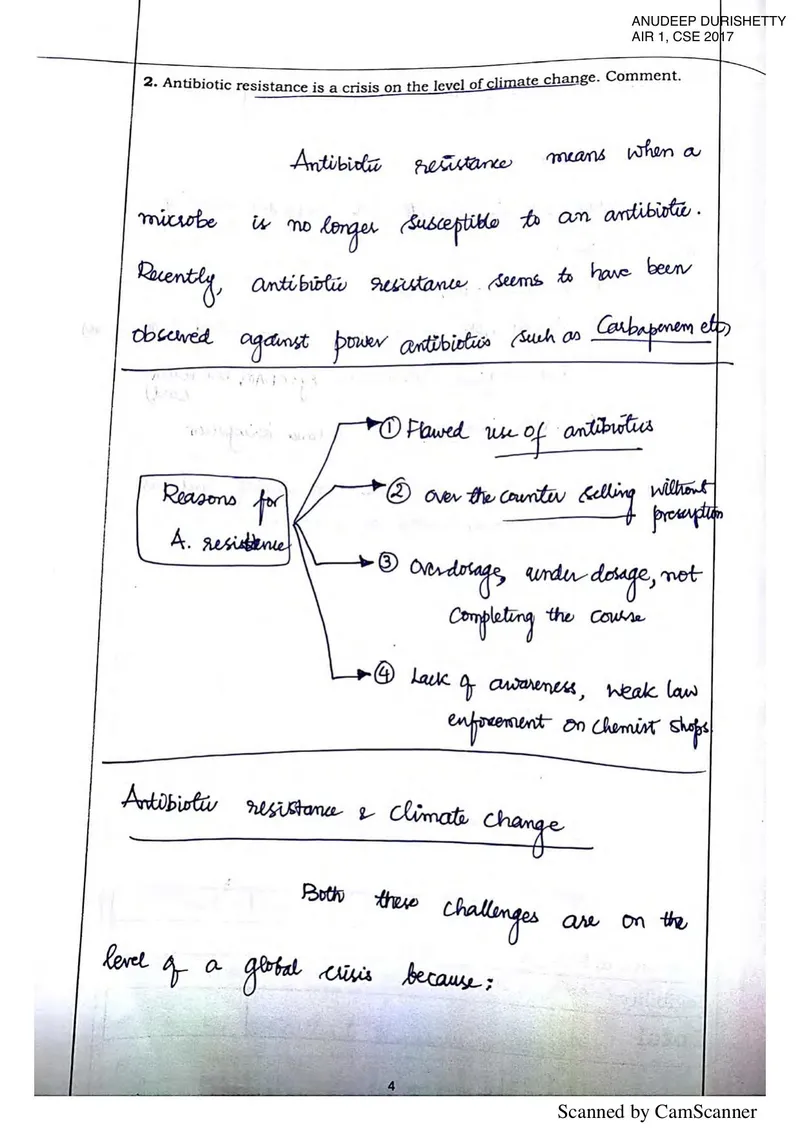
2.Antibiotic resistance as a crisis on the level of climate change (comment)
3(a).Black money as a 'steroid' for growth (critically examine)
3(b).Monetary Policy Committee (MPC) and the independence of the central bank (RBI)
4.Twin challenge: economic growth vs cutting emissions; balancing growth and environment
5.GST: reasons for implementation, impact on the unorganised sector, intended benefits
6.International Solar Alliance (ISA) rationale and bringing down solar energy cost
7(a).Demonetisation: clean economy and electoral reforms (critically examine)
7(b).Demonetisation: intended and unintended consequences
8.Jobless growth, demographic dividend, what ails job creation, govt interventions
9.Disasters intertwined with development; SDGs, Paris Accord, Sendai Framework for DM
10.Autonomous Vehicle Technology (ATV): benefits and challenges
11.ISRO's success vs other scientific organisations (DRDO/CSIR/CCMB); measures
12.Ransomware threat and India's (public institutions + citizens) preparedness
13.Hostile neighbours enabling and prolonging internal conflicts (with examples)
14.Left Wing Extremism / Maoism and its link to development; government steps
15.Transport modes competitive rather than cooperative; consequences and govt steps
16.Farm loan waivers: impact on fiscal health and farmers; do they meet their goals
17.History of land reforms in India and whether they achieved their purpose
18.Direct Benefit Transfer (DBT) as an alternative to the Public Distribution System
19.Transforming the food processing industry: employment, farmer realisations, forex
20.Role of mangroves in coastal ecosystem; depletion in Sunderbans and mitigation
Examples, data & evidence used
Q1 data: India ~200 mha under cultivation, 140 mha irrigation potential; ~350 MT foodgrain
Q1/Q16: Ashok Dalwai committee; MS Swaminathan; 'double farm income by 2022-23'
Q2: Carbapenem (resistance to powerful antibiotics); MDR-TB; Chennai Declaration 2012; Red Line campaign; UN/WHO/UNDP; Article 47 (State to ensure health for all)
Q6: Solar power 175 W/m² annually, ~7000 times global power consumption; India major ISA partner
Q7: ₹500/₹1000 notes; anonymous political donation cut from ₹20,000 to ₹2,000; electoral bonds; PM Garib Kalyan Yojana (~₹5000 cr collected); Ministry of Home Affairs report; ~26% rise in income tax post-demonetisation
Q8: Economic Survey 2016-17; Industrial Disputes Act; NITI Aayog report (only ~5% of rural youth skilled); World Bank EoDB ranking India 130/189; Amartya Sen (poor health & education -> poor employment); Make in India (100 million jobs by 2022); abolition of FIPB; Startup India, Stand-up India; Skill India Mission (skill 40 cr); IPR policy; Mudra Bank; Insolvency & Bankruptcy Code; ICDS, RTE; GDP growth 7.5% vs employment growth 2% (2000-2010)
Q9: World Bank estimate disaster loss ~3% of GDP annually; Paris deal reduce emissions 20-25% of 2005 level; Sendai Framework guidelines; Disaster Management Cycle
Q10: Self-driving cars Tesla and Waymo (Google); only 1 Waymo accident in 2 years of operation
Q11: SAARC satellite, indigenous cryogenic/Kaveri engine, NAVIC, INSAT/PSLV/GSLV, Mars Orbiter Mission, Chandrayaan; DRDO/CSIR/CCMB; R&D spend India 0.7% vs China 1.7% vs S Korea 3% (NITI Aayog); INCOSPAR (written as under S. Swarup Bhatnagar); leadership of S.S. Bhatnagar, Kalam; Germany industry-academia model
Q12: Ransomware attack on British National Health Service demanding $1.2 million in Bitcoins; CERT-In nodal agency; 19 public sector banks attacked by cyberbots; Digital India; regulation of cryptocurrencies (Bitcoin, Ethereum)
Quotes the candidate used
Maoism described as the 'gravest threat' to internal security — attributed to former PM (Manmohan) Singh (Q14)
Chief Economic Adviser called farm loan waivers 'destructive to economy' (Q16, attributed paraphrase)
'polluter pays' principle (used in Q4 and Q20)
'self policing' — used as a GST benefit heading (Q5)
Black money 'greases' the administration (candidate's own phrasing, Q3)
Note: the booklet uses short attributed phrases rather than long verbatim quotations; no poet/philosopher epigraphs were written.
How it’s written: Highly consistent template per answer within the 200-word limit: (1) 1-2 line definition/context intro; (2) a boxed or underlined sub-heading (e.g. 'India & food security', 'Reasons for GST', 'Way Ahead'); (3) body delivered as numbered points and arrow-led flowcharts/mind-maps or a two-column table rather than pros…
Diagrams & visuals: Hand-drawn labelled maps of India: solar-potential/irradiance zones with legend (very high/high/moderate/low) (Q6); security threats from each neighbour (Q13); Maoist 'Red Corridor' strongholds - Bastar, Gadchiroli, Nallamala hills (Q14); Dedicated Freight Corridors WDFC/EDFC + Bangalore-Chennai (Q15); mega food park & export locations (Q19); mangrove sites (Q20); Flowcharts / mind-maps (spider diagrams) in almost every answer: features of food security (Q1), reasons for antibiotic resistance (Q2), sources of black money (Q3), reasons for GST (Q5), rationale for ISA (Q6), unintended consequences of demonetisation (Q7), threat of ransomware (Q12), benefits of ATV (Q10), role of mangroves and reasons for depletion (Q20), features of DBT (Q18); Two-column comparison tables: MPC violates vs does not violate RBI independence (Q3); economic-growth challenge vs cutting-emissions challenge (Q4); clean economy vs electoral reforms (Q7); demographic dividend vs jobless growth (Q8); land reforms positives vs negatives (Q17); DBT beneficial vs harmful (Q18); Population pyramid showing the 18-59 'demographic bulge' (Q8) and a small data table of GDP growth 7.5% vs employment growth 2% for 2000-2010 (Q8); Supply-chain / process diagrams: before-vs-after GST chain Manufacturer-Wholesaler-Retailer-Consumer (Q5); Farm -> FPI -> domestic sale/export -> consumer (Q19); Disaster Management Cycle as a circular diagram - Disaster->Rescue->Relief->Preparedness->Mitigation/Adaptation (Q9); Process box-chains: Farm loan waiver -> govt fiscal burden -> more borrowing -> inflation/low growth/hurts poor/chokes investment (Q16); Disaster -> destroys infrastructure -> loss of lives/property/development -> chaos (Q9)
Evaluator: A printed evaluation rubric grid appears after every answer ("Feedback (For OFFICE use only)" with rows: Structure / Content Orientation / Content / Sentence & Paragraph Formation / Innovation / Legibility / Total). However, no numeric m…
Anudeep Durishetty — ForumIAS GS Test 6C evaluated copy
GS Mains (ForumIAS practice test)PDF · 14.6 MB
What’s inside this copy
▸Anudeep attempted all 20 questions of ForumIAS GS Test-6C (250 marks) across 50 handwritten pages, opening nearly every answer with a crisp definition and closing with a 'Way Forward'/'Way Ahead' section.
▸Visual-first answering: a detailed hand-drawn India-China border map (Aksai Chin, Shaksgam Valley, Doklam, Siliguri 'chicken's neck') plus at least ten tree/mind-map/flow diagrams across IPR, police, poverty, women's schemes and global governance.
▸Dense factual scaffolding — committees (Dandekar-Rath, Lakdawala, Tendulkar, Rangarajan; Padmanabhaiah, Ribeiro), hard data (MMR 167 vs 212; poverty 37% to 18%; Tendulkar Rs 27/Rs 33), and cases (Vedanta-Niyamgiri, Nirbhaya, Prakash Singh).
▸Every policy answer is anchored to named schemes/projects — TAPI, INSTC, Chabahar, Sukanya Samriddhi, Namami Gange, NREGA, PRAGATI, GARV, JAM trinity — showing strong current-affairs integration.
▸Clear, reasoned stances: argues the Election Commission should NOT receive contempt powers (it already has constitutional autonomy), defends EVM integrity via VVPAT, and frames the internet as a 'global commons' needing multi-stakeholder governance.
▸Boxed/underlined sub-headings, arrow bullets and consistent two-part structure give the booklet a clean, examiner-friendly layout throughout.
What to learn from this copy
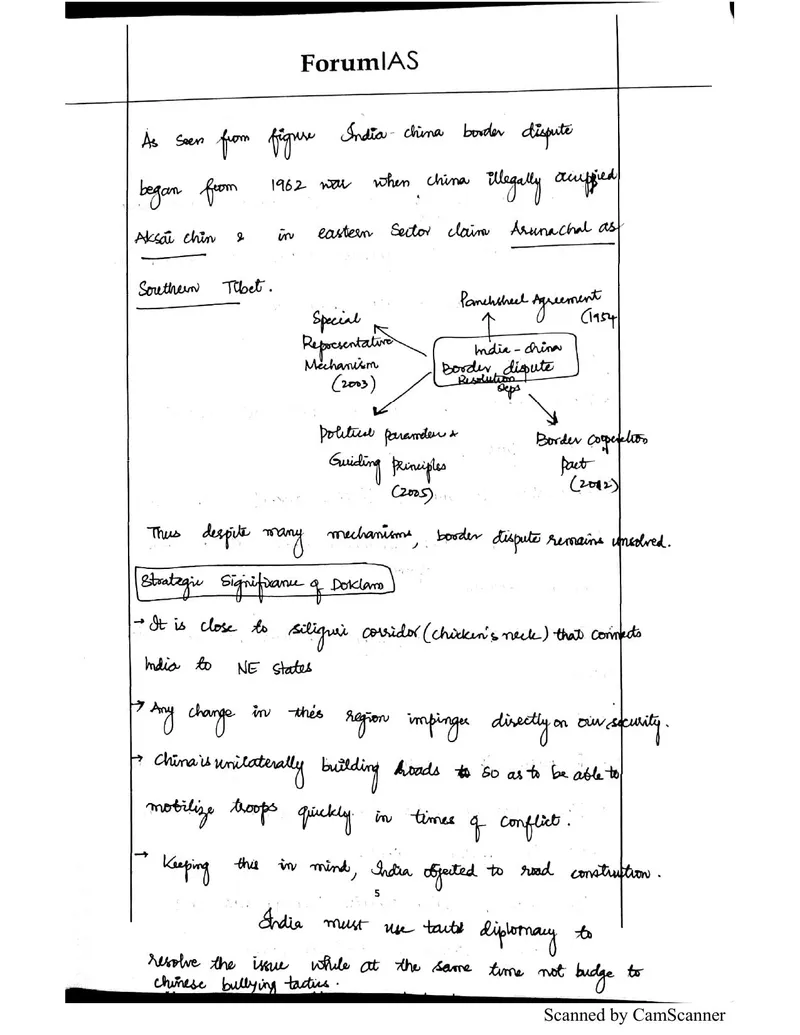
★On the India-China question (Q2) Anudeep didn't just describe the dispute in prose — he hand-drew a labelled map of India marking Aksai Chin & Shaksgam Valley (Western Sector), the Middle Sector, Doklam plateau and Arunachal (Eastern Sector), AND a separate flowchart of the resolution mechanisms (Panchsheel 1954 -> Special Representative Mechanism 2003 -> Political Parameters 2005 -> Border Cooperation Pact 2012). -> For spatial/territorial questions, a labelled sketch-map plus a chronology-flowchart shows command of geography and process in seconds that paragraphs cannot — convert 'where' and 'how it evolved' into visuals.
★He converted abstract classifications into tree/cycle diagrams: a tree of the six IPR types (Copyright, Trademark, Industrial Design, Patent, Trade Secret, GI) in Q5, and a cycle diagram of the SHG movement (pooling resources -> lump-sum -> self-employment -> autonomy/empowerment) in Q11. -> When a question asks for 'types of X' or the 'mechanism by which X works', a tree or cycle diagram is a faster, more examiner-legible structure than a bulleted list — use the visual form that matches the logic (branching = types, loop = process).
★Each IPR type in Q5 was pinned to a concrete real-world instance — Volvo (trademark), fountain-pen design (industrial design), 20-year drug patents, Coca-Cola recipe (trade secret), Benaras Sarees (GI) — rather than abstract definitions. -> Attach one memorable, verifiable example to every concept you define; a single recognisable case (Coca-Cola for trade secret) cements understanding and lifts the answer above a textbook definition.
★He took clear, reasoned positions instead of hedging: on Q8 he argued the Election Commission should NOT get contempt powers because it already has constitutional autonomy under Article 324, and defended EVM integrity by citing VVPAT and the EC's public hack challenge. -> When a question asks 'should X', commit to a side and justify it with a specific constitutional/factual anchor — a defended stance backed by Article 324 and VVPAT beats a balanced-but-noncommittal answer.
★His data-heavy questions stacked named committees and hard numbers as scaffolding — the poverty answer (Q17) chained Dandekar-Rath, Lakdawala, Tendulkar and Rangarajan committees with figures (poverty 37% to 18%; Tendulkar Rs 27/Rs 33), and grounded specific cases like Vedanta-Niyamgiri (Q10) and Prakash Singh (Q9). -> Build evaluation answers on a spine of named committees + a precise statistic + a landmark case; this triad signals depth and currency far more than generalised claims.
Questions attempted: Full SCO membership and India's economic expansion vs national security — critically evaluate; Doklam face-off, India-Bhutan special relationship, India-China border dispute and strategic concern; Instability in neighbouring countries affecting India's stability; threats and ways to tackle, and 17 more below.
Questions attempted in this booklet (20)+
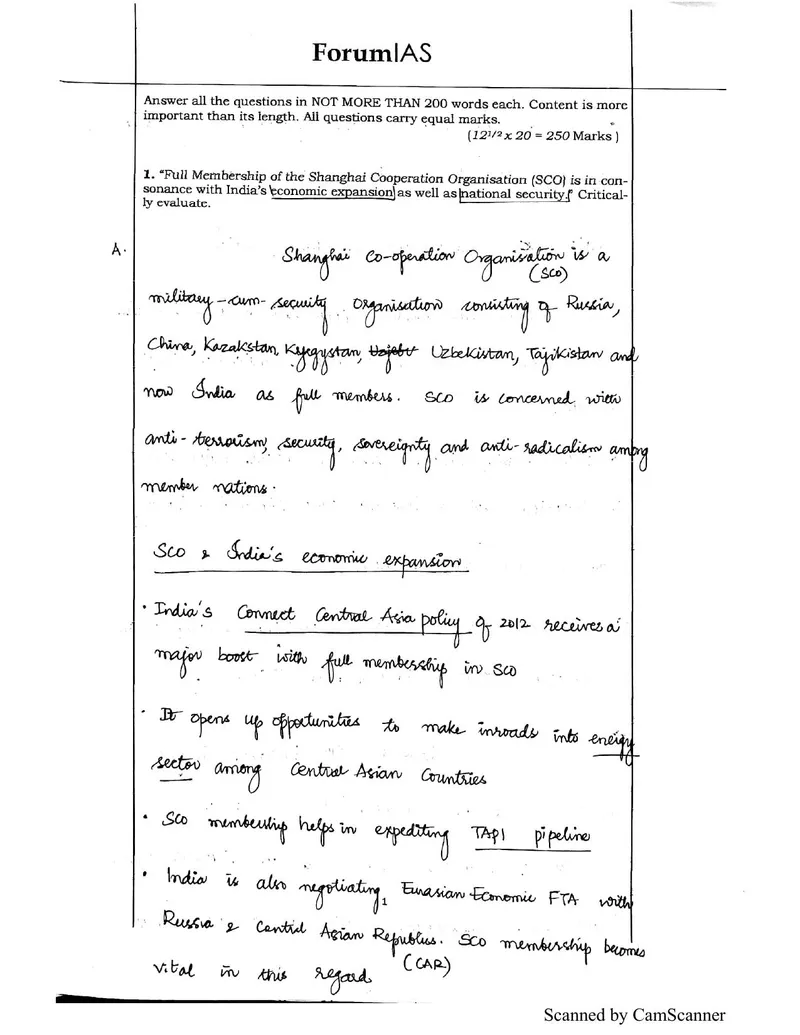
1.Full SCO membership and India's economic expansion vs national security — critically evaluate
2.Doklam face-off, India-Bhutan special relationship, India-China border dispute and strategic concern
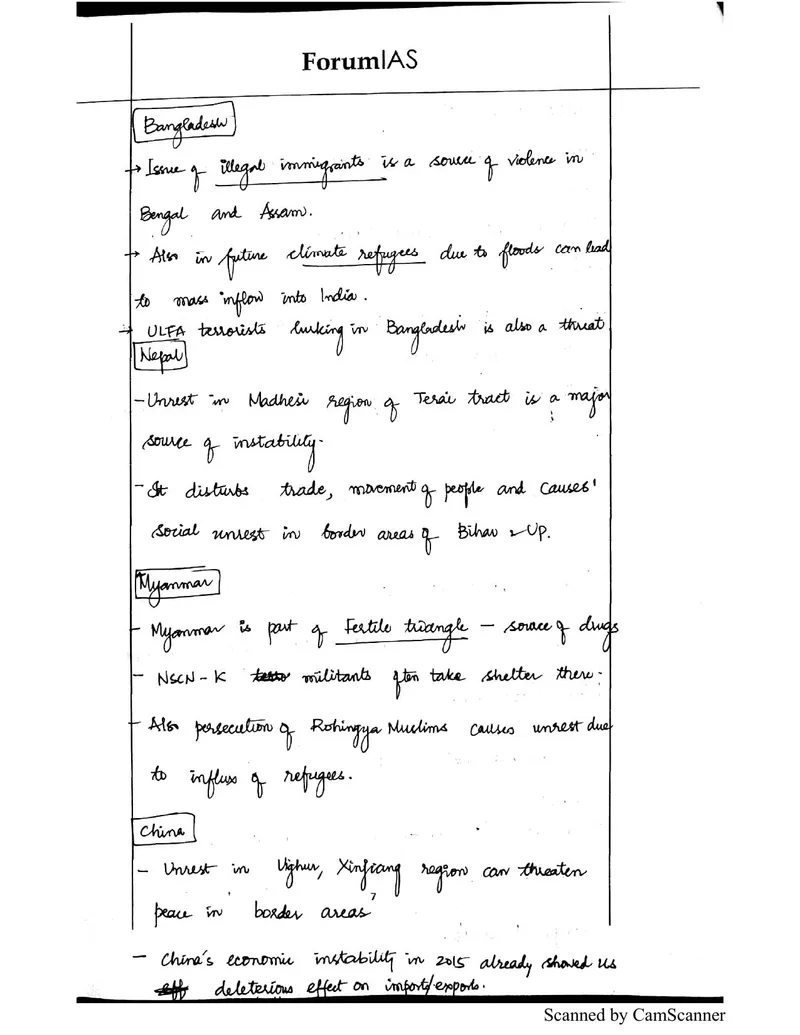
3.Instability in neighbouring countries affecting India's stability; threats and ways to tackle
4.Impediments to India's Look West Policy
5.Intellectual Property Rights — types; and Intellectual Property Exchange (benefits/challenges)
6.De-hyphening of India's Israel-Palestine ties; opportunities and challenges
7.Need for a coherent diaspora policy — contributions and challenges of Indian Diaspora
8.Should the Election Commission get contempt-of-court powers; growing challenges before EC
9.Police reform in context of Prakash Singh case; need for community policing
10.Forest Rights Act implementation failures and corrective steps
11.Self-Help Group movement as a model to lift the rural poor — critical examination
12.Social Audit and its success in ensuring administrative accountability
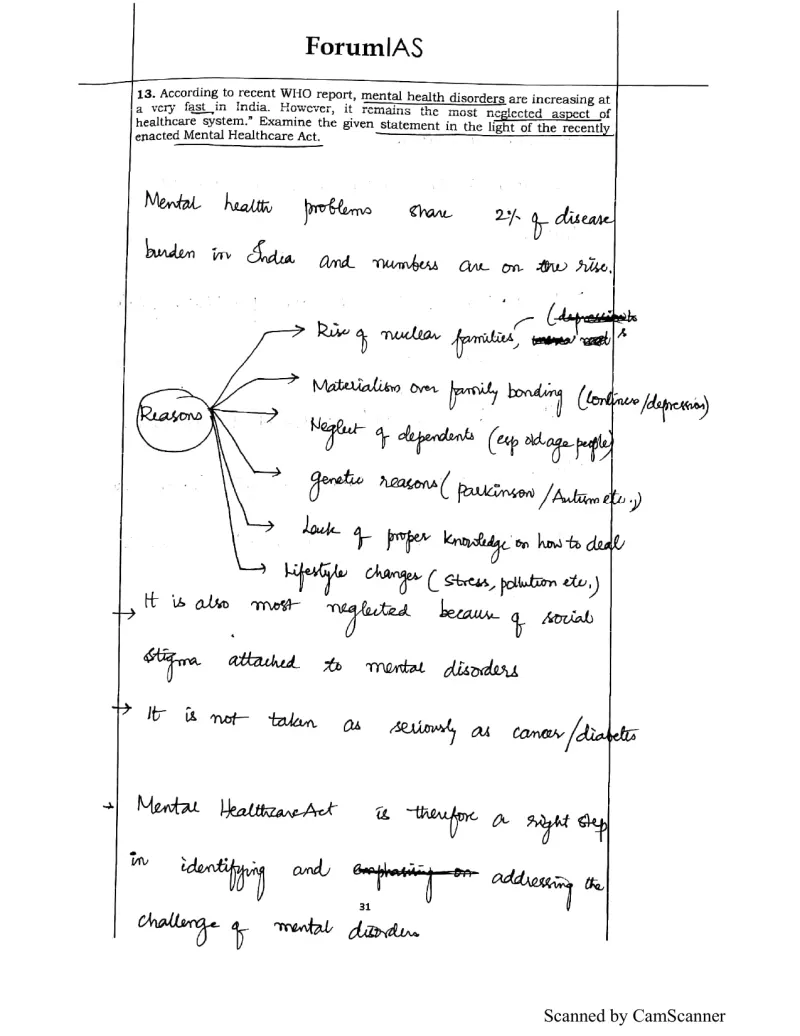
13.Rising mental-health disorders, neglect in healthcare, and the Mental Healthcare Act
14.Abolition of No-Detention Policy under RTE; alternative RTE provisions to fill the vacuum
15.Universal Social Security network; and Payment of Wages (Amendment) Bill 2017 impact
16.Women empowerment — government interventions, effectiveness, and challenges
17.Evolution of the poverty-line definition and effectiveness of poverty-eradication interventions
18.Global governance reforms India is seeking and the rationale
19.'Minimum Government, Maximum Governance' — governance taking a back seat
20.M-Governance, ICT, and solving issues ailing Indian development
Examples, data & evidence used
SCO members listed (Russia, China, Kazakhstan, Kyrgyzstan, Uzbekistan, Tajikistan, India); RATS / Regional Anti-Terrorism mechanism; China's Belt & Road Initiative; Ferghana Valley & Uighur as terror sources (Q1)
Connect Central Asia policy (2012), TAPI pipeline, Eurasian Economic FTA (Q1, Q4)
Indo-Bhutan Treaty of Friendship; Panchsheel Agreement (1954); Special Representative Mechanism (2003); Political Parameters & Guiding Principles (2005); Border Cooperation Pact (2012); 1962 war; Siliguri corridor / 'chicken's neck' (Q2)
Chabahar port (Iran) bypassing Pakistan; INSTC (International North-South Transport Corridor); ONGC Videsh (OVL) gas investment in CAR; US sanctions on Iran as an impediment (Q4)
India first non-Arab country to recognise Palestine (late 1940s); full diplomatic ties with Israel since 1991; NASSCOM ~USD 5 billion trade potential; Barak missiles, AWACS; RAW-MOSSAD intel sharing; India-Israel Innovation Fund; pilgrimage tourism (Jerusalem/Varanasi) (Q6)
Diaspora achievers — Chandrasekhar & Venkataraman (Nobel), Indra Nooyi, Satya Nadella, Sundar Pichai, Nikki Haley, Richard Verma; remittances bridging Current Account Deficit; diaspora funds to Namami Gange & Swachh Bharat (Q7)
Article 324 (Election Commission); paid news, criminalisation of politics, Model Code of Conduct; EVM-tampering debunked via VVPAT and EC's hack challenge (Q8)
Police a State subject (Schedule 7); IPC 1860, Evidence Act 1872, CrPC; Padmanabhaiah & Ribeiro committees; Prakash Singh case SC directions (police board, fixed tenure, custodial-death guidelines) (Q9)
Forest Rights Act (Gram Sabha authority, minor forest produce); PESA Act; Vedanta / Niyamgiri Hills case (Q10)
SHG examples — Kudumbashree (Kerala), SEWA (Gujarat), TANWA (Tamil Nadu Women Association); JAM trinity, Banking Correspondents, PM Kaushal Vikas Yojana (Q11)
Social audit — MKSS of Rajasthan, 'Hamara Paisa Hamara Hisab', Aruna Roy, Nikhil Dey; JAM trinity & bulk SMS (Q12)
None visible — the answers rely on schemes, committees, cases and data rather than attributed quotations. Recurring conceptual phrases used by the candidate include 'chicken's neck' (Siliguri corridor) and 'global commons' (internet), but these are not cited quotes with named authors.
How it’s written: Highly templated, exam-optimised structure. Each answer follows a definition-led intro, then boxed/underlined sub-headings (e.g., "SCO & India's economic expansion", "Challenges", "Way Forward"/"Way Ahead"), arrow/dash bullet points, and a closing synthesis. Diagrams and tree/mind-maps are used heavily to compress c…
Diagrams & visuals: Q2: hand-drawn map of India showing the China border dispute — Aksai Chin & Shaksgam Valley (Western Sector), Middle Sector, Doklam plateau, Bhutan, Sikkim, Nepal and Arunachal Pradesh (Eastern Sector); Q2: flowchart of India-China border dispute-resolution steps (Panchsheel 1954, Special Representative Mechanism 2003, Political Parameters & Guiding Principles 2005, Border Cooperation Pact 2012); Q5: tree diagram of IPR types (Copyright, Trademark, Industrial Design, Patent, Trade Secret, Geographical Indicator); Q9: mind-map of 'Problems with Police in India' (human-rights violations/fake encounters, political interference, arbitrary transfers, no merit-based progression, trust deficit, excessive force, lack of modern infrastructure, no human-rights training); Q11: cycle diagram of the SHG movement (pooling resources to lump-sum to self-employment to autonomy/empowerment); Q12: mind-map of challenges to Social Audit (not undertaken, citizen ignorance, bureaucratic apathy, collusion of officials, patriarchy/casteism)
Evaluator: No examiner marks or comments are filled in on this copy.
How many Anudeep Durishetty answer copies can I download here?+
This page links to 5 of Anudeep Durishetty's mains answer copies (GS2, GS3 and General Studies) as free PDFs, from the UnlockIAS topper-copy archive. Each opens in Google Drive — no sign-up or payment.
What rank did Anudeep Durishetty get and in which year?+
Anudeep Durishetty secured AIR 1 in UPSC CSE 2017.
Are Anudeep Durishetty's answer copies evaluated with marks?+
These are Anudeep Durishetty's test-series mains booklets. Most are clean (unmarked) fair copies — their value is in the actual answers: the questions attempted, the examples and quotations used, and how the answers are structured, which we summarise on this page. A few topper copies in the wider library do carry the evaluator's qualitative feedback.
What can I learn from Anudeep Durishetty's answer copies?+
Decode the pattern, don't copy the content. For example, in Anudeep Durishetty's copies: anchors almost every answer to a specific Constitutional Article in the opening line (Art 312 for civil services, Art 153 for Governor, Art 324 for EC, Art 47 for health) before defining the term.. Read a copy, then write the same question yourself and compare structure, example density and conclusion quality.
Are these Anudeep Durishetty copies really free?+
Yes — every PDF on this page is free to view and download. UnlockIAS hosts this index for free educational use; credit for each booklet belongs to the candidate and the evaluating test series.
Studying Anudeep Durishetty's copies shows you the target; the Sherlocking Mains programme trains you to hit it — daily answer writing with AWE Bot evaluation and mentorship. Or get one Mains answer evaluated free.