Jagrati Awasthi — Mains test booklet 1417
What’s inside this copy
- ▸Opens almost every answer with a crisp one-line definition or context, then builds with Roman-numeral points, each capped by a concrete 'Eg' scheme or case - a repeatable, examiner-friendly template.
- ▸Q5 (social security) maps each point to a real scheme (MGNREGA, Jan Dhan, MUDRA, Ayushman Bharat, PM Matru Vandana) and closes with Ambedkar: 'social equality is a prelude to democracy.'
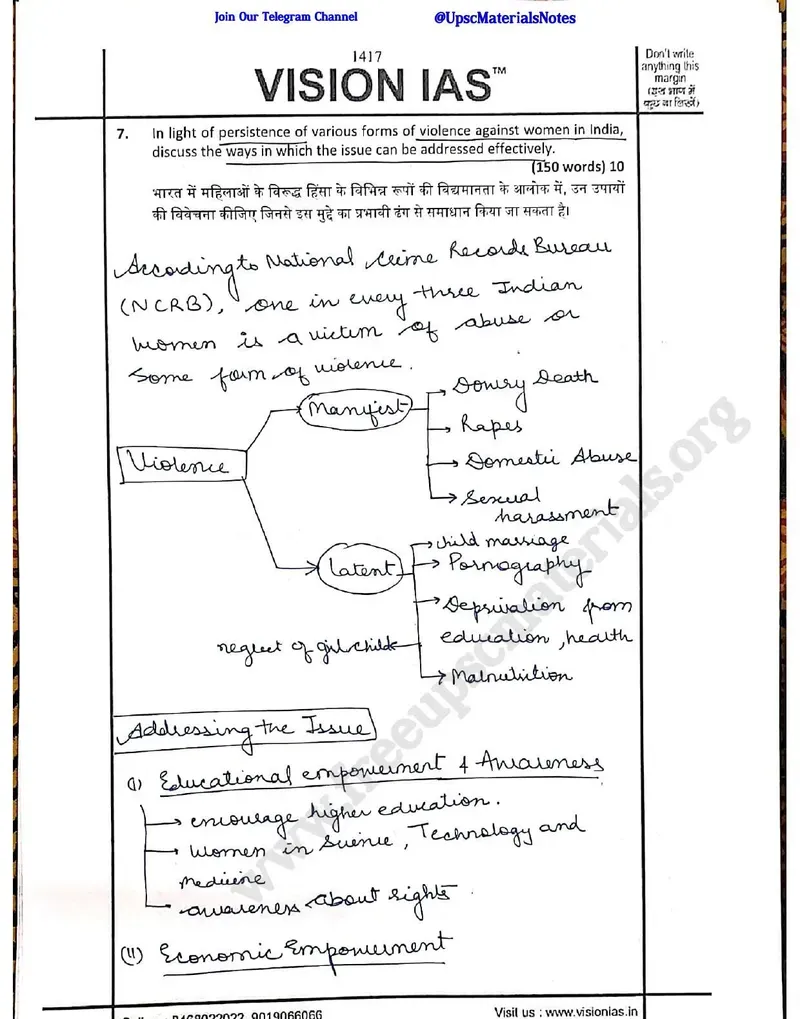
- ▸Q7 (violence against women) leads with NCRB data and a hand-drawn tree splitting violence into 'Manifest' (dowry death, rape) vs 'Latent' (child marriage, malnutrition) before listing solutions.
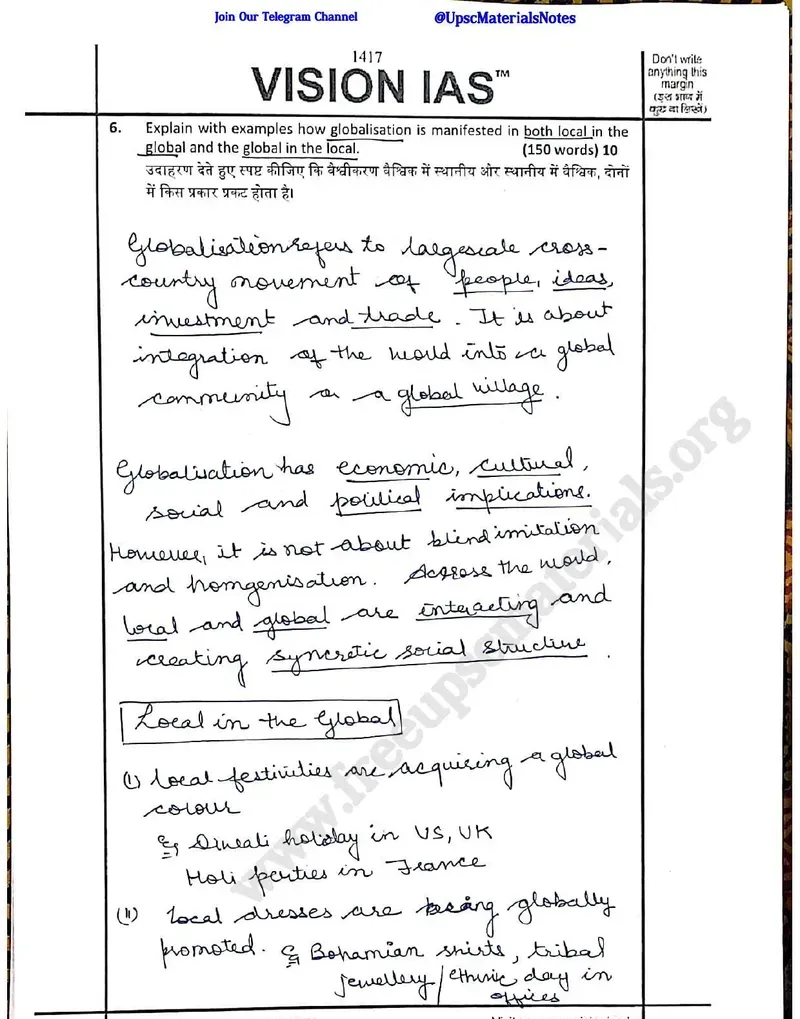
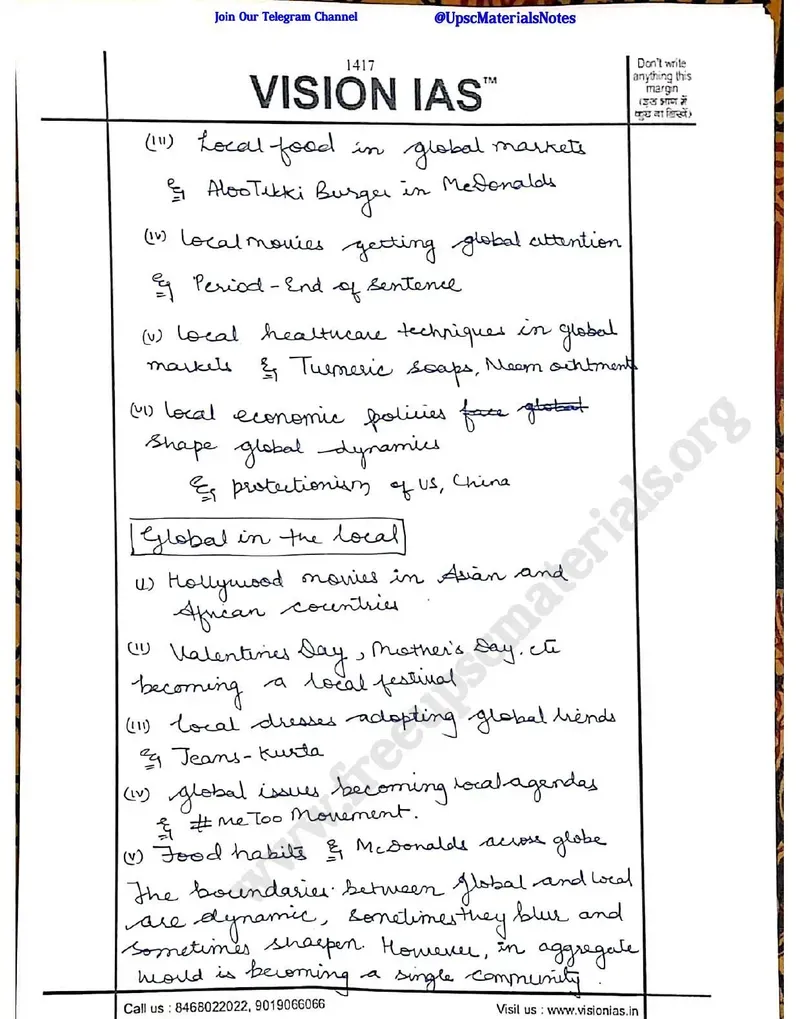
- ▸Q6 (globalisation) is example-dense and memorable - Diwali in US/UK, Aloo Tikki Burger at McDonald's, 'Period: End of Sentence', #MeToo - sorted under boxed 'Local in the Global' vs 'Global in the local' heads.
- ▸Static topics are consistently hooked to contemporary policy: Paris Agreement and Miyawaki forests (Q8), BEPS and DTAA (Q9), NAM (Q3) - showing applied, current-affairs-aware preparation.
- ▸Tight word-limit discipline and boxed/underlined sub-headings make each answer fast to skim; conclusions are short and thesis-linked (urban forests as a 'tool for Sustainable Development'; eco-tourism tied to 'Incredible India').
What to learn from this copy
- ★She closes value-laden answers with a named thinker's line rather than a vague summary: Q5 on social security ends with 'According to Ambedkar, social equality is a prelude to democracy.' -> End such answers with one attributed, on-thesis quote from a constitutional figure to lift the conclusion above a routine recap.
- ★In Q5 she doesn't just list welfare schemes, she maps each body point to a specific real scheme (MGNREGA, Jan Dhan Yojana, MUDRA, Ayushman Bharat-Jan Arogya Yojana, PM Matru Vandana Yojana, SVANidhi) so 'economic AND social empowerment' is proven by evidence, not asserted. -> For any governance/social-justice question, attach a concrete named scheme to every sub-point so claims are backed by India-specific evidence.
- ★Q7 on violence against women opens with NCRB data ('one in every three Indian women a victim') and a hand-drawn tree splitting violence into 'Manifest' (dowry death, rape, sexual harassment) vs 'Latent' (child marriage, malnutrition, neglect of girl child) before giving solutions. -> Lead a problem-solution answer with a hard data hook, then use a classification diagram to demarcate the problem's dimensions before you prescribe fixes.
- ★Q6 answers the abstract 'local in the global / global in the local' prompt with vivid, concrete examples sorted under two boxed heads: Diwali holidays in US/UK and Aloo Tikki Burger at McDonald's on one side, 'Period: End of Sentence' and #MeToo on the other. -> When a question gives you a conceptual binary, turn each side into a labelled box and fill it with specific, memorable real-world instances rather than explaining the theory abstractly.
- ★She hooks static/conventional topics to current policy and concepts: urban forests (Q8) cited Paris Agreement, Green India Mission and Miyawaki regeneration in Karnataka/Telangana; the IT-industry geography answer (Q9) brought in BEPS and DTAA. -> Refresh seemingly static topics with one or two contemporary policy/current-affairs anchors to show applied, up-to-date preparation.
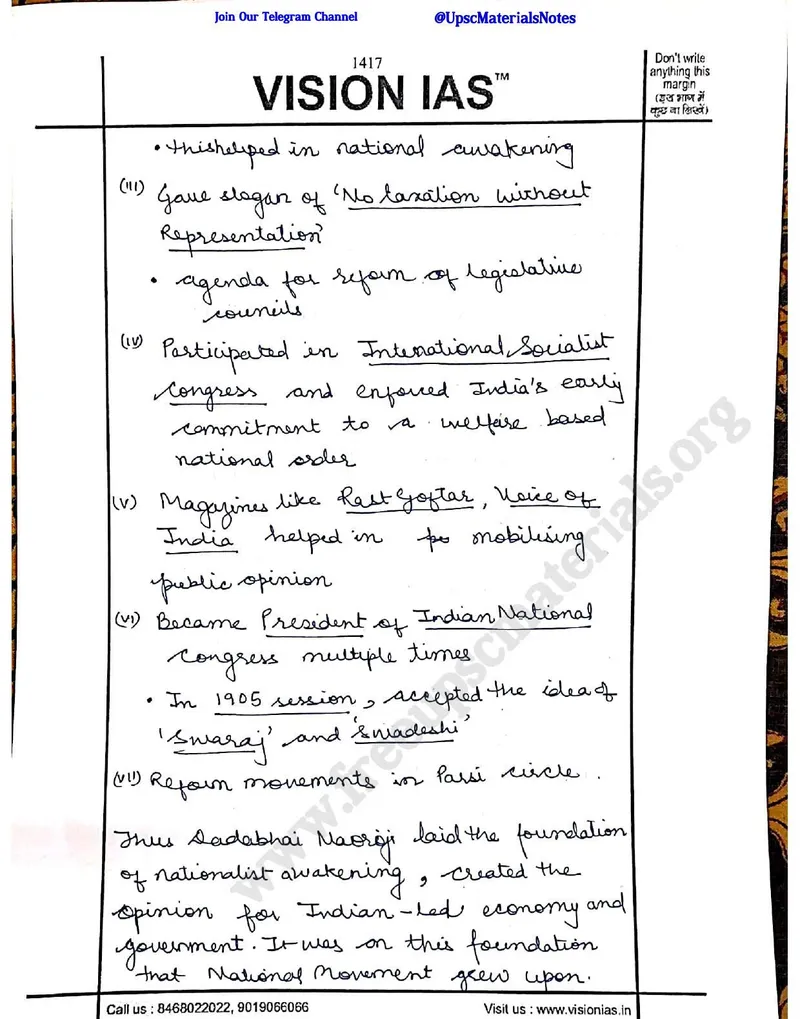
- ★She runs a single repeatable template across nearly every answer: a one-line definitional intro ('Naoroji is often referred to as the Grand Old Man of India...'; 'Social security refers to guarantee of a good standard of life...'), Roman-numeral body points each capped by a concrete 'Eg', and a short thesis-linked conclusion (urban forests as a 'tool for Sustainable Development', eco-tourism tied to 'Incredible India'). -> Build one disciplined intro-points-with-examples-conclusion template you can deploy under time pressure so every answer is fast to skim and structurally complete.
Questions attempted: Dadabhai Naoroji left an indelible imprint on the national movement - Explain (10m, 150w); Quit India movement marked a new direction in the struggle against British colonial rule - Analyse (10m, 150w); End of World War II marked the birth of a new international order - Examine (10m, 150w), and 9 more below.
Questions attempted in this booklet (12)+
- 1.Dadabhai Naoroji left an indelible imprint on the national movement - Explain (10m, 150w)
- 2.Quit India movement marked a new direction in the struggle against British colonial rule - Analyse (10m, 150w)
- 3.End of World War II marked the birth of a new international order - Examine (10m, 150w)
- 4.Simla Agreement (1972) and Lahore Declaration (1999) as milestones in subcontinent history - Discuss (10m, 150w)
- 5.Social security must involve economic AND social empowerment - Discuss in Indian context (10m, 150w)
- 6.How globalisation manifests as 'local in the global' and 'global in the local' - with examples (10m, 150w)
- 7.Violence against women in India - ways to address it effectively (10m, 150w)
- 8.Urban forest - meaning, benefits, and government steps to promote urban forestry (10m, 150w)
- 9.How globalization has impacted the location of the IT industry (10m, 150w)
- 10.Eco-tourism to sustainably harness India's tourism potential - challenges & government steps (10m, 150w)
- 11.Advent of Buddhism and Jainism instrumental in development of ancient Indian architecture - Discuss (15m, 250w)
- 12.Reactionary policies of Lord Lytton and liberal policies of Lord Ripon as catalyst in formation of INC - Discuss (15m, 250w) - TRUNCATED: answer cuts off mid-way; Q13-Q20 not present in this file
Examples, data & evidence used
- Q1 Naoroji: 'Grand Old Man of India', East India Association (London), 'Drain of Wealth' theory, slogan 'No taxation without Representation', International Socialist Congress, Rast Goftar and Voice of India magazines, INC presidency, 1905 session (Swaraj & Swadeshi), Parsi reform movements
- Q2 Quit India: Cripps Proposal, 'Do or Die', parallel governments (Chittu Pandey in Ballia, Nana Patil in Satara), underground radio by Usha Mehta and Aruna Asaf Ali, 'August Revolution', Muslim League's separate Pakistan demand
- Q3 Post-WWII order: bipolar US-USSR world, United Nations, IMF, World Bank, Cold War, NATO/CENTO/SEATO, Warsaw Pact/Baghdad Pact, NAM, decolonisation in Asia-Africa-Latin America
- Q4 Simla/Lahore: Bangladesh Liberation War, exchange of POWs, ceasefire line renamed as LOC, No-First-Use of nuclear weapons (Lahore), post-Kargil context
- Q5 Social security: MGNREGA, Jan Dhan Yojana, Aam Aadmi Bima Yojana, PM Jeevan Suraksha Yojana, ESIC, MUDRA, SVANidhi, RTE, Ayushman Bharat-Jan Arogya Yojana, Swabhimaan scheme (sanitary pads), PM Matru Vandana Yojana, National Commission on Transgender
- Q6 Globalisation: Diwali holiday in US/UK, Holi parties in France, Bohemian shirts/tribal jewellery, Aloo Tikki Burger at McDonald's, film 'Period - End of Sentence', turmeric soaps/neem ointment, US-China protectionism, Hollywood films, Valentine's/Mother's Day, Jeans-Kurta, #MeToo Movement
- Q7 Violence vs women: NCRB ('one in every three Indian women a victim'), Nai Roshni, National Urban & Rural Livelihood Missions, STEP scheme, MUDRA loans, PSL norms, Anganwadi, POSHAN Abhiyan, One Stop Centre, Mahila Shakti Kendra, glass-ceiling concept
- Q8 Urban forest: Paris Agreement, Green India Mission (under National Action Plan on Climate Change), Urban Forest Scheme 2020, Smart City Mission, Green Good Deeds (Ministry of Environment), Miyawaki regeneration in Karnataka & Telangana, BHEL Bhopal, Urban Heat Island effect
- Q9 IT industry: BPO/call centres, US/UK/France design centres, India (Bangalore), China (Hong Kong, Beijing), Google, Work-from-Home/foot-loose industry, Double Taxation Avoidance Agreement, Base Erosion and Profit Shifting (BEPS)
- Q10 Eco-tourism: Swadesh Darshan scheme (eco-tourism/wildlife/desert/Himalayan circuits), Ecologically Sensitive Areas, CRZ norms, Kerala (slopes used for resorts), 'Incredible India'
- Q11 Architecture: Sanchi & Bharhut Stupas, Amravati Stupa (limestone/marble), Jataka tales, Bhaja & Karle caves, Chaitya & Vihara, Gandhara & Mathura art, Sultanganj Buddha, Udayagiri caves (Odisha), Meguti Jain temple (Aihole), Jali work, Udaigiri caves (Vidisha), Durga temple (Aihole), Ajanta caves, Kailashnath temple (Ellora), Ashokan Tirthankara torso
- Q12 Lytton/Ripon: Delhi Durbar during famine year, reducing ICS maximum age to 19, Arms Act, Vernacular Press Act, Ripon's repeal of Vernacular Press Act, 'Magna Carta of local governance' (local self-government)
Quotes the candidate used
- 'According to Ambedkar, social equality is a prelude to democracy.' (closing line of Q5, attributed to Ambedkar)
- 'Do or Die' (Q2, attributed to Gandhi's ideal for Quit India)
- 'No taxation without Representation' (Q1, given as Naoroji's slogan)
How it’s written: Highly consistent answer-writing template. Each answer opens with a 1-2 line definitional/contextual introduction (e.g., "Naoroji is often referred to as the 'Grand Old Man of India'..."; "Social security refers to guarantee of a good standard of life..."). Body is organised under boxed or underlined sub-headings (e…
Diagrams & visuals: Branching tree/mind-map diagram in Q7 classifying 'Violence' into 'Manifest' (dowry death, rape, domestic abuse, sexual harassment) and 'Latent' (child marriage, pornography, deprivation of education/health, malnutrition, neglect of girl child); Boxed and underlined sub-headings used as visual section markers throughout; Arrow-flow notation and brace/bracket groupings to link points and examples (no formal tables or maps in Jagrati's portion)
Evaluator: No examiner marks or comments are filled in on this copy.
From the first half of this booklet (Q1–Q12); the later pages were a different copy and are excluded.