
Raghav Jhunjhunwala — NextIAS GS Paper 4 (Ethics) copy
What’s inside this copy
- ▸Example density is the signature strength - named role-models (Bose, Shastri, S.R. Sankaran, Ashok Khemka, Visvesvaraya, E. Sreedharan, Prasanth Nair) are deployed for almost every point.
- ▸Nearly every answer opens with a hook (film, Sanskrit maxim, or quote) and closes with a thinker's line - a deliberate, repeatable answer-writing rhythm.
- ▸Case studies use a clean, consistent template: stakeholder web-diagram -> ethical issues -> options as pros/cons -> Action|Rationale table -> way forward.
- ▸Strong constitutional and administrative anchoring: Art. 47, Art. 48A, MC Mehta v. UOI, Conduct Rules 1961, Companies Act 2013, 2nd ARC.
- ▸Current-affairs and corporate hooks woven in: Wayanad landslide 2024, Yes Bank/Videocon, ESG, Triple Bottom Line, 'Data is the new oil'.
- ▸Booklet is UNEVALUATED - no marks, grand total, remarks or evaluator feedback are filled anywhere (shared as a sample/topper copy).
What to learn from this copy
- ★For 'ends justify means' (Q1a) Raghav reached for a hard, debatable case - Subhas Chandra Bose joining the Axis powers for the freedom struggle - rather than a safe textbook line, and paired role-models like Lal Bahadur Shastri resigning after the Ariyalur train accident and Shastri-type conscience cases with the constraint-violation theme -> Mine history for the genuinely contested example that fits the exact wording of the question; a well-chosen real instance does the arguing for you.
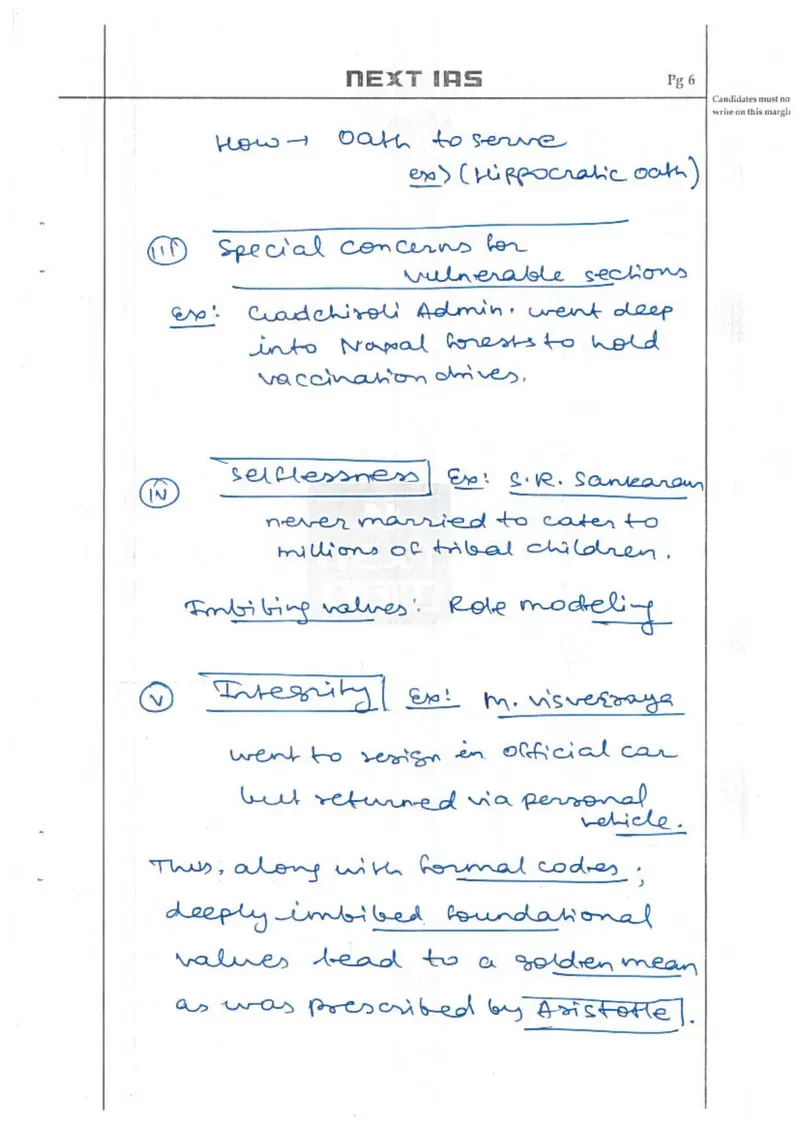
- ★Almost every theoretical point is welded to a named bureaucrat-exemplar - S.R. Sankaran staying unmarried to serve tribal children, Ashok Khemka's 53 transfers, M. Visvesvaraya returning home in his personal vehicle to keep official and private separate, E. Sreedharan, Prasanth Nair's 'Compassionate Kozhikode', Awanish Sharan's bike ambulance -> Build a personal stock of ~8-10 administrator role-models with one crisp signature act each, so any 'ethical attribute / how to develop it' answer (Q2a) is illustrated, not asserted.
- ★He engages the quote prompt directly instead of paraphrasing it - on J.S. Mill's 'it is not because men's desires are strong... it is because their consciences are weak' (Q6a) he answers with the contrast of Ravana (strong desires) and reinforces it with the Sanskrit maxim 'Sheelam Param Bhushanam' (character is the ultimate ornament) -> In quote questions, restate the author's own claim, then prove it with a contrasting example plus a second corroborating line; layering a maxim onto the given quote shows you grasped its logic.
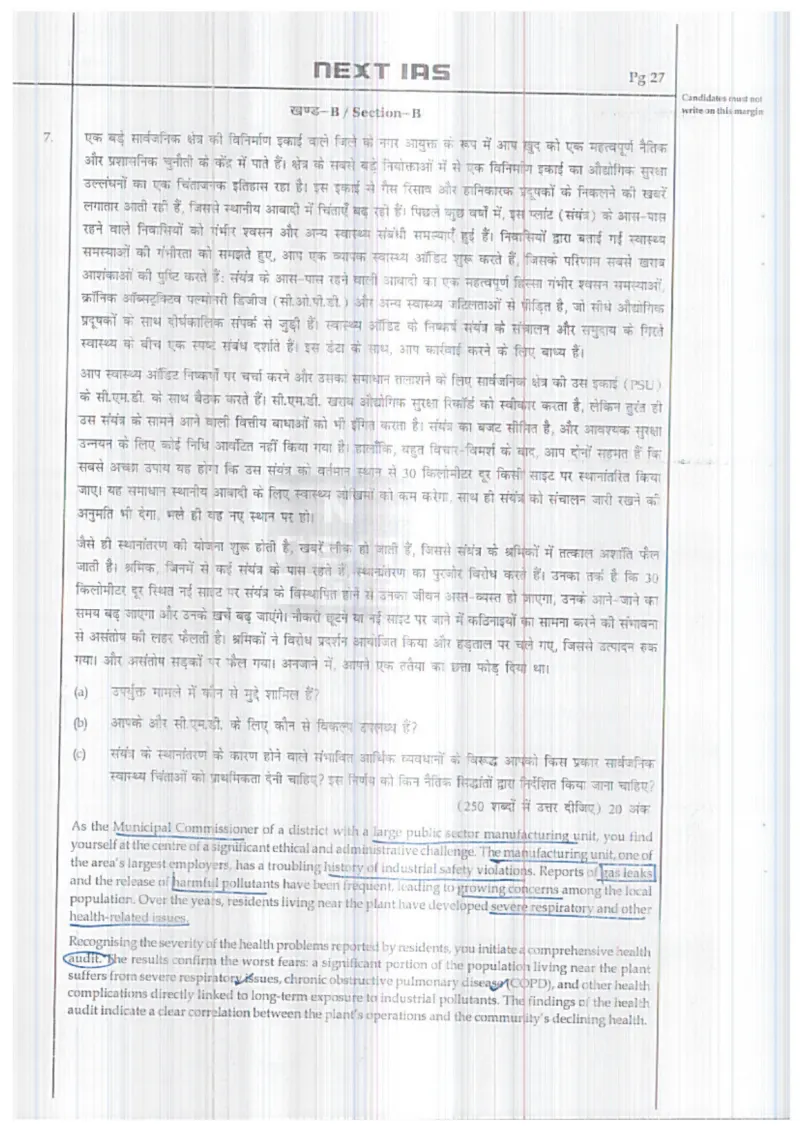
- ★Every case study (Q7-12) runs the same disciplined skeleton: a stakeholder web/bubble diagram with the candidate placed in it (Q7 hub branching to municipal staff, Govt, 'Municipal Commissioner (me)', Residents, Plant CMD, Plant workers) -> ethical issues -> options as pros/cons tables -> a two-column 'Course of Action vs Rationale' table -> way forward -> Pre-decide one repeatable case-study template so under time pressure you spend thought on content, not format; the Action|Rationale table forces you to justify each step rather than just narrate.
- ★Theory answers are anchored in citable law and reports, not vague principle - Art. 47 (Right to Health), Art. 48A, MC Mehta v. UOI, Conduct Rules 1961, Companies Act 2013, and the 2nd ARC's 'RTI = golden key to good governance' - and on the RTI question (Q4b) he layers current hooks like the MGNREGA scam, '80% PMO requests withheld' and the 2019 amendment dilution -> Even in Ethics, back claims with specific articles, cases, conduct rules and ARC lines; it converts a moral essay into a governance-literate answer.
- ★He varies hooks and closers deliberately so the templated rhythm doesn't read as formulaic - opening Q3b with 'It is easier to build strong children than to repair broken men' and Q8 with 'A stitch in time saves nine, and the failure to do so invites famine', then closing with thinkers' lines (Dalai Lama, Buddha's 'compassion itself is the righteous path' in Q9) -> Curate a small bank of openers and closers spanning proverbs, scripture and philosophers so each answer has a fresh frame while keeping a consistent open-with-a-hook, close-with-a-thinker discipline.
Questions attempted: Is it ethically justified for leaders to violate deepest moral constraints for greater good / 'ends justify means'; Humans as intuitive virtue theorists vs deontologists/consequentialists - critical analysis; Five ethical attributes for an administrator and how to develop them, and 16 more below.
Questions attempted in this booklet (19)+
- 1(a).Is it ethically justified for leaders to violate deepest moral constraints for greater good / 'ends justify means'
- 1(b).Humans as intuitive virtue theorists vs deontologists/consequentialists - critical analysis
- 2(a).Five ethical attributes for an administrator and how to develop them
- 2(b).Political vs professional vs personal responsibility and prioritisation in conflict
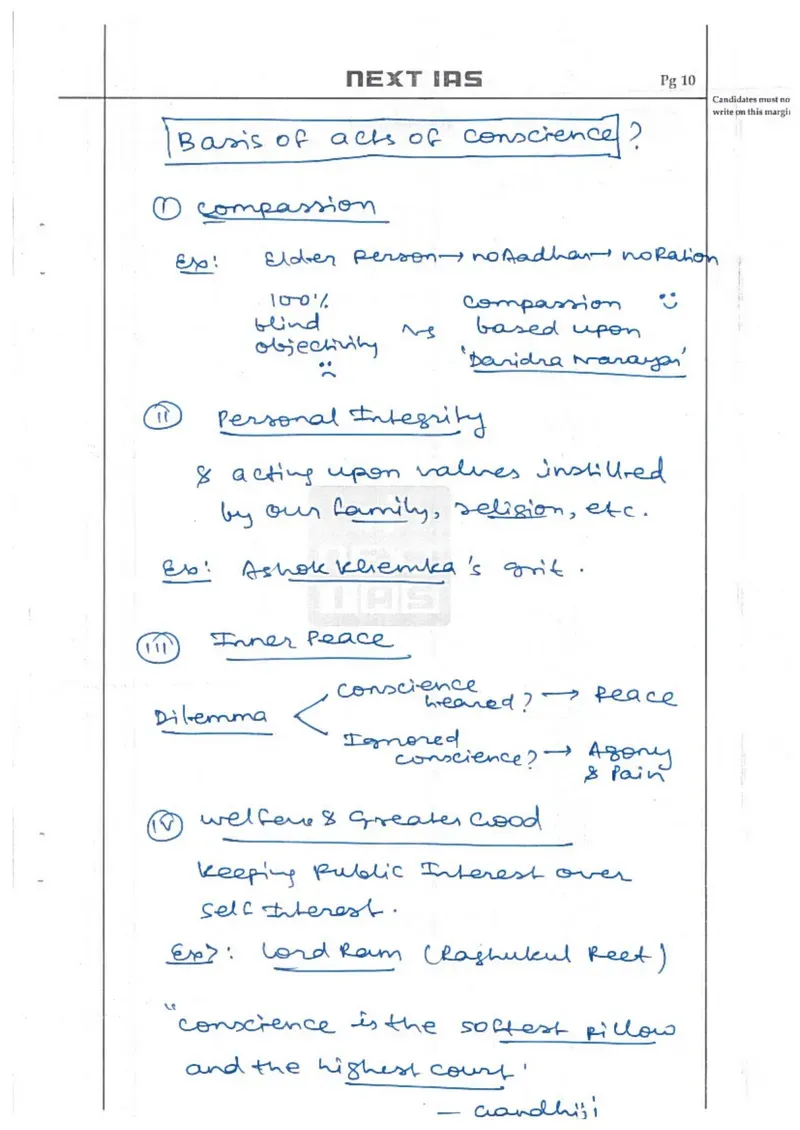
- 3(a).'Acts of conscience' in civil service - meaning, example, basis
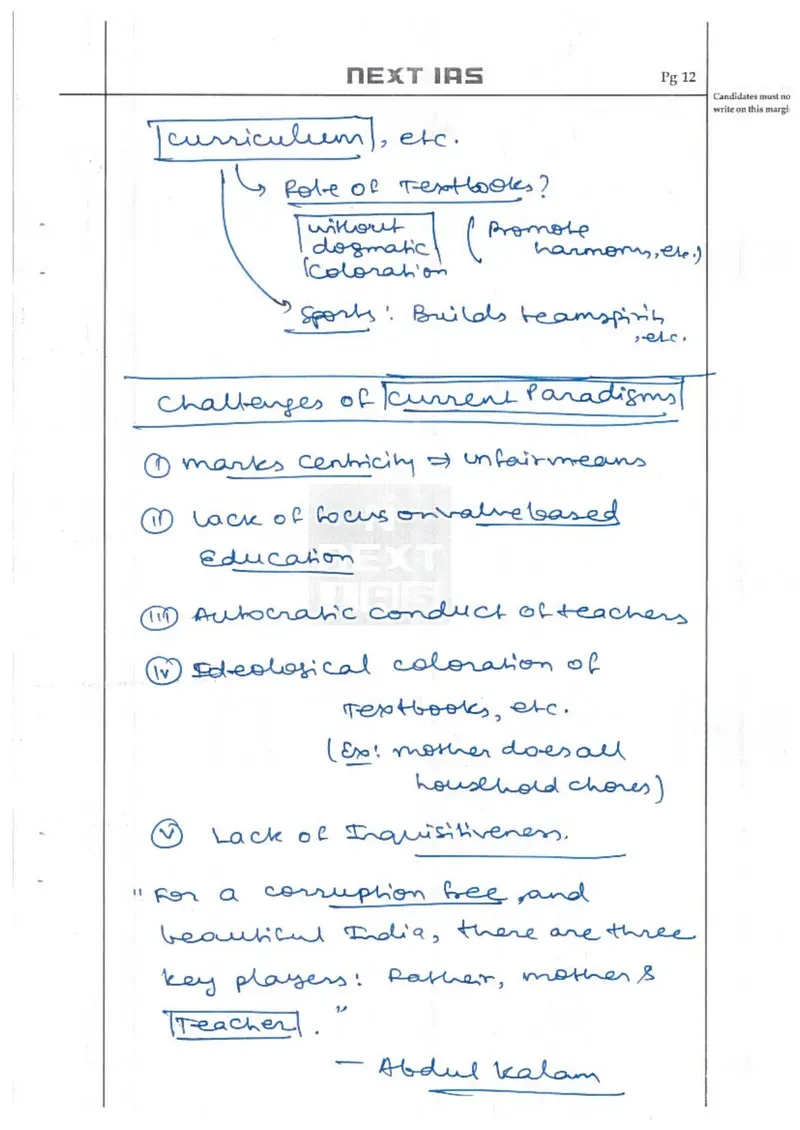
- 3(b).Role of educational institutions in shaping ethical decision-making in future civil servants
- 4(a).Ethical challenges of persuasion/social-influence techniques for rural health interventions
- 4(b).RTI 2005 and ethical accountability / curbing bureaucratic corruption
- 5(a).Ethical implications of high-quality service delivery; probity and marginalised communities
- 5(b).Regulatory frameworks in corporate governance without stifling innovation
- 6(a).Quote - J.S. Mill: weak consciences (not strong desires) cause ill acts
- 6(b).Quote - B.R. Ambedkar: ascending reverence / descending contempt and compassionate society
- 6(c).Quote - Gandhi: unwise to be too sure of one's own wisdom; strongest may weaken, wisest may err
- 7.Case study - Municipal Commissioner: PSU plant relocation, public health vs local economy/workers
- 8.Case study - Executive Assistant: bid-rigging concealment, loyalty to superior vs duty to report
- 9.Case study - Audit Officer: DM diverting road funds to build a school; rules vs public benefit
- 10.Case study - SP: forest conservation vs tribal rights, political pressure to go soft
- 11.Case study - CDO: conflicting directives (Chief Secy speed-up vs anti-corruption audit halt)
- 12.Case study - FMCG greenwashing, BSI conflict of interest, profit vs ethical responsibility
Examples, data & evidence used
- Subhas Chandra Bose joining Axis powers for the freedom struggle (ends-justify-means)
- Lal Bahadur Shastri resigning after the Ariyalur train accident (moral responsibility / conscience)
- S.R. Sankaran (stayed unmarried to serve tribal children) and Ashok Khemka (grit despite 53 transfers)
- M. Visvesvaraya returning via personal vehicle (integrity); E. Sreedharan; Prasanth Nair's 'Compassionate Kozhikode'; Awanish Sharan's bike ambulance
- Gadchiroli administration's vaccination drives in Naxal-affected forests; Hippocratic oath; Aristotle's golden mean
- Constitutional/legal anchors: Art. 47 (Right to Health), Art. 48A, MC Mehta v. UOI, Conduct Rules 1961, Companies Act 2013, 2nd ARC ('RTI = golden key to good governance')
- RTI 2005 + MGNREGA scam, '80% PMO requests withheld', 2019 amendment dilution; 'Data is the new oil, information is the new currency'
- Corporate cases: Tata Group (paid families affected by 26/11), Videocon & Yes Bank failures, ESG / Triple Bottom Line (People-Planet-Profit), Tesla; Singapore zero-tolerance on corruption
- Pop-culture/current hooks: Taare Zameen Par, 'Panchayat' web-series family-planning slogan, Bhilwara model on child marriage, Japanese 'Chi-Toku-Tai', Wayanad landslide 2024 (300+ deaths), Bhopal Gas Tragedy
- Mythology/history: Abhimanyu in the Chakravyuh (virtue/courage), Lord Ram / 'Raghukul Reet', Ravana (strong desires), Sant Ravidas's 'Begumpura', Athens vs Sparta, Rukhmabai, Non-Cooperation Movement
Quotes the candidate used
- 'It is not because men's desires are strong that they act ill; it is because their consciences are weak' - J.S. Mill (the Q6a prompt, engaged directly)
- 'Conscience is the softest pillow and the highest court' - attributed to Gandhi (Q3a)
- 'Love and compassion are not the necessities but the minimum requisites for harmonious functioning of our society' - Dalai Lama (Q6b)
- 'Sheelam Param Bhushanam' (character is the ultimate ornament/fortitude) - Sanskrit maxim (Q6a)
- 'Prakriti Rakshita Rakshati' - those who protect Mother Earth, she protects them too (Q7 case study)
- Lord Buddha: 'sometimes compassion overpowers righteousness because compassion itself is the righteous path' (Q9 case study)
- 'It is easier to build strong children than to repair broken men' - opening of Q3b (no author written)
- 'A stitch in time saves nine, and the failure to do so invites famine' - opening of Q8 case study
How it’s written: Highly consistent, templated structure across all answers. Neat blue-ink cursive with disciplined underlining of keywords; the right-hand margin rule ('Candidates must not write on this margin') is respected throughout. Theory answers open with a hook (a quote, Sanskrit maxim, film or named example), develop via cir…
Diagrams & visuals: Stakeholder web/bubble diagrams (e.g. Q7 'Stakeholders' hub branching to municipal staff, Govt, Municipal Commissioner (me), Residents, Plant CMD, Plant workers); Flow/relationship diagrams (e.g. conscience-behaviour chain; individual-societal values); 'Course of Action vs Rationale' two-column tables in every case study; Pros/cons (merit-demerit) option tables; Triple Bottom Line (People-Planet-Profit) schematic in Q12; No maps (not applicable to an Ethics paper)
Evaluator: No examiner marks or comments are filled in on this copy.