
Ravi Gangwar — Topper copy archive GS copy
What’s inside this copy
- ▸Hindi-medium GS Paper IV (Ethics) copy — 13 of 14 questions attempted; only sub-part Q2(a) on Weberian impersonal bureaucracy is left blank.
- ▸Section A answers anchor each value/quote in a named thinker — Gandhi's golden rule tied to Jain anekantavada/syadvada, Chanakya's fish-in-water corruption analogy, Kant's duty-over-consequences, the Gita's nishkama karma.
- ▸Contemporary examples are deployed across answers: US exit from the Paris accord and Brexit (international ethics), Triple Talaq abolition and Sabarimala (common good vs individual), Nirbhaya/death penalty (Kantian motive).
- ▸All six Section B case studies (Q9-Q14) are attempted part-wise (a/b/c), each with a concrete policy hook — carbon credit, NGT mine-closure, Bonded Labour rehabilitation, vote-bank politics.
- ▸Consistent answer architecture: opens with a quote or definition, then breaks into numbered sub-points (i, ii, iii), underlining headings such as laabh/haaniyaan (merits/demerits).
- ▸Purely prose-and-points — no diagrams, flowcharts or maps anywhere in the copy.
What to learn from this copy
- ★Every value in Section A is anchored to a NAMED thinker, and Gandhi's 'golden rule = mutual toleration' is further grounded in Jain anekantavada/syadvada (Q1a) rather than left as a bare assertion -> don't just name a concept, tie it to a specific philosopher and reinforce it with a second tradition so the marker sees depth, not a memorized line.
- ★Quotations are chosen to fit the exact demand: Kant's 'moral worth depends on motive, not consequences' is deployed on the Kantian Q5b, the Gita's Nishkama Karma on the civil-services question Q8b, and Chanakya's fish-in-water corruption analogy on Q2b -> match each quote to the precise sub-part it answers instead of front-loading generic quotes; relevance, not volume, is what earns the credit.
- ★Contemporary examples are mapped one-to-one onto the right ethical idea -- US exit from the Paris accord and Brexit for international ethics (Q4a), Triple Talaq abolition and Sabarimala for common good vs individual interest (Q6), Nirbhaya/death penalty for Kantian motive (Q5b) -> pick a current example that directly illustrates the concept being tested, so the example proves the argument rather than decorating it.
- ★All six Section B case studies (Q9-Q14) are attempted part-wise (a/b/c) and each lands a concrete policy hook -- carbon credit for the polluting-industry case (Q12), the NGT closure order for unsafe coal mines (Q13), and invoking Bonded Labour rehabilitation for the bonded-worker case (Q14) -> in case studies, close every sub-part with a real, nameable scheme/instrument so your resolution is actionable, not just moral commentary.
- ★Coverage is maximised honestly: 13 of 14 questions attempted, with only Q2(a) on Weberian impersonal bureaucracy left genuinely blank rather than padded -> attempt nearly everything to capture marks across the paper, but skip cleanly when you have nothing rather than writing filler that signals weakness.
- ★A consistent answer architecture is held throughout -- open with a quote or crisp definition, then break into numbered sub-points (i/ii/iii, a/b/c) with underlined headings like laabh/haaniyaan (merits/demerits) -> a predictable open-then-segment structure makes a prose Ethics answer scannable for the examiner even with zero diagrams (this copy has none).
Questions attempted: (a) Gandhi: golden rule = mutual toleration; (b) Confucius: superior man understands righteousness, mean man understands gain — both attempted; (a) Weberian impersonal bureaucracy breeding indifference — NOT attempted (answer page blank); (b) political power compromising means erodes public trust — attempted; (a) ethical corporate governance / ethical workplace; (b) law should be succinct & intelligible to a peasant — both attempted, and 11 more below.
Questions attempted in this booklet (14)+
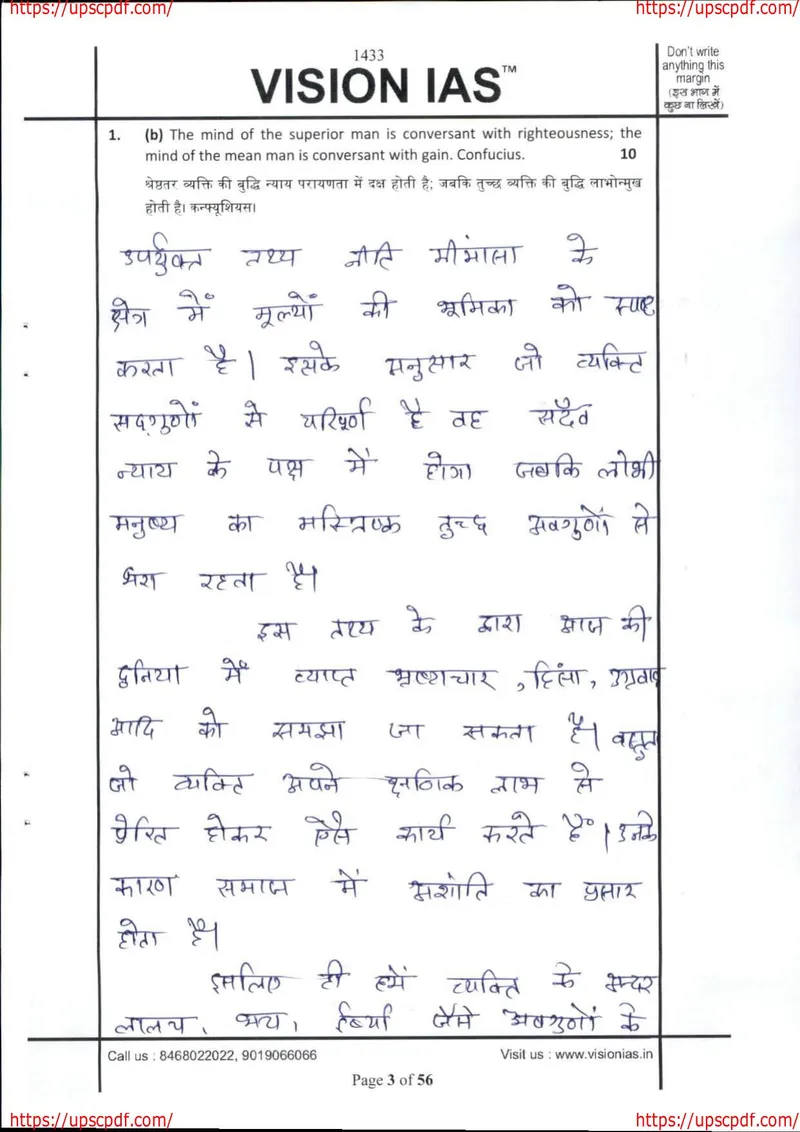
- Q1.(a) Gandhi: golden rule = mutual toleration; (b) Confucius: superior man understands righteousness, mean man understands gain — both attempted
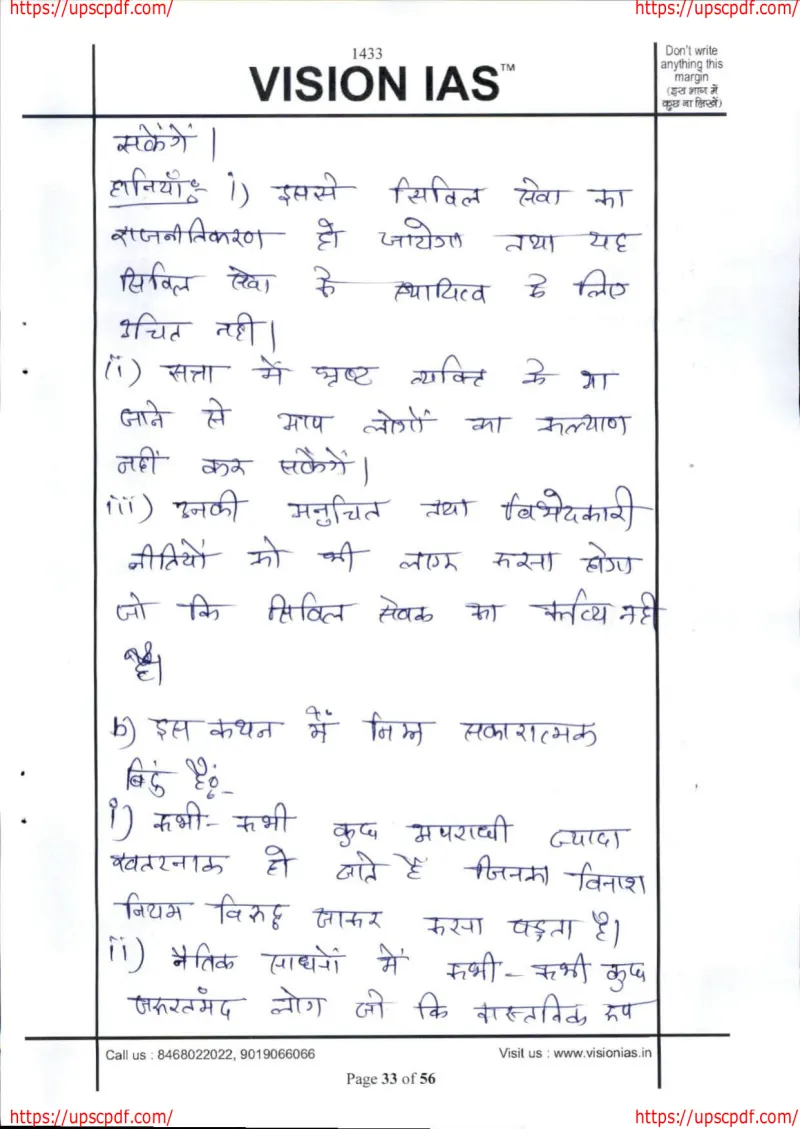
- Q2.(a) Weberian impersonal bureaucracy breeding indifference — NOT attempted (answer page blank); (b) political power compromising means erodes public trust — attempted
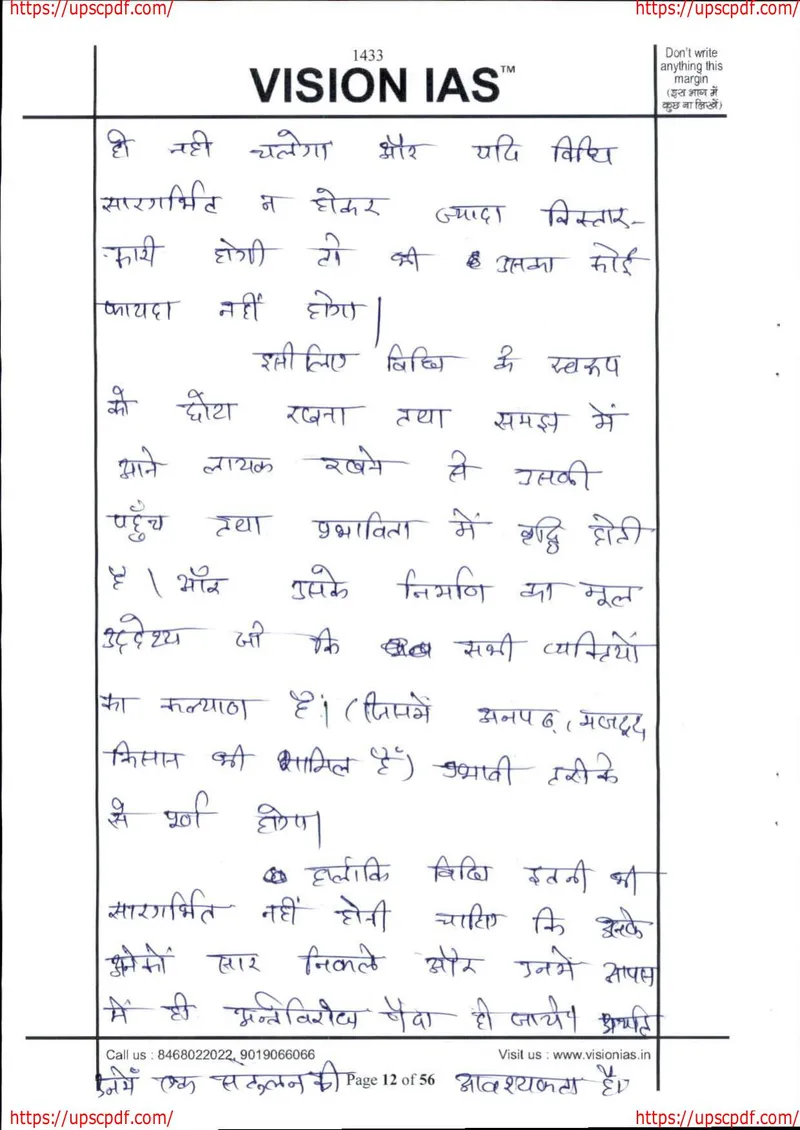
- Q3.(a) ethical corporate governance / ethical workplace; (b) law should be succinct & intelligible to a peasant — both attempted
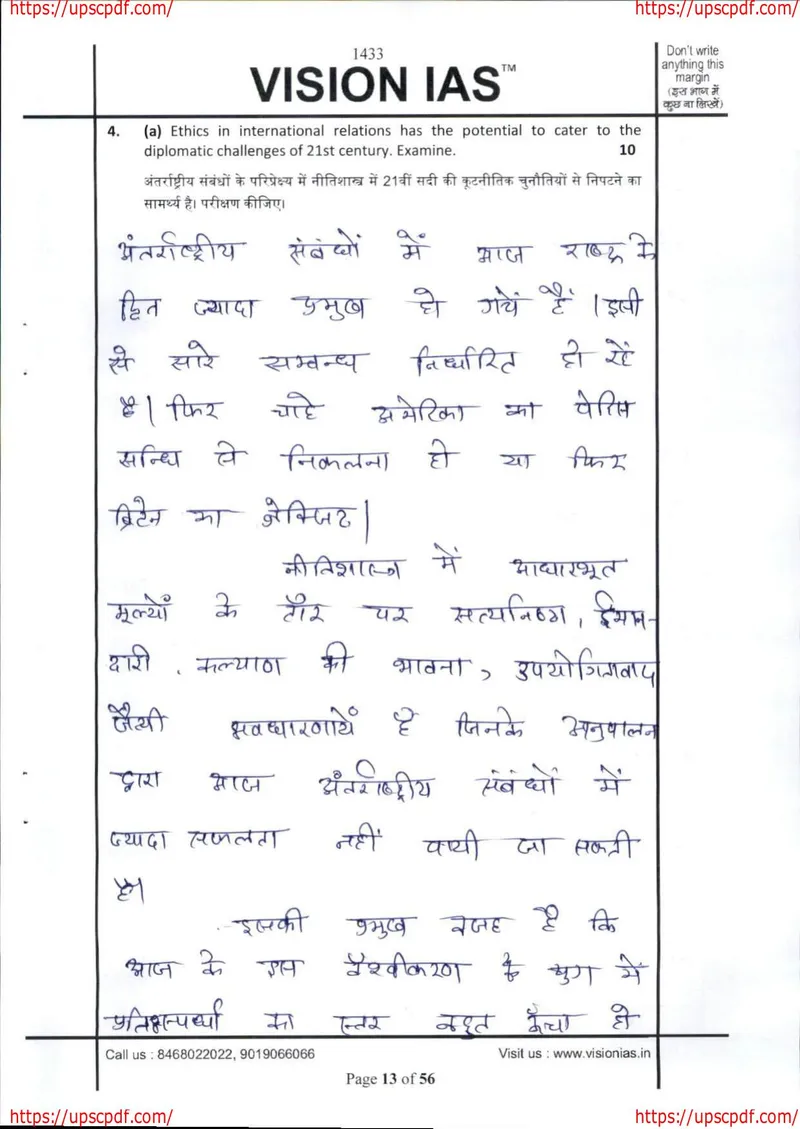
- Q4.(a) ethics in 21st-century international relations/diplomacy; (b) Nolan Committee standards for public office — both attempted
- Q5.(a) socio-economic disparities as corruption incentive (point-wise i-v); (b) Kantian moral worth depends on motive not consequences — both attempted
- Q6.Common good vs individual interest dilemma — attempted
- Q7.Compassion as administrative strength, not weakness (framed as emotional intelligence) — attempted
- Q8.(a) Professionalism; (b) Nishkama Karma — meaning and importance for civil services — both attempted
- Q9.Case study: chairman of reservation-extension committee vs government's political inclination — attempted (a, b, c)
- Q10.Case study: honest civil servant — loyalty to power / ethical means impractical / petty corruption expedites delivery — attempted (merits & demerits)
- Q11.Case study: sportspersons' misogynistic & racist remarks; public figures' responsibility & punishment — attempted (a, b, c)
- Q12.Case study: polluting leather industries — shutdown / relocate / stricter norms / incentives — attempted (all four options + chosen course)
- Q13.Case study: coal mines with inhuman conditions, NGT closure order, politician-miner-bureaucrat nexus — attempted (a, b)
- Q14.Case study: DM & bonded-labour-like ties of agricultural workers to large landowners; human-rights violation — attempted (a, b, c)
Examples, data & evidence used
- US withdrawal from the Paris climate agreement (Q4a)
- Brexit (Q4a)
- Nirbhaya case (Q5b)
- Death penalty / capital punishment (Q5b)
- Triple Talaq abolition (Q6)
- Sabarimala dispute (Q6)
- Vote-bank politics around reservation (Q9)
- Carbon credit as an emission-control incentive (Q12)
- National Green Tribunal order to close unsafe coal mines; politician-miner-bureaucrat nexus (Q13)
- Bonded Labour rehabilitation scheme/Act invoked to free and rehabilitate workers (Q14)
Quotes the candidate used
- Mahatma Gandhi — the golden rule is mutual toleration (Q1a, question prompt interpreted); also cited in Q2b for purity of both means and ends
- Confucius — 'The superior man understands righteousness; the mean man understands gain' (Q1b, question prompt interpreted)
- Chanakya / Kautilya — fish-in-water analogy of corruption; saam-daam-dand-bhed (Q2b)
- Immanuel Kant — moral worth of an act depends on its motive/duty, not its consequences (Q5b)
- Bhagavad Gita — Nishkama Karma: perform action without attachment to its fruit (Q8b)
- 'An organization is only as ethical as its leadership' (candidate's own opening line, Q3a)
- Jain philosophy — Syadvada / Anekantavada invoked to ground Gandhi's tolerance (Q1a); Sarvodaya invoked in Q3b
How it’s written: Vision IAS scripted answer booklet (Test Code 1433), 58 PDF pages = 56 written/printed pages plus cover and rubric. Cover: Name "Ravi Gangwar", Hindi medium, Reg 121488, Centre Mukherjee Nagar, 14 questions, "19 AUG 2019" received stamp. Each answer page carries the bilingual (English+Hindi) printed question at top,…
Diagrams & visuals: None — no diagrams, flowcharts, tables or maps appear anywhere across the 56 written pages; answers are pure prose with point-wise (i/ii/iii, a/b/c) breakdown
Evaluator: No examiner marks or comments are filled in on this copy.