
Madhav Agrawal — Vajiram & Ravi GS Paper 4 (Ethics) copy
What’s inside this copy
- ▸Genuine Madhav Agarwal copy — cover shows Roll 6907627, Admin 16301324, 'UPSC CSE 2024 AIR-16', V&R Ethics Full Length Test (250 marks), submitted 30 Aug 2024
- ▸Entirely unevaluated: cover marks table, parameter rubric, suggestions box and all Remarks columns are blank — no marks/ticks/comments
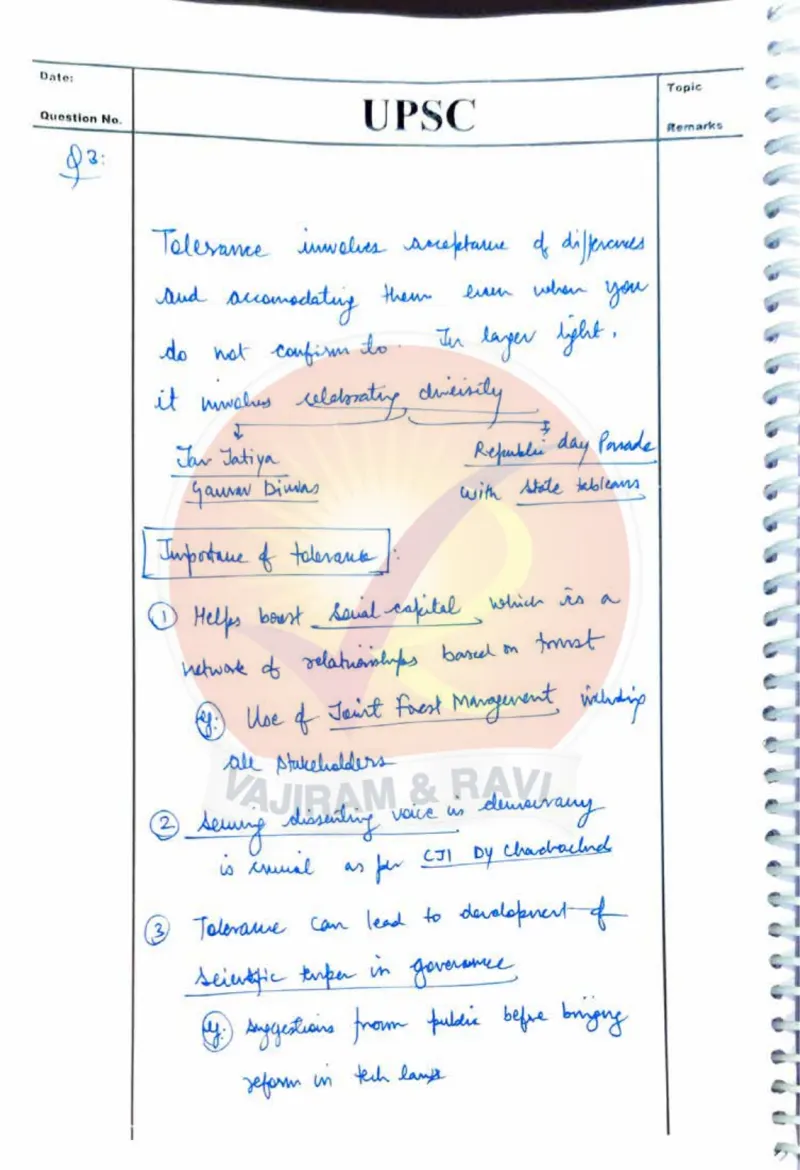
- ▸Extremely example-dense — nearly every point is backed by a real case (Vinod Rai, Awanish Sharan's bike ambulances, Ira Singhal, Chhavi Rajawat, Lijjat Papad, Jaga Mission)
- ▸Strong keyword discipline: answers open with a sharp definition and underline thinker-terms (Kant's dignity, Vasudhaiva Kutumbakam, Nishkama Karma)
- ▸Consistent value-add structure: definition → numbered points with 'eg:' → forward-looking conclusion ('future is GREEN or BLACK'; 'sound work culture that attracts best talent')
- ▸Quotes attributed to authors — MLK on adversity (Q6b) and Gandhi on conscience (Q6c)
What to learn from this copy
- ★He anchors nearly every numbered point with a concrete 'eg:' case rather than a generic claim - e.g. Awanish Sharan's bike ambulances for innovation, the Uttarakhand social audit that exposed 11,000 fake pensioners for accountability, Ira Singhal hiring transgenders for inclusion, and Chhavi Rajawat / Lijjat Papad / Jaga Mission for grassroots empowerment -> Build a personal bank of 2-3 real, specific administrative cases per ethics theme so you can attach a named example to each point instead of writing in abstractions.
- ★For the impartiality-vs-neutrality question he drew a true comparison table with named axes (Basis / Meaning / Association / positive-vs-negative concept / Scope) rather than prose -> When a question asks you to 'distinguish' two close concepts, a labelled two-column table on chosen parameters shows the difference faster and more clearly than paragraphs.
- ★He attributes his quotes to their authors - Martin Luther King for adversity being the real test of character (Q6b) and Mahatma Gandhi for conscience working irrespective of the majority (Q6c) -> In quote-based and value questions, naming the thinker behind a line (and only when you're sure of it) adds weight; an unattributed line like his 'first we make our choices, later our choices make us' stays a plain closing line.
- ★He opens answers with a crisp one-line definition and underlines the thinker-terms he invokes - Kant's human dignity in the Oxfam inequality answer, Vasudhaiva Kutumbakam, Nishkama Karma -> Lead with a sharp definition and visually flag your keywords (underline) so an examiner skimming the page instantly sees you've used the right ethical vocabulary.
- ★Every answer closes with a forward-looking line rather than a summary, e.g. framing environmental stewardship as a future that is 'GREEN or BLACK' and reform ending in 'a sound work culture that attracts the best talent' -> End on a constructive, future-facing note tied to the question's stake instead of merely restating points - it leaves the evaluator with a solution-oriented impression.
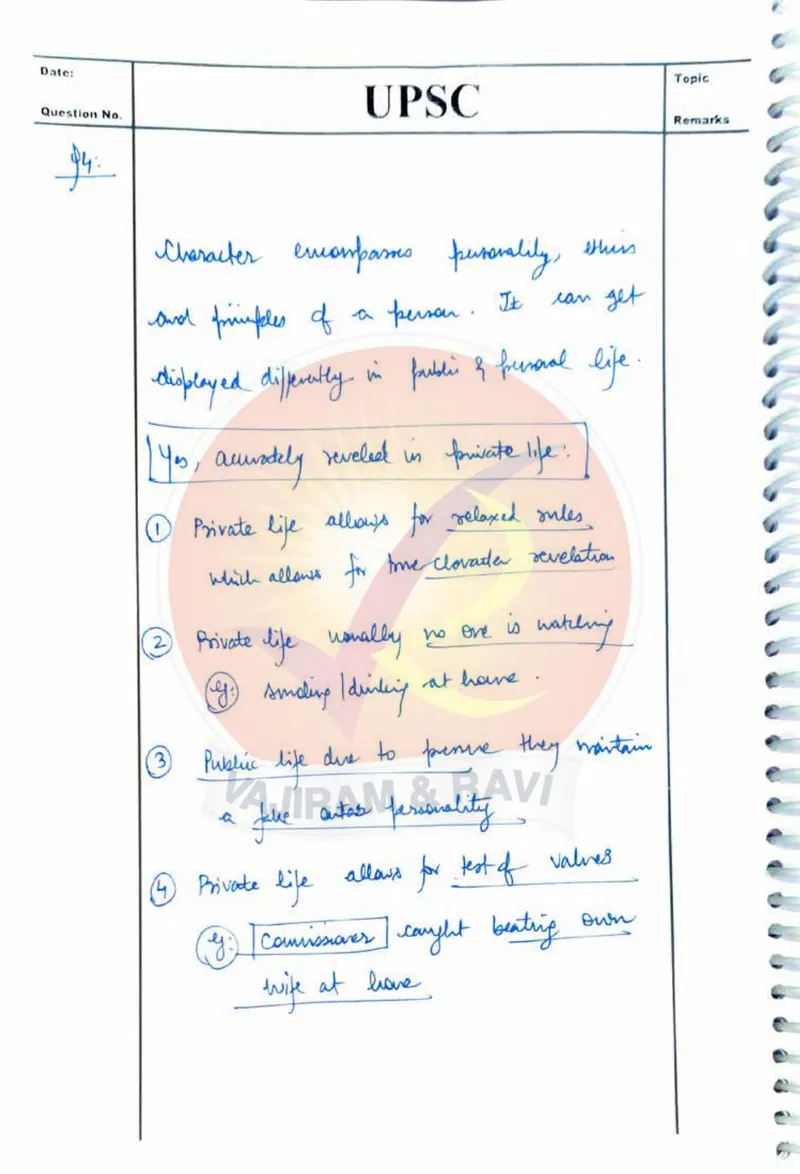
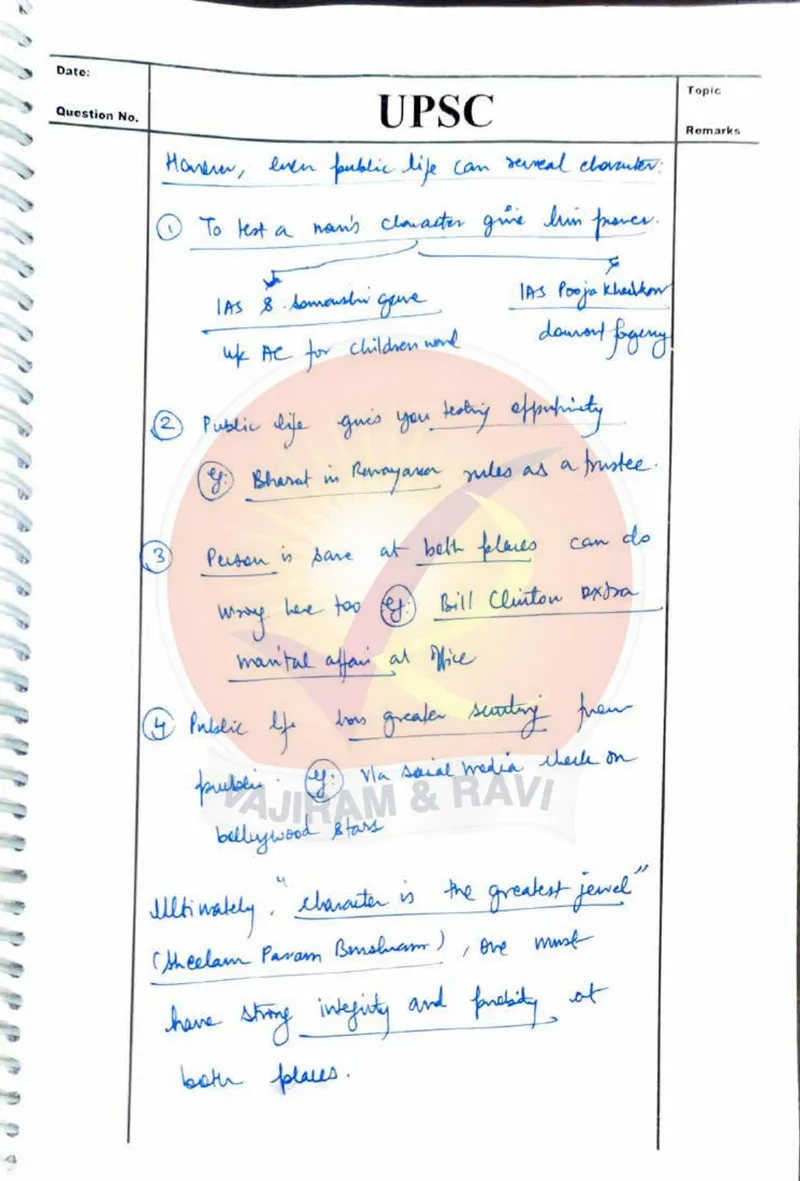
Questions attempted: Intellectual integrity and its role in ethical decision-making; Family and school as agents of value formation / building ethical citizenry for Amrit Kaal; Tolerance — accepting and celebrating diversity in public life and governance, and 14 more below.
Questions attempted in this booklet (17)+
- Q1.Intellectual integrity and its role in ethical decision-making
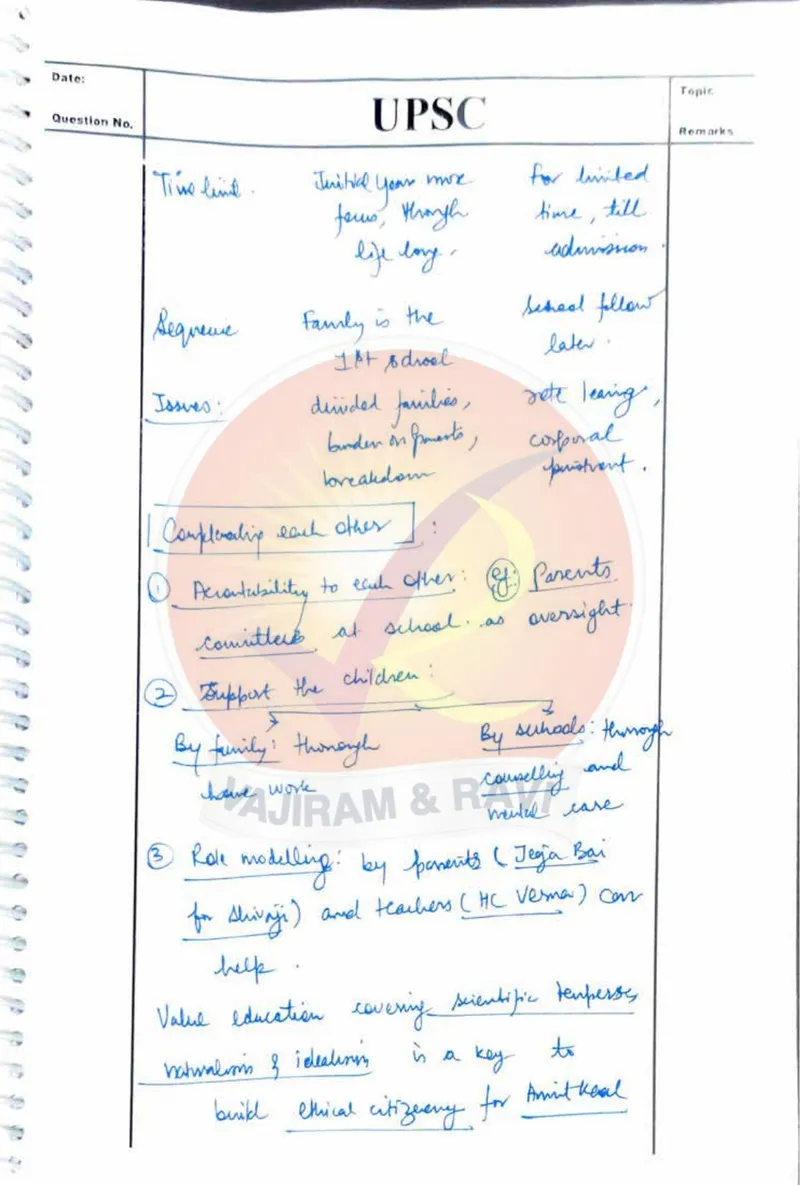
- Q2.Family and school as agents of value formation / building ethical citizenry for Amrit Kaal
- Q3.Tolerance — accepting and celebrating diversity in public life and governance
- Q5.Accountability in ethical governance — merits and the red-tape/delay downside
- Q6(b).Quote-based: adversity/challenge (not comfort) as the true test of character
- Q6(c).Quote-based: conscience as the inner voice irrespective of majority
- Q7.Emotional intelligence and empathy for ethical governance and service delivery
- Q8.Oxfam report on rising global inequality — ethical implications
- Q9/Q10 (env, approx.).Environment as a common good — shared ethical/environmental stewardship
- Q11 (approx.).Impartiality vs neutrality — distinction for civil servants
- Q12 (20m, approx.).Nishkama Karma / Gita — public service as selfless duty
- Q13 (20m case, approx.).Disaster case — relocating people and cultural/temple heritage to safety
- Q14 (20m case, approx.).Equitable relief distribution and courage of conviction in disasters
- Q15 (20m case, approx.).Women's empowerment against societal rigidity
- Q16 (20m case, approx.).AI / personal-data regulation and governance framework
- Q? (20m case, approx.).Pharma whistleblower dilemma — unsafe drug release ('Good Life Pharma')
- Q17 (20m case, approx.).Toxic work culture / corruption in public offices — reform measures
Examples, data & evidence used
- CAG Vinod Rai (objective decision-making)
- IAS Awanish Sharan — Bike Ambulances
- Jijabai (role model for Shivaji); HC Verma (teacher)
- Akbar's Sulh-i-kul; IAS Ira Singhal hiring transgenders
- CJI DY Chandrachud; Justice Venkatesh (LGBTQ sensitivity)
- Uttarakhand social audit — 11,000 fake pensioners
- Hardik Pandya; LBSNAA director; India's legal aid to Kasab
- Chauri Chaura (Gandhi); Ashoka after Kalinga
- CRPF suicides; Google team-building; IAS Minga Sherpa
- E Sreedharan; Antyodaya/PDS; IAS U Sagayam disclosing assets
- Mission LiFE; Save Soil; The Body Shop; Patagonia; International Solar Alliance; FAME-II EV subsidy; net-zero 2070
- Chhavi Rajawat (sarpanch); Lijjat Papad; Jaga Mission, Odisha
- Vasudhaiva Kutumbakam; Boko Haram/ISIS; UN/UNSC; GDPR; Karmayogi Mission
Quotes the candidate used
- Martin Luther King — adversity/challenge as the real test of a person (Q6b, author written by candidate)
- Mahatma Gandhi — conscience works irrespective of numbers/majority (Q6c, author written)
- Kant — humans must be treated with dignity (invoked as principle in Q8 inequality answer)
- 'As first we make our choices, later our choices make us' — used as a concluding line (no author attributed; echoes Churchill)
How it’s written: Neat, consistent blue-ink cursive on Vajiram & Ravi answer template (columns: Date / Question No. / 'UPSC' header / Topic / Remarks). Each answer follows a definition → numbered points → conclusion arc: opens with a crisp one-line definition, then 3–6 numbered points each anchored by an 'eg:' example, ending with a…
Diagrams & visuals: Impartiality vs Neutrality two-column comparison table (Basis / Meaning / Association / positive-vs-negative concept / scope); No maps or formal flowcharts elsewhere — visual structure is limited to numbered points, underlining and arrow (→) cause-effect chains
Evaluator: No examiner marks or comments are filled in on this copy.