
The colourful part of the Sunflower or Marigold plant is
- (a)Flower
- (b)Inflorescence
- (c)Fruit
- (d)Seed
Answer
Why
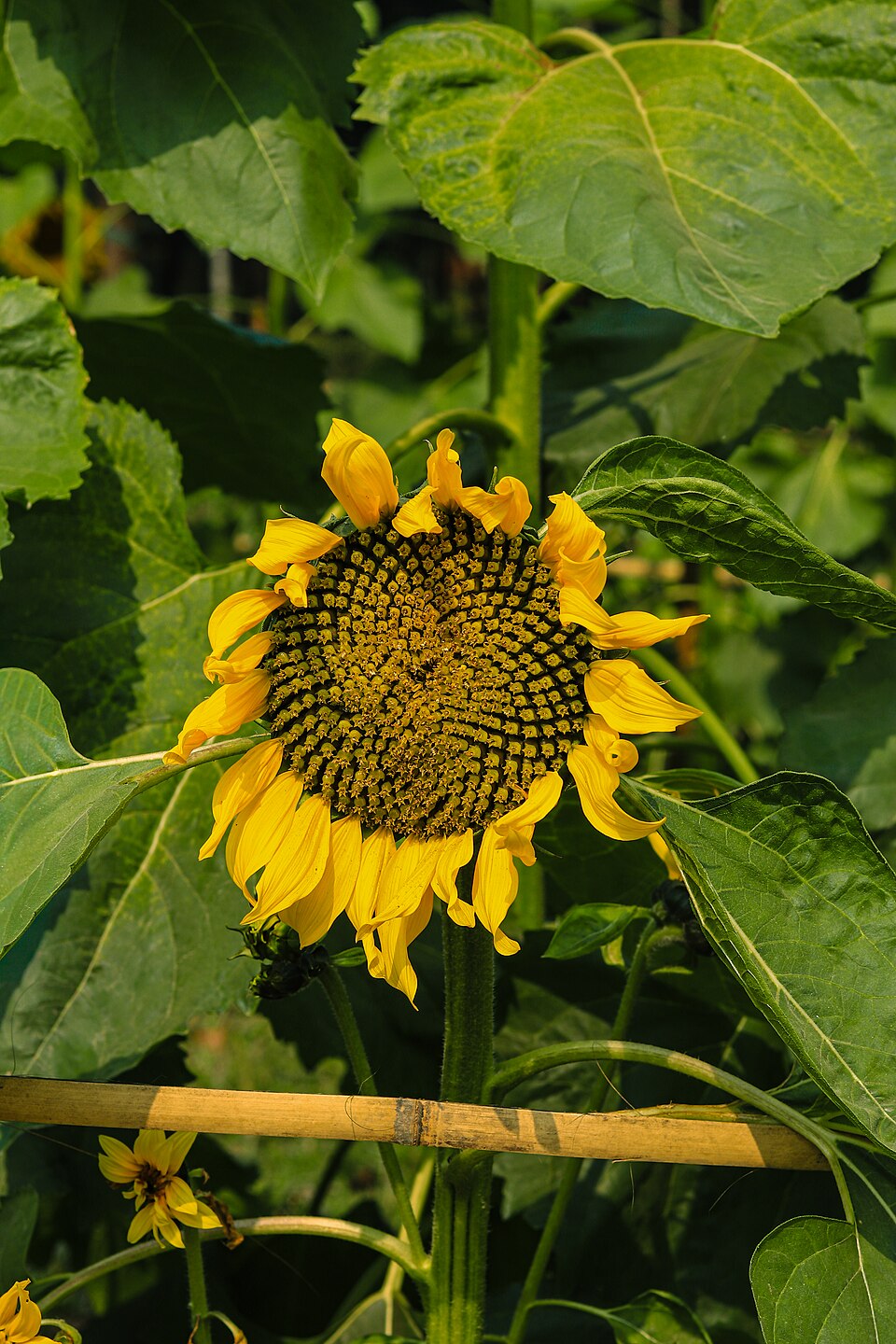
Correct — B, Inflorescence. What looks like one large flower on a sunflower or a marigold is a head, or capitulum — a compact inflorescence carrying many tiny flowers called florets on a common flattened base. The showy outer florets, the ray florets, supply the display, while the crowded central disc florets are the ones that set seed. Botanically each floret is a complete flower, so the colourful structure is a cluster of flowers and not a single one.
Why the others are wrong
- (a)Flower — This is the everyday answer and the trap. A single flower has one set of floral parts; the sunflower head has hundreds of complete little flowers packed together, each capable of producing its own seed.
- (c)Fruit — The fruit develops only after fertilisation, from the ovary of each floret. It appears later and is not the colourful part that attracts pollinators.
- (d)Seed — The seed develops from the ovule inside the ovary, again after fertilisation. The sunflower's seeds are what fill the centre of the head at the end of the season, not the display that opens it.
Concept
An inflorescence is the arrangement of flowers on the floral axis. In the daisy and sunflower family, Asteraceae — which includes marigold, sunflower, chrysanthemum and safflower — that arrangement is the capitulum, in which a great many stalkless florets sit on a flattened receptacle surrounded by green bracts, so that the whole head mimics a single large flower. Botanists call such an assembly a pseudanthium, a false flower. The advantage is that many small florets share one conspicuous advertisement and a visiting insect pollinates dozens at a time.
The question is testing a definition rather than a fact about a particular plant, so the reasoning is to ask how many complete flowers you are looking at. Once the head is opened, the answer is obvious — count the florets. Related structures worth keeping straight are the racemose and cymose types of inflorescence, and the special cases such as the fig's hypanthodium, where the flowers are enclosed inside a hollow receptacle, and the cyathium of Euphorbia.
Key facts
- An inflorescence is a cluster of flowers arranged on a common floral axis.
- The capitulum, or head, of sunflower and marigold packs many small florets on a flattened receptacle, so it is an inflorescence and not one flower.
- The outer ray florets provide the colourful display while the central disc florets are the chiefly seed-setting ones.
- Sunflower and marigold both belong to the family Asteraceae, whose members typically bear this head-type inflorescence.
Study next
Common traps
- Calling the whole sunflower head a single flower.
- Confusing the fruit and the seed, which appear only after fertilisation.
- Assuming the showy part of every plant is a petal — in some plants coloured bracts or sepals do the advertising.
NDA asks which structure a named plant's showy part really is, or for the part of the flower that a fruit or seed develops from.
Related PYQs
Which one of the following plants has unisexual flowers?
- (a) Papaya
- (b) Hibiscus
- (c) Mustard
- (d) Sunflower
Answer(a) Papaya
Another item that turns on looking closely at what a plant's flowers actually are, using the same set of familiar garden species.
After fertilization, the fruit and the seed are produced by
- (a) ovule and ovary, respectively
- (b) ovary and ovule, respectively
- (c) ovary, no ovule required
- (d) ovule, no ovary required
Answer(b) ovary and ovule, respectively
Settles the two distractors in this question by placing fruit and seed at the correct, post-fertilisation stage.
Practice
- practice — not a real PYQ
The capitulum type of inflorescence is characteristic of the family
- (a)Asteraceae
- (b)Fabaceae
- (c)Poaceae
- (d)Solanaceae
Answer(a) Asteraceae — the sunflower and daisy family, in which many florets sit together on a flattened head. - practice — not a real PYQ
After fertilisation in a flowering plant, the ovary and the ovule develop respectively into
- (a)seed and fruit
- (b)fruit and seed
- (c)fruit and flower
- (d)seed and embryo
Answer(b) fruit and seed — the ovary ripens into the fruit while each ovule inside it becomes a seed.