
Ten captive-bred Asian Giant Tortoises (Manouria emys), one of the largest tortoise species in mainland Asia, were recently released into which National Park of India?
- (a)Ntangki National Park
- (b)Periyar National Park
- (c)Pench National Park
- (d)Khangchendzonga National Park
Answer
Why
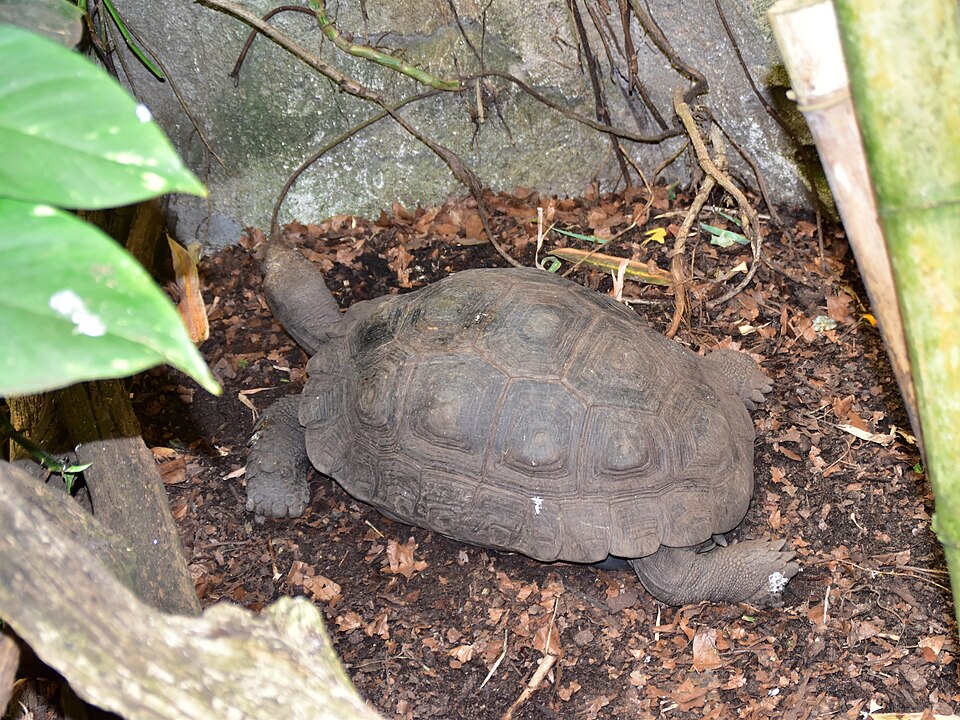
Correct: A, Ntangki National Park. On 19 December 2022 ten captive-bred juvenile Asian giant tortoises (Manouria emys) were soft-released inside Ntangki (also spelt Intanki) National Park in Peren district, Nagaland, in a joint operation by the Nagaland Forest Department, the Turtle Survival Alliance and Wildlife Conservation Society India. The animals were hatched in 2018 and reared for five years at the Nagaland Zoological Park, Dimapur, and weighed about 2.4 kg each at release; that zoo holds 110 hatchlings and juveniles bred from 13 adults, the largest captive holding of the species anywhere. 'Soft release' is the operative term: the juveniles were first moved into a large fenced enclosure of native habitat to acclimatise through the winter, to be allowed to disperse into the surrounding forest at the onset of the monsoon under active tracking by a joint project team, so that they develop site fidelity instead of wandering out of the protected area. The choice of park was not arbitrary. The subspecies that occurs in India, Manouria emys phayrei, ranges only from north-western Thailand across Myanmar to north-eastern India, so a rewilding release had to be made inside that natural range, and Ntangki, notified as a reserved forest in 1923, upgraded to a wildlife sanctuary of about 202 sq km in April 1975 and declared a national park in March 1993, sits in exactly the moist forest belt the tortoise needs. The species is listed Critically Endangered on the IUCN Red List, driven there mainly by over-exploitation for consumption; Nagaland's chief wildlife warden described this as a pilot release, the first step in repopulating the species in stages, with the project designed to generate the first baseline data for a long-term regional release strategy.
Why the others are wrong
- (b)Periyar National Park: Periyar lies in the Cardamom Hills of Idukki district, Kerala, on the other side of the subcontinent from this tortoise's range, and it is famous for a completely different set of animals: the elephant herds around Periyar lake, the tiger reserve declared in 1978, the Nilgiri tahr and the lion-tailed macaque. Manouria emys has never occurred in the Western Ghats. Periyar is a plausible-looking guess only because it is the Indian national park most students can name for wildlife tourism.
- (c)Pench National Park: Pench straddles Seoni and Chhindwara districts of Madhya Pradesh and continues into Maharashtra, in the dry-to-moist deciduous forests of the Satpura landscape that gave Kipling the setting for The Jungle Book. Central India does have a native tortoise (the Indian star tortoise, Geochelone elegans) and that association is what makes Pench tempting. But the star tortoise and the Asian giant tortoise are different animals with non-overlapping ranges, and no Manouria population exists in central India.
- (d)Khangchendzonga National Park: Khangchendzonga in Sikkim is the strongest-sounding north-eastern distractor, since it is in the same broad region and became India's first Mixed UNESCO World Heritage Site in 2016. It fails on altitude, not geography: the park climbs from roughly 1,200 m to the 8,586 m summit of Kanchenjunga, a high-Himalayan and alpine landscape of snow leopard and blue sheep. A lowland moist-forest tortoise cannot be rewilded there.
Concept
The Asian giant tortoise, Manouria emys, is the largest tortoise in mainland Asia; adults of the northern subspecies can reach about 25 kg in the wild. It is also, on molecular and morphological evidence, among the most primitive living tortoises (the genus Manouria is basal to the rest of the family Testudinidae) and it behaves unlike any other tortoise in one striking way: it is the only tortoise that lays its eggs above ground, the female raking leaf litter into a mound nest with her front and hind legs, laying up to 50 eggs inside it, then sitting on and near the nest and driving intruders off. It is largely herbivorous, feeding on fungi, shoots, ferns and especially Alocasia leaves in damp evergreen forest. Two subspecies are recognised: M. e. emys of southern Thailand, Malaysia, Sumatra and Borneo, and M. e. phayrei from north-western Thailand to north-eastern India. The species is recorded from Bangladesh, Cambodia, India, Indonesia, Malaysia, Myanmar, Thailand and Vietnam, and the IUCN Red List assessment of 2019 places it in the Critically Endangered category.
This question is answerable without having read the news item, and that is the skill to take from it. Three of the four parks can be struck out on distribution alone. Manouria emys is a lowland-to-hill evergreen forest animal of the Indo-Burma region, so Periyar in the Western Ghats and Pench in the Satpuras are outside its range by well over a thousand kilometres, and Khangchendzonga, though in the north-east, is a high-Himalayan park whose lowest reaches are already above the tortoise's habitat. That leaves Ntangki, in Nagaland, the only option lying inside the Indo-Burma forest belt where the phayrei subspecies actually lives. The single discriminating fact is therefore range, not the release date. It also pays to know the park by both spellings: the Commission wrote 'Ntangki', while the Nagaland Forest Department official quoted at the time gave his designation as director of 'Intanki' National Park, and a candidate who has only met one spelling can hesitate. Note finally that a captive-breeding release always happens inside the species' historical range; that rule alone converts many rewilding current-affairs questions into geography questions. One more thing is worth carrying away from Nagaland specifically. The threat here was hunting for food rather than habitat loss, and under Article 371A of the Constitution the ownership and transfer of land and its resources in Nagaland are governed by Naga customary law, so most forest outside the notified parks is community land. That is why the recovery project pairs the release with community awareness work instead of relying on enforcement alone: the same logic that puts village councils at the centre of the Amur falcon story in the same State.
Key facts
- Ten captive-bred juvenile Manouria emys were soft-released into Ntangki (Intanki) National Park, Peren district, Nagaland on 19 December 2022 by the Nagaland Forest Department with the Turtle Survival Alliance and Wildlife Conservation Society India
- The juveniles hatched in 2018 and were reared for five years at the Nagaland Zoological Park, Dimapur, averaging 2.4 kg at release; the zoo holds 110 hatchlings and juveniles bred from 13 adults, the largest captive holding of the species
- Ntangki National Park: notified as a reserved forest in 1923, declared Ntangki Wildlife Sanctuary of about 202 sq km in April 1975 and a national park in March 1993, covering roughly 200 sq km; the name comes from the Zeme dialect of the Zeliangrong Nagas
- Manouria emys is listed Critically Endangered on the IUCN Red List (2019 assessment) and is the largest tortoise in mainland Asia, adults of the northern subspecies reaching about 25 kg in the wild
- It is the only tortoise known to lay its eggs above ground, in a mound nest of leaf litter holding up to 50 eggs, which the female then guards: behaviour that makes nests unusually easy for people and predators to find
- The Indian subspecies is Manouria emys phayrei, ranging from north-western Thailand through Myanmar into north-eastern India, and named after Sir Arthur Purves Phayre, Commissioner of British Burma
- Other fauna recorded from Ntangki include the hoolock gibbon, golden langur, hornbills, Asian palm civet, black stork, tiger, python and sloth bear
- Nagaland's chief wildlife warden identified over-exploitation and unsustainable use for consumption as what pushed the species to the brink, and called the 2022 event a pilot release: the first step in repopulating the species in multiple stages
- The release is run under a Joint Asian Giant Tortoise Recovery Project intended to produce the first baseline information for a long-term monitoring and release strategy at regional scale, with community awareness work built into the programme
Study next
Common traps
- Confusing the Asian giant tortoise (Manouria emys, north-east India) with the Indian star tortoise (Geochelone elegans, dry peninsular and north-western India)
- Reading 'Ntangki' and 'Intanki' as two different parks: they are the same protected area in Peren district, Nagaland
- Assuming a north-eastern answer must be the most famous north-eastern park; Khangchendzonga is in the region but is alpine, and altitude rules it out
BPSC asks rewilding and species news as a straight one-line identification (which park, which state, which species) and rewards a candidate who reads a monthly current-affairs digest. UPSC almost never names the news event; it converts the same knowledge into a distribution or legal-status item, as in its 2013 question asking which of the star tortoise, monitor lizard, pygmy hog and spider monkey are naturally found in India, or its 2017 item on what Schedule I listing of a tortoise actually implies.
Related PYQs
Consider the following: 1. Star tortoise 2. Monitor lizard 3. Pygmy hog 4. Spider monkey Which of the above are naturally found in India?
- (a) 1, 2 and 3 only
- (b) 2 and 3 only
- (c) 1 and 4 only
- (d) 1, 2, 3 and 4
Answer(a) 1, 2 and 3 only
The same reasoning tool, and it even features a tortoise. UPSC's item is solved by asking where each animal naturally occurs and striking out the one that is out of range; that is precisely how three of the four parks fall away here.
In India, if a species of tortoise is declared protected under Schedule I of the Wild Life (Protection) Act, 1972, what does it imply?
- (a) It enjoys the same level of protection as the tiger.
- (b) It no longer exists in the wild, a few individuals are under captive protection; and now it is impossible to prevent its extinction.
- (c) It is endemic to a particular region of India.
- (d) Both (b) and (c) stated above are correct in this context.
Answer(a) It enjoys the same level of protection as the tiger.
The legal half of the same story, on the same animal group. A captive-breeding and release programme of the kind run at Dimapur only makes sense for a species carrying the highest tier of statutory protection, and UPSC's item tests exactly what that tier means.
Kanha National Park is established in -
- (a) Uttarakhand
- (b) Assam
- (c) Madhya Pradesh
- (d) Maharashtra
Answer(c) Madhya Pradesh
BPSC asking the same underlying thing two years later: place a named national park on the map of India. Whichever way the question is framed, the marks go to the candidate who has memorised park-to-State pairings rather than park names alone.
Practice
- practice, not a real PYQ
Ntangki National Park, in the news for the rewilding of the Asian giant tortoise, is located in which State?
- (a)Manipur
- (b)Nagaland
- (c)Meghalaya
- (d)Mizoram
Answer(b) Nagaland: Ntangki (Intanki) National Park is in Peren district, declared a national park in 1993. - practice, not a real PYQ
Which of the following is a distinctive nesting behaviour of the Asian giant tortoise (Manouria emys)?
- (a)It buries its eggs in riverine sand banks
- (b)It lays eggs above ground in a mound nest of leaf litter and guards it
- (c)It lays a single egg in a rock crevice
- (d)It deposits eggs in abandoned crocodile nests
Answer(b) It lays eggs above ground in a mound nest of leaf litter and guards it: the only tortoise known to do so, with clutches of up to 50 eggs.