
Kanha National Park is established in -
- (a)Uttarakhand
- (b)Assam
- (c)Madhya Pradesh
- (d)Maharashtra
Answer
Why
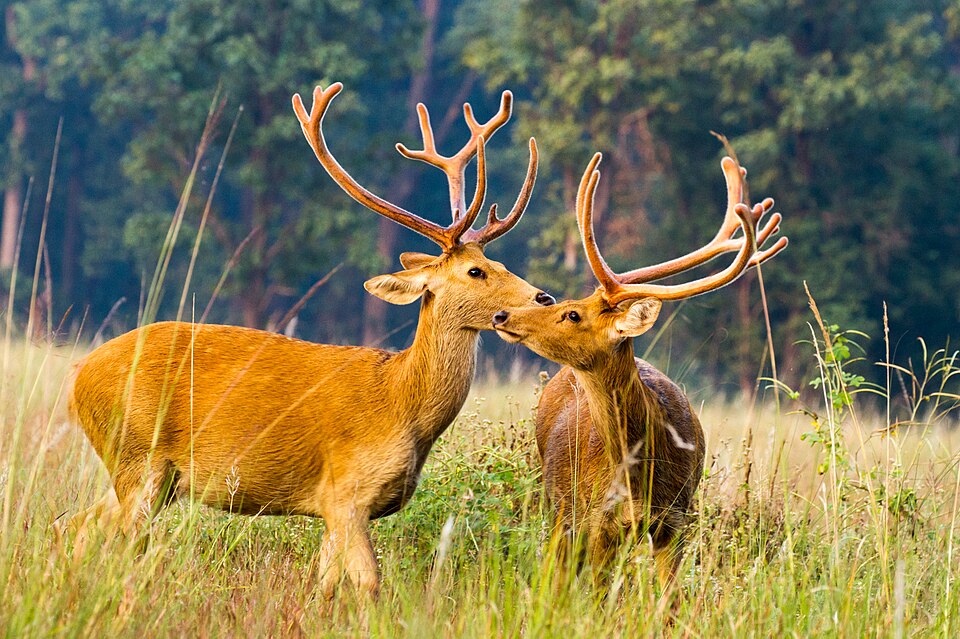
Correct — C, Madhya Pradesh. Kanha lies in the Mandla and Balaghat districts of Madhya Pradesh, on the Maikal range at the eastern end of the Satpuras. Its three legal identities arrived in stages worth memorising as a set: wildlife sanctuary in 1933, national park in 1955, and tiger reserve in 1973–74 as one of the nine reserves with which Project Tiger was launched. The national park covers 940 sq km out of two earlier sanctuaries, Hallon (about 250 sq km) and Banjar (about 300 sq km), created in 1933 and enlarged into the national park on 1 June 1955 — those two figures are the old sanctuary areas, not a partition of the present park, which makes it the largest national park in Madhya Pradesh; as a tiger reserve the notified area is far bigger — 917.43 sq km of core critical tiger habitat plus 1,134.36 sq km of buffer, 2,051.79 sq km in all. The 2022 All India Tiger Estimation counted 105 tigers inside it, and the park drew 213,804 visitors that year. What actually fixes Kanha in memory, though, is not the tiger but the deer. Kanha holds the world's only surviving population of the hard-ground barasingha, Rucervus duvaucelii branderi — a swamp deer that adapted to firm grassland instead of marsh and grazes on nothing but grass — and Kanha was the first Indian tiger reserve to adopt an official mascot, Bhoorsingh the Barasingha, precisely to advertise that recovery. Its sal and bamboo forests and open maidans sit in the Satpura–Maikal belt traditionally associated with Kipling's The Jungle Book, although Kipling set the stories in Seoni and never visited India's central highlands.
Why the others are wrong
- (a)Uttarakhand — Uttarakhand's flagship is Jim Corbett — India's oldest national park, notified in 1936 as Hailey National Park, and like Kanha one of the original nine Project Tiger reserves of 1973–74. A candidate who has filed 'the famous tiger park' under Corbett reaches for Uttarakhand on reflex.
- (b)Assam — Assam holds Kaziranga, the one-horned rhino stronghold and a World Heritage Site, and Manas, which is both a World Heritage Site and — exactly like Kanha — one of the nine original 1973–74 tiger reserves, with 58 tigers across 2,837.10 sq km in 2022. That shared vintage makes Manas an easy substitution for Kanha.
- (d)Maharashtra — Maharashtra's entry in the original nine was Melghat (57 tigers, 2,768.52 sq km), and its best-known park today is Tadoba-Andhari. Because Pench straddles the Madhya Pradesh–Maharashtra boundary inside the very same Satpura belt, anyone who places Kanha vaguely 'in central India' can slip one State south-west.
Concept
Kanha is a useful teaching case because it carries all three of India's protected-area labels at once, and they are not synonyms. A wildlife sanctuary is declared by a State government under the Wildlife (Protection) Act, 1972, and some private rights and regulated grazing can survive inside it. A national park is the stricter category under section 35 of the same Act: no grazing, and no rights of any person inside except as expressly permitted, with boundaries that cannot be altered except on a resolution of the State Legislature. A tiger reserve is a third and separate thing, created not by the original Act but by the 2006 amendment that placed the National Tiger Conservation Authority on a statutory footing — a State notifies a tiger reserve on the NTCA's recommendation, keeping a core or critical tiger habitat inviolate and managing a buffer zone for human–wildlife coexistence. That is why one forest can be a sanctuary from 1933, a national park from 1955 and a tiger reserve from 1973 with no contradiction at all, and why the figures differ so sharply: Kanha National Park is 940 sq km while Kanha Tiger Reserve is 2,051.79 sq km. Confusing the three is the commonest error in this whole section of the syllabus.
The identity anchor here is the deer, not the tiger. Every State in the option list owns a famous tiger park, so 'famous tiger reserve' discriminates nothing at all. The hard-ground barasingha does: that subspecies survives in exactly one place on earth, and once you have chained barasingha → Kanha → Mandla and Balaghat, Madhya Pradesh follows without further thought. The second anchor is worth learning as a block, because both BPSC and UPSC mine it repeatedly — the nine reserves with which Project Tiger began in 1973–74 were Bandipur in Karnataka, Corbett in Uttarakhand, Kanha in Madhya Pradesh, Manas in Assam, Melghat in Maharashtra, Palamau in Jharkhand, Ranthambore in Rajasthan, Similipal in Odisha and Sunderbans in West Bengal. Notice what that reveals about this question: three of its four options appear in the list with a different park attached — Corbett for Uttarakhand, Manas for Assam, Melghat for Maharashtra. The distractors were built out of the very list that solves the question. Learn the nine as State–park pairs and the item collapses in seconds, which matters because a wrong answer costs 1⅓ marks under BPSC's +1 / −⅓ scheme.
Key facts
- Kanha lies in Mandla and Balaghat districts of Madhya Pradesh, on the Maikal range at the eastern end of the Satpuras; sanctuary 1933, national park 1955, tiger reserve 1973–74, and at 940 sq km it is the largest national park in the State.
- Kanha Tiger Reserve totals 2,051.79 sq km — 917.43 sq km of core critical tiger habitat plus 1,134.36 sq km of buffer — and held 105 tigers in the 2022 All India Tiger Estimation.
- It is the only home of the hard-ground barasingha (Rucervus duvaucelii branderi), an exclusively grass-eating swamp deer, and was the first Indian tiger reserve to adopt a mascot, Bhoorsingh the Barasingha.
- The nine original Project Tiger reserves of 1973–74, with their States: Bandipur (Karnataka), Corbett (Uttarakhand), Kanha (Madhya Pradesh), Manas (Assam), Melghat (Maharashtra), Palamau (Jharkhand), Ranthambore (Rajasthan), Similipal (Odisha) and Sunderbans (West Bengal).
- The park grew out of the Hallon (about 250 sq km) and Banjar (about 300 sq km) sanctuaries of 1933 and was constituted a national park on 1 June 1955; those two areas sum to 550 sq km and so do not partition today's 940 sq km park; it recorded 213,804 visitors in 2022, and its other large mammals include the Bengal tiger, Indian leopard, sloth bear and dhole.
Study next
Common traps
- Treating 'national park' and 'tiger reserve' as the same notification — Kanha National Park is 940 sq km while Kanha Tiger Reserve is 2,051.79 sq km, and the dates differ by eighteen years
- Confusing Kanha with Kaziranga because the names begin alike — Kaziranga is in Assam and is a rhino park, not a barasingha park
- Placing Kanha in Maharashtra because Pench spans the Madhya Pradesh–Maharashtra border in the same Satpura landscape
BPSC asks this in its barest possible form — park in, State out, one mark, ten seconds — and repeats the pattern across Kaziranga, Gir, Corbett and Bihar's own Valmiki. UPSC has never asked where Kanha is; in 2020 it inverted the question and asked which protected area conserves the hard-ground barasingha, so it tests species-to-park while BPSC tests park-to-State.
Related PYQs
Which one of the following protected areas is well-known for the conservation of a sub-species of the Indian swamp deer (Barasingha) that thrives well on hard ground and is exclusively graminivorous?
- (a) Kanha National Park
- (b) Manas National Park
- (c) Mudumalai Wildlife Sanctuary
- (d) Tal Chhapar Wildlife Sanctuary
Answer(a) Kanha National Park
The same park reached from the opposite direction — UPSC gives you the hard-ground barasingha and asks for the park, BPSC gives you the park and asks for the State; either way the barasingha is the fact that unlocks Kanha.
Consider the following pairs : 1. Dampa Tiger Reserve : Mizoram 2. Gumti Wildlife Sanctuary : Sikkim 3. Saramati Peak : Nagaland Which of the above pairs is/are correctly matched?
- (a) 1 only
- (b) 2 and 3 only
- (c) 1 and 3 only
- (d) 1, 2 and 3
Answer(c) 1 and 3 only
Exactly the skill BPSC is testing — attach a named protected area to the right State — only stacked three-deep so that one wrong pairing (Gumti is in Tripura, not Sikkim) sinks the whole answer.
Practice
- practice — not a real PYQ
The hard-ground Barasingha, a sub-species of the Indian swamp deer, is conserved mainly in which National Park ?
- (a)Bandhavgarh National Park
- (b)Kanha National Park
- (c)Dudhwa National Park
- (d)Kaziranga National Park
Answer(b) Kanha National Park — the hard-ground subspecies Rucervus duvaucelii branderi survives only at Kanha in Madhya Pradesh; Dudhwa holds a different, wetland-dwelling swamp deer subspecies. - practice — not a real PYQ
Which one of the following was NOT among the nine tiger reserves with which Project Tiger was launched in 1973-74 ?
- (a)Melghat
- (b)Similipal
- (c)Valmiki
- (d)Palamau
Answer(c) Valmiki — Bihar's Valmiki was brought under Project Tiger only in 1989-90, as India's 18th tiger reserve; Melghat, Similipal and Palamau were all in the original nine of 1973-74.