
Which one of the following pairs is correctly matched? Bhakti Saint Philosophy
- (a)Shankara : Avadhuta
- (b)Ramananda : Kevaladvaita
- (c)Ramanuja : Vishishtadvaita
- (d)Chaitanya : Advaita
Answer
Why
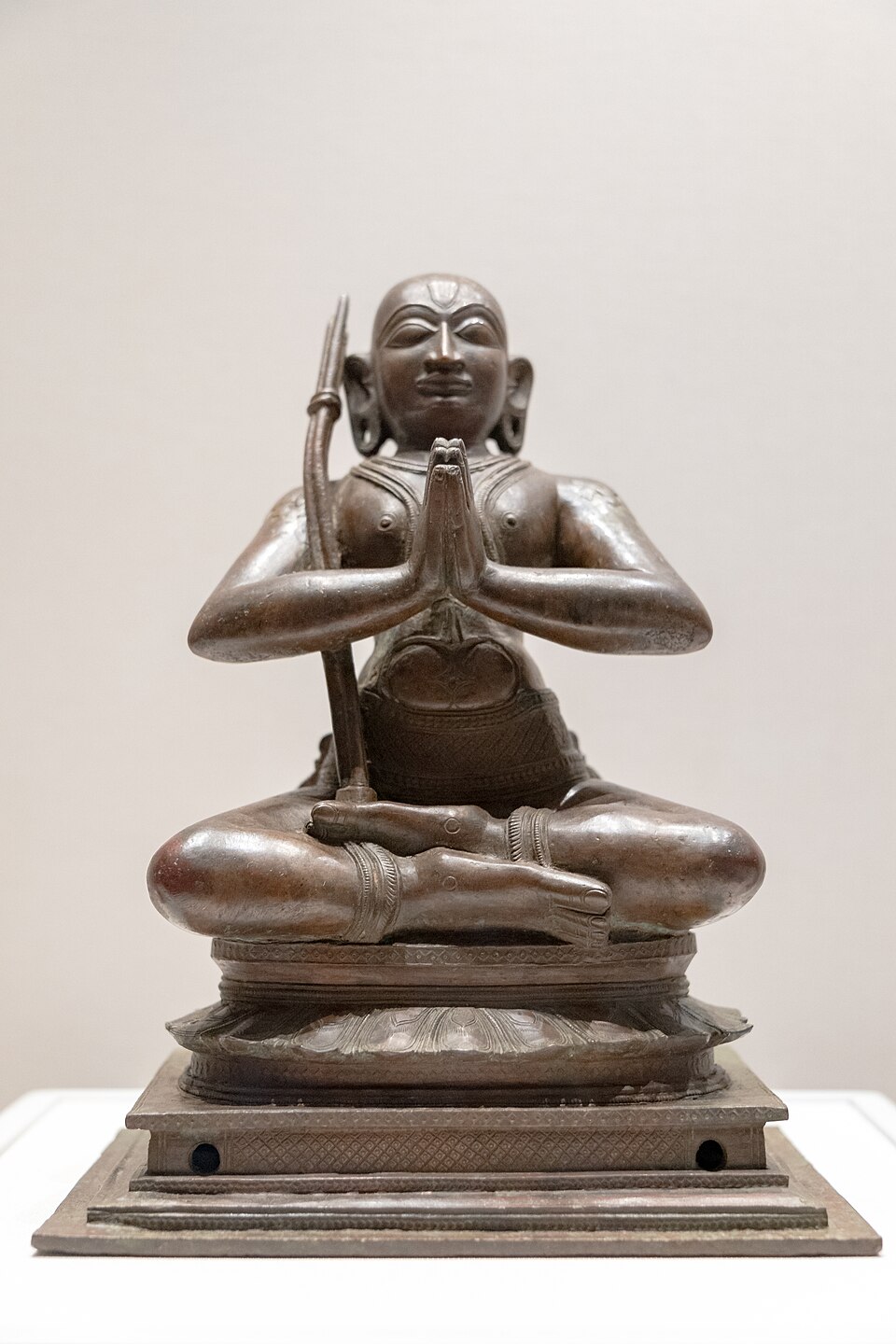
Correct: C, Ramanuja and Vishishtadvaita. Ramanuja, the eleventh-century Tamil teacher of the Srivaishnava tradition, is the chief exponent of Vishishtadvaita, usually translated as qualified non-dualism. His position is that matter, individual souls and Brahman are all equally real, and that souls are inseparable from Brahman yet never dissolve into it: Brahman is one, but one with qualification. That is what the Sanskrit name literally says, vishishta meaning qualified, so the pair almost checks itself. Each of the other three pairs takes a real teacher and hands him a label belonging to somebody else, or to no school at all.
Why the others are wrong
- (a)Shankara : Avadhuta: Adi Shankara's school is Advaita: absolute non-dualism, in which Brahman alone is ultimately real. Avadhuta is not a school of philosophy at all; the word names a type of realised ascetic who lives beyond ordinary social convention, and it belongs mainly to Shaiva and Natha usage rather than to Vedanta.
- (b)Ramananda : Kevaladvaita: Kevaladvaita is simply another name for Shankara's Advaita, and Ramananda taught the opposite of it. He was trained in Ramanuja's Vishishtadvaita line (his guru Raghavananda belonged to that school) and he went on to found the Ramanandi Sampradaya in the north.
- (d)Chaitanya : Advaita: Chaitanya Mahaprabhu is the chief proponent of Achintya Bheda Abheda, inconceivable difference in non-difference, and the founder of Gaudiya Vaishnavism. The accounts of his life show him arguing against followers of Advaita Vedanta rather than counting himself among them.
Concept
Vedanta is not one philosophy but a family of readings of the same three foundational texts, and each reading is remembered by a school name attached to one teacher. Shankara's Advaita treats Brahman as the sole reality. Ramanuja's Vishishtadvaita accepts Brahman as one but insists that souls and matter are real modes of it, which is what makes personal devotion meaningful. Madhva's Dvaita separates soul and God outright. Chaitanya's Achintya Bheda Abheda holds difference and non-difference together as a relation the mind cannot fully resolve.
The trick in this item is that every label printed is a genuine term, so it cannot be solved by spotting nonsense: three of them are simply attached to the wrong man. The fastest route is the Sanskrit. Vishishta means qualified, and qualified non-dualism is exactly the position Ramanuja is known for, so option (c) can be confirmed without touching the others. One honest observation about the printed stem: the heading calls all four figures Bhakti Saints, which fits Ramananda and Chaitanya comfortably and Ramanuja reasonably, but stretches for Shankara, who is remembered as a Vedanta acharya rather than as a bhakti poet. That looseness in the heading does not affect the answer.
Key facts
- Ramanuja, traditionally dated 1017–1137 CE, is the chief proponent of the Vishishtadvaita school of Vedanta.
- Vishishtadvaita holds that material objects, conscious souls and Brahman are all real, with souls remaining eternally distinct from Brahman though never separate from it.
- Adi Shankara's school is Advaita, also called Kevaladvaita, in which Brahman alone is ultimately real.
- Chaitanya Mahaprabhu (1486–1534) founded Gaudiya Vaishnavism and taught Achintya Bheda Abheda.
- Ramananda, who stood in Ramanuja's line, founded the Ramanandi Sampradaya; Kabir and Ravidas are counted among his disciples.
Study next
Common traps
- Handing Advaita to Ramanuja because both names begin the same way; Advaita is Shankara's.
- Treating Kevaladvaita as a fifth school when it is only another name for Shankara's Advaita.
- Assuming every figure listed under a Bhakti heading is a bhakti poet: Shankara is a Vedanta acharya, and this paper's heading stretches to accommodate him.
Asked as a one-line pair-matching item in which three real philosophical labels are attached to the wrong teacher.
Related PYQs
Which one of the following sequences indicates the correct chronological order?
- (a) Shankaracharya - Ramanuja - Chaitanya
- (b) Ramanuja - Shankaracharya - Chaitanya
- (c) Ramanuja - Chaitanya - Shankaracharya
- (d) Shankaracharya - Chaitanya - Ramanuja
Answer(a) Shankaracharya - Ramanuja - Chaitanya
The same three teachers, asked for their order in time rather than their schools. Shankara around 800 CE, Ramanuja in the eleventh and twelfth centuries, Chaitanya in the late fifteenth: the chronology and the school labels are worth learning together.
Which of the following statements about Saguna bhakti traditions is/are correct? 1. Saguna bhakti traditions focus on the worship of specific deities such as Vishnu or his avatars. 2. In Saguna bhakti traditions, Gods and Goddesses are conceptualised in anthropomorphic forms. Select the correct answer using the code given below:
- (a) 1 only
- (b) 2 only
- (c) Both 1 and 2
- (d) Neither 1 nor 2
Answer(c) Both 1 and 2
Goes at the devotional side of the same divide. Ramanuja's insistence that souls and the world are real is precisely what gives a saguna, form-bearing deity something to be devoted to, which is why the Vaishnava bhakti of Ramananda and Chaitanya grew out of his line rather than Shankara's.
Practice
- practice, not a real PYQ
The doctrine of Achintya Bheda Abheda, inconceivable difference in non-difference, is associated with
- (a)Adi Shankara
- (b)Ramanuja
- (c)Madhvacharya
- (d)Chaitanya Mahaprabhu
Answer(d) Chaitanya Mahaprabhu: the founder of Gaudiya Vaishnavism, who held difference and non-difference between the soul and God to be simultaneously true. - practice, not a real PYQ
Which one of the following schools of Vedanta holds that Brahman alone is ultimately real and the perceived world is not?
- (a)Advaita
- (b)Vishishtadvaita
- (c)Dvaita
- (d)Shuddhadvaita
Answer(a) Advaita: Shankara's absolute non-dualism, against which Ramanuja's qualified position was framed.