
Consider the following statements about merchant guilds of South India : 1. Ayyavole merchant guild was originally established in Aihole. 2. Manigraman merchant guild was subordinated to the Anjuvannam merchant guild in the 13th century. Which of the statements given above is/are correct?
- (a)1 only
- (b)2 only
- (c)Both 1 and 2
- (d)Neither 1 nor 2
Answer
Why
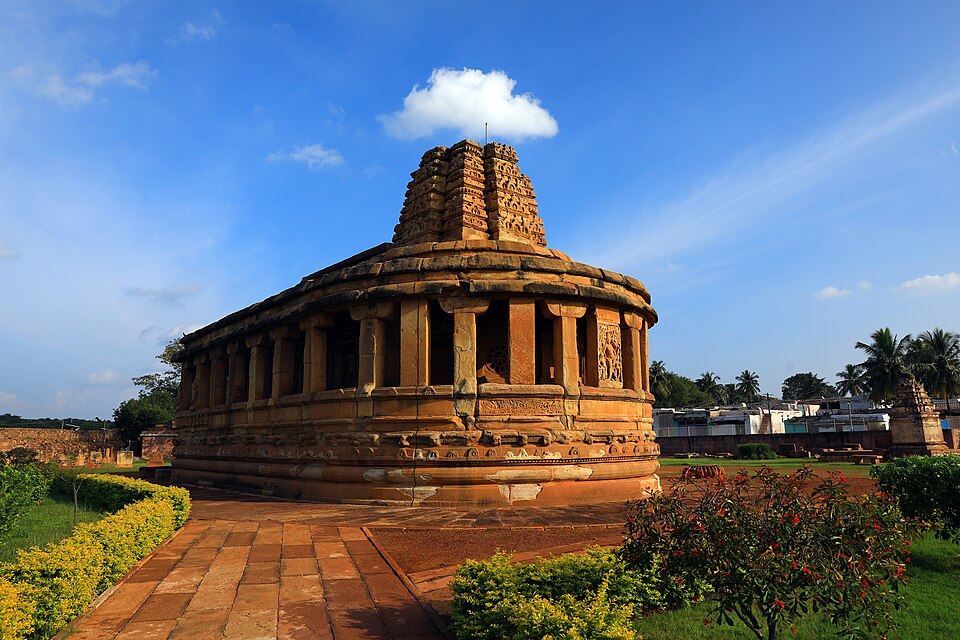
Correct: A, 1 only. The first statement is sound. The Ayyavole guild, known also as the Ainurruvar or the Five Hundred, takes its name from Ayyavolepura, the old name of Aihole in Karnataka, the former Chalukya town that historical texts of the Deccan and South India remember as a hub of artisans and merchants. The second statement is where the paper plants its error, and it is an error of one word. Manigramam was indeed subordinated in the thirteenth century, but to the Ayyavole, not to the Anjuvannam. By the twelfth century the Ainurruvar had grown into an umbrella organisation that took in the other merchant bodies, and both the Manigramam and the Anjuvannam were eventually absorbed into it. Swapping the senior guild for a junior one makes statement 2 false, so only the first stands.
Why the others are wrong
- (b)2 only: This rejects the well-attested link between the Ayyavole guild and Aihole while accepting the one claim in the pair that names the wrong guild. It reverses the truth of both statements.
- (c)Both 1 and 2: It is the option a candidate reaches for on recognising that both sentences sound like real history. They do, but the subordination in the thirteenth century was to the Ayyavole, so the second statement misnames the guild that did the absorbing.
- (d)Neither 1 nor 2: Statement 1 is correct, so this cannot be right. Aihole and Ayyavole are the same place under two names, which is why the guild carries the town's name.
Concept
Early medieval South India had powerful merchant corporations that operated across kingdoms and across the sea. The Ayyavole or Ainurruvar was the largest, an itinerant body that grew into a community out of its own operations and eventually functioned as an umbrella for the rest. The Manigramam traded in both port towns and inland centres, while the Anjuvannam was confined to the port towns and is generally associated with West Asian merchant communities settled on the coast. Inscriptions record the Anjuvannam being patronised by the Ayyavole and even treated as members of it.
Two-statement questions of this kind are usually decided by a single word, and here that word is Anjuvannam. A candidate who knows only that the Ainurruvar became the umbrella body in the twelfth century can see at once that a smaller port-town guild cannot have taken over another guild in the thirteenth. The pattern is worth internalising: examiners rarely invent a fact out of nothing, they take a true sentence and change one name in it. As for the spelling, the paper prints 'Manigraman' where the guild is more usually written Manigramam, a variant that does not affect the answer. These guilds matter beyond the trivia: the Chola-period expansion of maritime trade with Southeast Asia was carried on their networks.
Key facts
- The Ayyavole or Ainurruvar guild, the Five Hundred, takes its name from Ayyavolepura, the old name for Aihole in Karnataka.
- By the twelfth century the Ainurruvar functioned as an umbrella organisation encompassing the other merchant guilds.
- The Manigramam was fully subordinated to the Ayyavole by the thirteenth century, not to the Anjuvannam.
- Unlike the Anjuvannam, which was confined to the port towns of southern India, the Manigramam operated in both port towns and inland trade centres.
Study next
Common traps
- Accepting a statement because every proper noun in it is genuine; here all three guild names are real and only their relationship is wrong.
- Confusing Anjuvannam with Ainurruvar: similar-sounding names for very different bodies.
- Treating the guilds as purely local; the Ayyavole operated across kingdoms and overseas.
Asked as a two-statement item where the false statement is produced by substituting one guild's name for another.
Related PYQs
With reference to the guilds (Shreni) of ancient India that played a very important role in the country's economy, which of the following statements is/are correct? 1. Every guild was registered with the central authority of the State and the king was the chief administrative authority on them. 2. The wages, rules of work, standards and prices were fixed by the guild. 3. The guild had judicial powers over its own members.
- (a) 1 and 2 only
- (b) 3 only
- (c) 2 and 3 only
- (d) 1, 2 and 3
Answer(c) 2 and 3 only
Sets out what an Indian guild actually was and did: self-regulating on wages, standards and prices, and holding judicial authority over its own members rather than being an arm of the state. That autonomy is what allowed a body like the Ayyavole to absorb others.
Practice
- practice, not a real PYQ
The merchant guild known as the Ainurruvar or the Five Hundred is more commonly referred to as
- (a)Manigramam
- (b)Anjuvannam
- (c)Ayyavole
- (d)Nagaram
Answer(c) Ayyavole: named after Ayyavolepura, the old name of Aihole in Karnataka, from which the guild took its title. - practice, not a real PYQ
Which of the following distinguishes the Manigramam from the Anjuvannam?
- (a)The Manigramam operated only overseas
- (b)The Manigramam operated in both port towns and inland trade centres
- (c)The Manigramam was a guild of weavers rather than merchants
- (d)The Manigramam was confined to the Deccan plateau
Answer(b) The Manigramam operated in both port towns and inland trade centres: the Anjuvannam, by contrast, was confined to the port towns of southern India.