
When did the Stamp Act Congress consisting of delegates from 9 of the 13 colonies of America meet in New York City?
- (a)1763
- (b)1764
- (c)1765
- (d)1766
Answer
Why
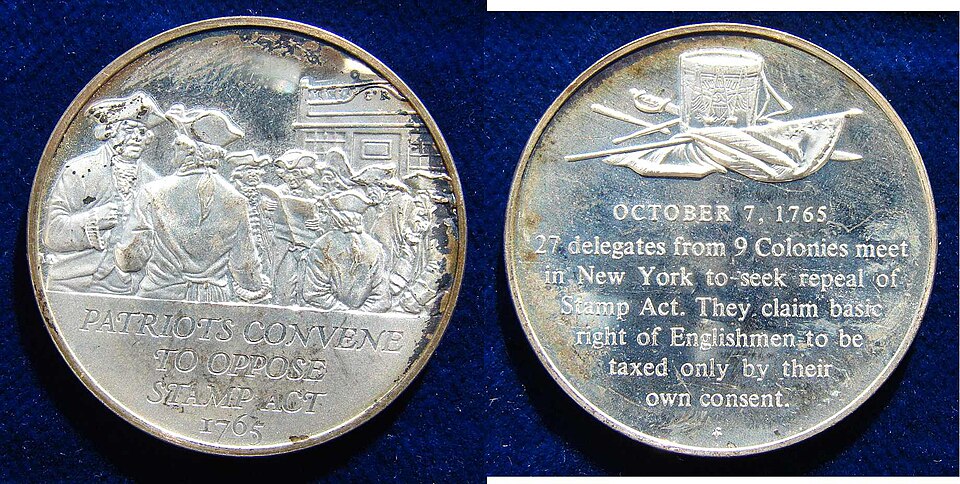
Correct: C, 1765. The Stamp Act Congress sat at City Hall in New York from 7 to 25 October 1765, with delegates from nine of the thirteen colonies. It met in the same year the Act was passed and before the duty was to take effect on 1 November, which is the whole point of the timing: the colonies wanted their protest on record while the law was still only on paper. On 19 October the Congress adopted a Declaration of Rights and Grievances and sent petitions to the House of Lords, the House of Commons and King George III. It was the first time delegates from a majority of the colonies had assembled to act together against a measure of the British Parliament, and that habit of meeting is what later produced the Continental Congresses.
Why the others are wrong
- (a)1763: 1763 is the year the Seven Years' War ended and the Royal Proclamation was issued. The war debt it left behind is the reason Britain began taxing the colonies at all, but no colonial congress met in that year.
- (b)1764: 1764 belongs to the Sugar Act, the earlier revenue measure. Grenville signalled in that year that a stamp duty was coming, so 1764 is where the quarrel begins, but the Act itself, and the Congress that answered it, both fall in 1765.
- (d)1766: 1766 is the year the protest succeeded: Parliament repealed the Stamp Act on 18 March 1766 while simultaneously passing the Declaratory Act, asserting its right to legislate for the colonies in all cases whatsoever. By then the Congress had met and dispersed.
Concept
The Stamp Act required that printed material in the American colonies (newspapers, pamphlets, legal documents, playing cards) be produced on paper carrying an embossed revenue stamp, payable in British currency. It was the first direct internal tax Parliament had imposed on the colonies, and that is what made it constitutionally explosive rather than merely expensive. The colonial argument was not that the sum was large but that a legislature in which they had no members could not tax them, which is the argument compressed into the slogan about taxation and representation.
Four consecutive years are offered, so the item is really asking whether a candidate can order the sequence rather than recall a single date. The sequence runs cleanly: 1763 the peace and the debt, 1764 the Sugar Act, 1765 the Stamp Act and the Congress that answered it, 1766 the repeal. Anchoring the Act and its Congress to the same year is the safest hold, because a protest congress convened over a tax naturally meets while the tax is fresh. Note also that the stem's own detail helps: nine of thirteen colonies is a fact about the 1765 gathering specifically, not about the later Continental Congresses.
Key facts
- The Stamp Act Congress met at City Hall in New York City from 7 to 25 October 1765.
- Delegates from nine of the thirteen colonies attended.
- It adopted a Declaration of Rights and Grievances on 19 October 1765 and petitioned the Lords, the Commons and the King.
- The Stamp Act was to come into force on 1 November 1765 and was repealed on 18 March 1766, alongside the Declaratory Act.
Study next
Common traps
- Confusing the Stamp Act Congress of 1765 with the First Continental Congress, which met at Philadelphia in September 1774.
- Reading 1766 as the answer because it is the year most often remembered, that is the repeal, not the meeting.
- Assuming all thirteen colonies took part; only nine sent delegates in 1765.
Asked as a bare-date item with four consecutive years, so the sequence of events matters more than the isolated fact.
Related PYQs
Which of the following was/were among the decisions taken by the First Continental Congress held in Philadelphia in September 1774 ? 1. It rejected a plan for a colonial union under the British authority. 2. It drew up a statement of grievances. 3. It agreed upon a scheme to stop trade between the Colonies and England. Select the correct answer using the code given below :
- (a) 1 and 3 only
- (b) 2 only
- (c) 1 and 2 only
- (d) 1, 2 and 3
Answer(d) 1, 2 and 3
The gathering that grew out of the habit the Stamp Act Congress began. Both drew up a statement of grievances; the 1774 body went further and agreed to stop trade. Keeping 1765 New York and 1774 Philadelphia apart is exactly what this pair of questions rewards.
Consider the following statements concerning the American War of Independence: 1. The Americans raised the slogan, 'No taxation without representation'. 2. The American merchants resorted to the boycott of the British products. Select the correct answer using the code given below:
- (a) 1 only
- (b) 2 only
- (c) Both 1 and 2
- (d) Neither 1 nor 2
Answer(c) Both 1 and 2
Names the constitutional argument the Stamp Act Congress put into formal words, and the commercial weapon (non-importation) that actually forced the repeal in 1766.
Practice
- practice, not a real PYQ
The Stamp Act imposed on Britain's American colonies was repealed in the year
- (a)1764
- (b)1765
- (c)1766
- (d)1770
Answer(c) 1766: repealed on 18 March 1766, though Parliament passed the Declaratory Act on the same day to assert its authority. - practice, not a real PYQ
The slogan 'No taxation without representation' was raised by the colonists against
- (a)the British Parliament
- (b)the Continental Congress
- (c)the Estates-General of France
- (d)the Dutch States General
Answer(a) the British Parliament: the objection was that a legislature containing no colonial members could not levy an internal tax on the colonies.