
Which one of the following types of cloud is characterized by continuous precipitation?
- (a)Cirrocumulus
- (b)Cumulus
- (c)Nimbostratus
- (d)Cumulonimbus
Answer
Why
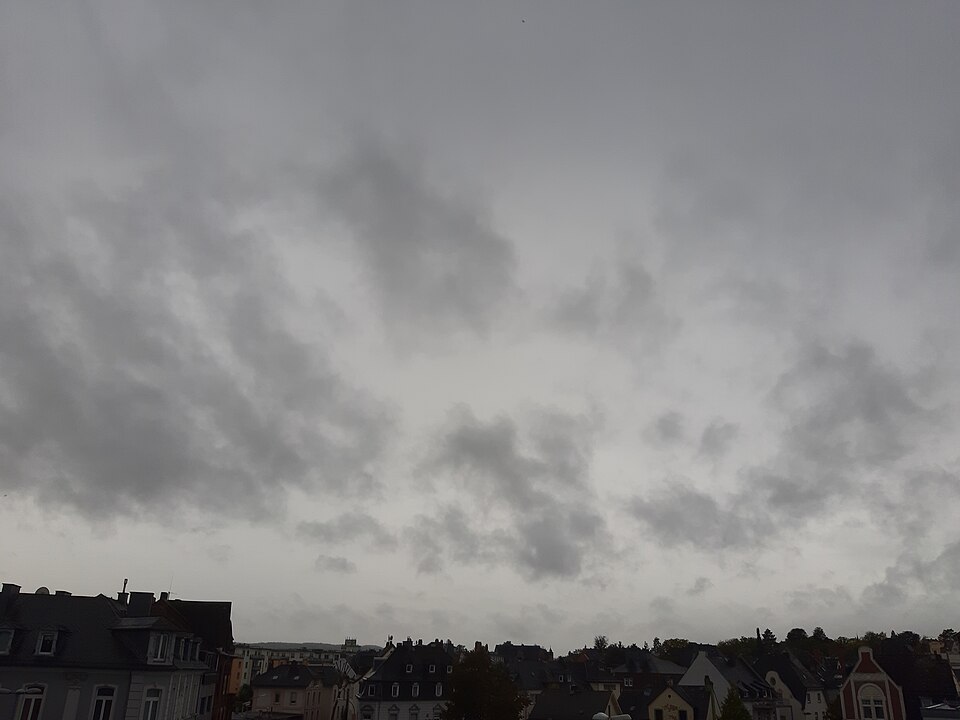
Correct: C, nimbostratus. Cloud names are built from a small vocabulary, and reading them settles most questions of this kind: cirrus means a wispy high cloud, cumulus a heaped cloud, stratus a flat layer, alto a middle height, and nimbus rain. Nimbostratus is therefore the rain-bearing layer cloud: a thick, uniform, featureless grey sheet that spreads over the whole sky, blots out the Sun and gives steady rain or snow for hours at a stretch. That continuity is the point of the question. Layer clouds form when a large mass of air is lifted gently over a wide area, typically along a warm front, so the precipitation they yield is light to moderate but persistent.
Why the others are wrong
- (a)Cirrocumulus: A high cloud of small white flakes, forming the mackerel sky, made of ice crystals at great altitude. Cirrus-family clouds are far too thin and too high to precipitate anything that reaches the ground; they are read as a sign of an approaching change of weather, not as a source of rain.
- (b)Cumulus: The detached, flat-based, cauliflower-topped fair-weather cloud of a summer afternoon. Ordinary cumulus is a convection cloud with clear sky between one cloud and the next, and it gives no precipitation at all unless it grows far taller.
- (d)Cumulonimbus: This is the sharpest distractor, because it does carry the nimbus root and it certainly rains. But a cumulonimbus is the towering thunderstorm cloud, and its rain is the opposite of continuous: it is a violent downpour over a small area for a short time, often with hail, lightning and squalls, and then it is over. The word the question uses, continuous, is what separates the two.
Concept
Clouds are classified by height and by form. By height they are high (cirrus, cirrostratus, cirrocumulus), middle (altostratus, altocumulus) and low (stratus, stratocumulus, nimbostratus), with cumulus and cumulonimbus growing vertically through all three levels. By form they are either heaped clouds produced by convection or layer clouds produced by the slow, widespread lifting of a stable air mass. That distinction controls the rainfall: convective clouds give short, heavy, localised showers, and layer clouds give light, steady, widespread precipitation. The root nimbus, added to either family, marks the two that actually rain: nimbostratus and cumulonimbus.
Options (c) and (d) both rain, so the item is decided by one adjective in the stem rather than by cloud knowledge in general. Continuous points to the layer cloud; intermittent, heavy or accompanied by thunder would point to the towering one. A useful physical picture is that nimbostratus rain comes from a warm front, where a warm air mass slides slowly up a shallow slope over cold air across hundreds of kilometres, while cumulonimbus rain comes from a single violently rising column. It is also worth remembering that nimbostratus blocks the Sun completely, whereas even a thick altostratus lets the Sun through as a dim watery disc: a distinction often used to identify the two in the field.
Key facts
- Nimbostratus is a thick, dark, featureless layer cloud that gives continuous rain or snow over a wide area.
- The root nimbus means rain, so the two precipitating types are nimbostratus and cumulonimbus.
- Cumulonimbus is the thunderstorm cloud and gives short, heavy, localised downpours with lightning and sometimes hail.
- Cirrus-family clouds, including cirrocumulus, are high ice-crystal clouds and give no precipitation that reaches the ground.
Study next
Common traps
- Choosing cumulonimbus because it is the cloud most associated with rain. Its rain is heavy and brief, not continuous.
- Assuming a large cloud must precipitate. Cirrocumulus covers much of the sky and yields nothing.
- Forgetting that the nimbus root is what marks a rain cloud; a name without it rarely precipitates.
NDA asks which cloud is rain-bearing, at what height a named cloud forms, or which cloud goes with a described kind of rainfall.
Related PYQs
Consider the following climatic and geographical phenomena: 1. Condensation 2. High temperature and humidity 3. Orography 4. Vertical wind Thunder-cloud development is due to which of these phenomena?
- (a) 1 and 2
- (b) 2, 3 and 4
- (c) 1, 3 and 4
- (d) 1, 2, 3 and 4
Answer(d) 1, 2, 3 and 4
Builds this card's other rain cloud from its ingredients: the thunder cloud needs strong vertical motion and heat, which is exactly the machinery that nimbostratus, formed by gentle widespread lifting, does not have.
Which one of the following clouds is a rain-bearing cloud?
- (a) Cumulus cloud
- (b) Stratus cloud
- (c) Nimbus cloud
- (d) Cirrus cloud
Answer(c) Nimbus cloud
The same naming rule stripped to its bare form, which is the shortcut this card's answer depends on.
According to the Indian Meteorological Department, which of the following is/are the feature/features of cloudburst? 1. Heavy precipitation in short period of time in a limited geographical area 2. It occurs generally during monsoon period and triggers flash flood and landslides Select the correct answer using the code given below.
- (a) 1 only
- (b) 2 only
- (c) Both 1 and 2
- (d) Neither 1 nor 2
Answer(c) Both 1 and 2
The extreme case of the convective rainfall this card contrasts with nimbostratus: enormous intensity, tiny area, very short duration.
Practice
- practice, not a real PYQ
Which cloud is associated with thunderstorms, lightning and short heavy downpours?
- (a)Nimbostratus
- (b)Cumulonimbus
- (c)Cirrostratus
- (d)Altocumulus
Answer(b) Cumulonimbus: the towering convective cloud whose rain is intense but brief and localised. - practice, not a real PYQ
The prefix 'cirro-' in a cloud name indicates that the cloud is
- (a)a low layer cloud
- (b)a rain-bearing cloud
- (c)a high cloud made of ice crystals
- (d)a cloud of vertical development
Answer(c) a high cloud made of ice crystals, which is why cirrus-family clouds do not give precipitation at the ground.