
Match List–I with List–II and select the correct answer using the code given below the Lists : List–I (Major Port) A. Kolkata B. Mormugao C. Visakhapatnam D. Paradip List–II (Location) 1. Landlocked area 2. In the delta region 3. On the riverside 4. On the entrance of the estuary Code : A B C D
- (a)3 1 4 2
- (b)3 4 1 2
- (c)2 4 1 3
- (d)2 1 4 3
Answer
Why
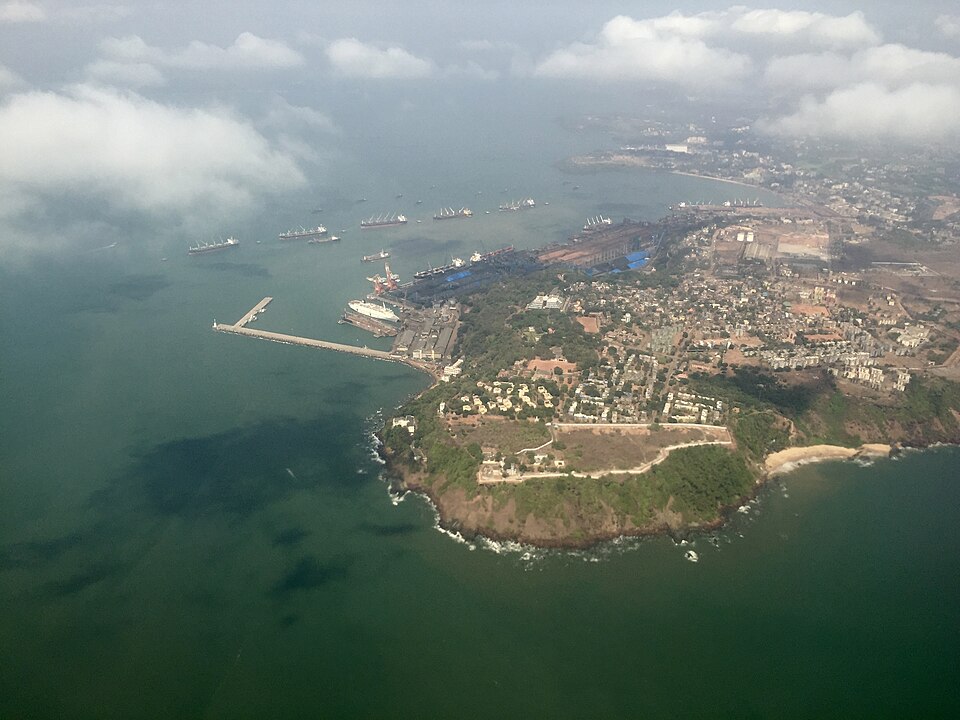
Correct: B, the code 3 4 1 2. Kolkata takes item 3 because it is the one major port of India that does not stand on the coast at all: it sits about 203 km up the Hooghly and is the country's only riverine major port, which is exactly what 'on the riverside' means. Mormugao takes item 4 because the Mandovi and the Zuari flush out into the Arabian Sea at one common point, and the harbour was built at that seaward mouth of the estuary. Visakhapatnam takes item 1 in the sense Indian geography textbooks use the word: its inner harbour lies behind the shoreline and is reached through a narrow entrance, so it is described as a land-locked harbour rather than an open roadstead; the NDA GAT used the very same pairing again in 2021. Paradip is left with item 2, and that is where it belongs, standing at the confluence of the Mahanadi and the Bay of Bengal in the river's delta.
Why the others are wrong
- (a)3 1 4 2: It gets Kolkata and Paradip right but swaps the two western and eastern harbours, making Mormugao the land-locked one and Visakhapatnam the estuary-mouth port. Mormugao is an open Arabian Sea harbour at the mouth of the Zuari, protected by a breakwater and a mole rather than by land, so it can never be the land-locked entry.
- (c)2 4 1 3: Mormugao and Visakhapatnam are placed correctly, but Kolkata and Paradip are exchanged. Kolkata does lie within the Ganga–Brahmaputra delta, which is what makes this option tempting, yet the label that distinguishes it from every other major port is that ships reach it along a river; and Paradip, sitting where the Mahanadi meets the sea, is the port that the delta description actually singles out.
- (d)2 1 4 3: Every pair is wrong. It calls Kolkata a delta port, Mormugao land-locked, Visakhapatnam an estuary-mouth port and Paradip a riverside port, which is the code you get if you shuffle the list without testing a single pairing against the map.
Concept
India's major ports differ less in what they handle than in the kind of site they occupy. A few are open-coast harbours needing artificial protection, some are natural bays sheltered by headlands, one is reached only by sailing up a river, and others sit where a river empties into the sea. The site decides the port's problems: a riverine port fights silt and draft limits, an estuary-mouth port has to be dredged against a river's sediment load, and a sheltered natural harbour has neither difficulty but may need a breakwater against swell.
A match-list of this kind is best cracked by finding the one pairing you are sure of and letting the code do the rest. Kolkata as India's only riverine major port is the safest anchor: fix Kolkata to item 3 and options (c) and (d) fall away at once, leaving only (a) and (b) to separate. Those two differ solely in whether Mormugao or Visakhapatnam is the land-locked one, and Mormugao, which stands where the Zuari opens into the Arabian Sea behind a breakwater and a mole, is obviously the estuary-mouth port. The genuine ambiguity in the item is Kolkata, because it does lie in the Ganga delta; the paper resolves it by reserving the delta label for Paradip, which has no competing description of its own.
Key facts
- The Port of Kolkata is the only riverine major port in India, roughly 203 km up the Hooghly from the sea.
- The Mandovi and the Zuari form an estuarine system in Goa and empty into the Arabian Sea at a common point, which forms the Mormugao harbour.
- Paradip Port lies at the confluence of the Mahanadi river and the Bay of Bengal, and was opened to traffic in March 1966.
- Visakhapatnam Port opened to ocean traffic in October 1933; the city has the only natural harbour on India's east coast, and NDA GAT papers repeatedly describe its inner harbour as land-locked.
Study next
Common traps
- Reading 'landlocked' as a country with no coast; here it describes a harbour enclosed by land and entered through a narrow channel.
- Assuming Kolkata must be the delta port because the city stands in the Ganga delta: the code needs one-to-one pairs, and Paradip has no other description available.
- Confusing Mormugao with Marmagao/Vasco spellings and losing the Goa link altogether.
Asked as a four-pair match-list where one certain pairing plus the code structure eliminates most options without checking every pair.
Related PYQs
In India, the ports are categorized as major and non-major ports. Which one of the following is a non-major port?
- (a) Kochi (Cochin)
- (b) Dahej
- (c) Paradip
- (d) New Mangalore
Answer(b) Dahej
Works the same list of India's major ports from the administrative side: Paradip, Kochi and New Mangalore are on it, Dahej is a state-run port. Knowing which names belong to the major-port roster is what makes a match-list like this readable.
Match List I with List II and select the correct answer using the code given below the lists: List I (Place) A. Mumbai B. Visakhapatnam C. Chennai D. Kochi List II (Feature) 1. Queen of the Arabian Sea 2. Biggest port of India 3. Land-locked harbour 4. Oldest port on the Eastern Coast Code: A B C D
- (a) 2 4 3 1
- (b) 2 3 4 1
- (c) 1 3 4 2
- (d) 1 4 3 2
Answer(b) 2 3 4 1
The same board pairing Visakhapatnam with a land-locked harbour, three years later. Reading the two items together shows the description is a settled convention in this paper rather than a one-off phrasing.
Practice
- practice, not a real PYQ
Which one of the following is the only riverine major port of India?
- (a)Paradip
- (b)Kolkata
- (c)Tuticorin
- (d)New Mangalore
Answer(b) Kolkata: it is reached by sailing about 203 km up the Hooghly, and is the only major port of India that is not on the open coast. - practice, not a real PYQ
Paradip Port is located at the confluence of the Bay of Bengal and which one of the following rivers?
- (a)Godavari
- (b)Subarnarekha
- (c)Mahanadi
- (d)Brahmani
Answer(c) Mahanadi: Paradip stands where the Mahanadi meets the Bay of Bengal, in the river's delta in Odisha.