
Radioactivity is measured by
- (a)GM Counter
- (b)Polarimeter
- (c)Calorimeter
- (d)Colorimeter
Answer
Why
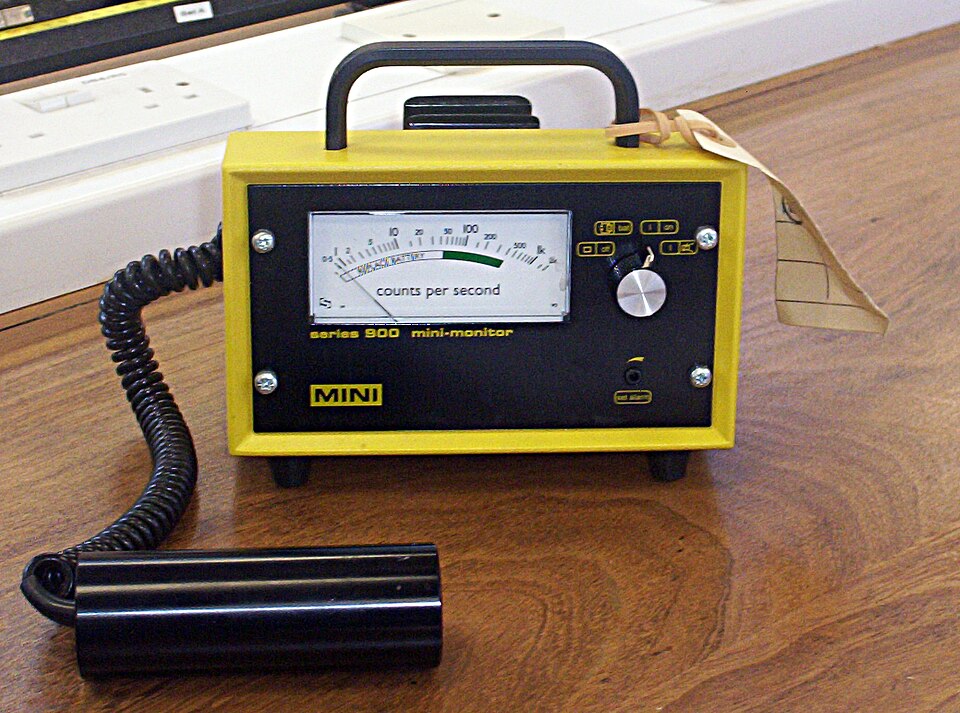
Correct: A, GM Counter. The Geiger-Muller counter, developed by Hans Geiger and Walther Muller, is the standard instrument for detecting and counting ionising radiation. Its heart is a sealed tube of low-pressure gas with a thin central wire held at a high positive voltage relative to the wall. When an alpha particle, a beta particle or a gamma ray enters the tube it ionises a gas atom; the freed electron is accelerated by the strong field, ionises further atoms, and the resulting avalanche produces a pulse of current large enough to be counted directly. Each pulse is one detected particle, and it is that pulse which produces the familiar click. The count rate gives the level of activity, and the instrument is the one carried for survey work in laboratories, nuclear installations and mining.
Why the others are wrong
- (b)Polarimeter: A polarimeter measures the angle through which an optically active substance rotates the plane of polarised light. It is used to identify and estimate sugars and other chiral compounds in chemistry, and it detects nothing nuclear.
- (c)Calorimeter: A calorimeter measures quantities of heat: the heat of a chemical reaction, or a specific heat capacity. Radiation does deposit heat, but a calorimeter cannot count individual particles or identify radioactivity as such.
- (d)Colorimeter: A colorimeter measures how strongly a coloured solution absorbs light, which gives the concentration of the substance dissolved in it. The name looks close to calorimeter and to counter, and that resemblance is the trap.
Concept
Radioactivity is the spontaneous disintegration of unstable nuclei, discovered by Henri Becquerel in 1896 and investigated by Marie and Pierre Curie. It emits alpha particles, beta particles and gamma rays, all of which ionise the matter they pass through, and every practical detector exploits that ionisation in some way. The SI unit of activity is the becquerel, one disintegration per second; the older unit is the curie. Absorbed dose is measured in gray and the biological dose in sievert.
Three of the four options are laboratory instruments whose names begin similarly, so the item is really a vocabulary test. Fix each name to what it measures (a polarimeter to rotation of polarised light, a calorimeter to heat, a colorimeter to colour and hence concentration) and only the counter is left for radiation. It is worth knowing the alternatives to a Geiger-Muller tube as well: the scintillation counter, in which radiation makes a crystal emit tiny flashes of light; the cloud and bubble chambers, which make visible tracks; and the ionisation chamber and dosimeter used for measuring accumulated dose.
Key facts
- The Geiger-Muller counter detects ionising radiation through gas amplification in a high-voltage tube.
- Each detected particle produces a single current pulse, counted as one event.
- Radioactivity was discovered by Henri Becquerel in 1896.
- The SI unit of activity is the becquerel, one disintegration per second; the older unit is the curie.
- Other detectors include the scintillation counter, the ionisation chamber and the cloud chamber.
Study next
Common traps
- Confusing calorimeter with colorimeter, and either of them with a counter.
- Assuming a polarimeter has something to do with polar or nuclear physics; it works with polarised light.
- Thinking a Geiger-Muller counter identifies which isotope is present, when it only counts events.
NDA asks instrument-to-quantity matching regularly, so keep a list of laboratory instruments each tied to the single quantity it measures.
Related PYQs
The known forces of nature can be divided into four classes, viz., gravity, electromagnetism, weak nuclear force and strong nuclear force. With reference to them, which one of the following statements is not correct?
- (a) Gravity is the strongest of the four
- (b) Electromagnetism acts only on particles with an electric charge
- (c) Weak nuclear force causes radioactivity
- (d) Strong nuclear force holds protons and neutrons inside the nucleus of an atom
Answer(a) Gravity is the strongest of the four: it is in fact the weakest, while the strong nuclear force is the strongest.
Names the force behind the events a Geiger-Muller counter is clicking at: beta decay is driven by the weak nuclear force, which is the physics underneath the measurement.
Which of the following pairs of physical phenomenon and the discoverer is/are correctly matched? 1. James Chadwick : Photoelectric effect 2. Albert Einstein : Neutron 3. Marie Curie : Radium Select the correct answer using the code given below:
- (a) 1, 2 and 3
- (b) 1 and 2 only
- (c) 2 and 3 only
- (d) 3 only
Answer(d) 3 only
Brings in the scientist who isolated radium and gave radioactivity its name, which is the history behind the instrument this question asks for.
Practice
- practice, not a real PYQ
The SI unit of radioactivity is the
- (a)Becquerel
- (b)Gray
- (c)Sievert
- (d)Tesla
Answer(a) Becquerel: one disintegration per second; the gray measures absorbed dose and the sievert the biological dose. - practice, not a real PYQ
A polarimeter is used to measure
- (a)the rotation of the plane of polarised light by a substance
- (b)the heat evolved in a reaction
- (c)the count rate of nuclear radiation
- (d)the refractive index of a glass block
Answer(a) the rotation of the plane of polarised light by a substance: the standard way of measuring optically active compounds such as sugars.