
How long does light take to reach the Earth from the Sun ?
- (a)About 4 minutes
- (b)About 8 minutes
- (c)About 24 minutes
- (d)About 24 hours
Answer
Why
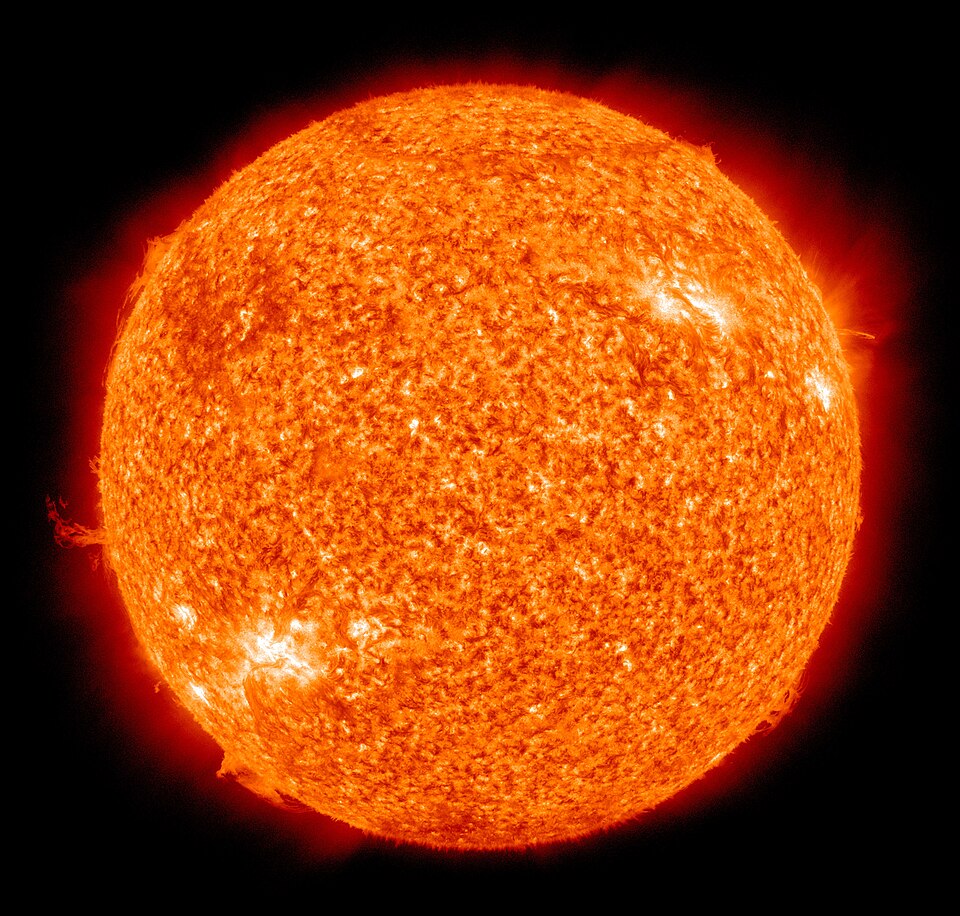
Correct: B, About 8 minutes. The mean distance from the Earth to the Sun is about 150 million kilometres, and light travels through space at about 300,000 kilometres per second. Dividing one by the other gives about 500 seconds, which is 8 minutes and 20 seconds. So the sunlight falling on you now left the Sun's surface a little over eight minutes ago, and if the Sun were somehow switched off, the sky would stay bright for that long. Because the Earth's orbit is slightly elliptical the figure varies a little through the year, which is why the option is worded 'about'.
Why the others are wrong
- (a)About 4 minutes: Four minutes corresponds to roughly 75 million kilometres, half the actual distance. It would place the Earth between the orbits of Mercury and Venus rather than where it is.
- (c)About 24 minutes: Twenty-four minutes of light travel is about 430 million kilometres, which is beyond the orbit of Mars and well into the region of the asteroid belt. It is roughly the light time to Jupiter at its nearest, not to the Earth.
- (d)About 24 hours: In twenty-four hours light covers around 26 billion kilometres, some four times the distance to Neptune. The number is memorable only because it matches the length of a day, which has nothing to do with the case.
Concept
Because light has a finite speed, everything we see in the sky is a picture of the past. That delay is small on the Earth but grows quickly with distance, which is why astronomers measure distance in units of travel time: the light-year for stars, and the astronomical unit, the mean Earth-Sun distance, for the solar system. One astronomical unit is a little over eight light-minutes.
Do the arithmetic rather than trusting memory: 150 million divided by 300,000 is 500, and 500 seconds is a bit over eight minutes. That single division also gives the other figures worth carrying: light takes about 1.3 seconds to reach us from the Moon, so a radio conversation with the Moon has a round-trip delay of about two and a half seconds, and the nearest star system beyond the Sun, Alpha Centauri, is about 4.2 light-years away. The eight-minute delay is the reason a spacecraft near Mars cannot be flown by remote control in real time.
Key facts
- The mean Earth-Sun distance is about 150 million kilometres, defined as one astronomical unit.
- The speed of light in vacuum is about 300,000 kilometres per second, or 3 × 10⁸ metres per second.
- Sunlight therefore takes about 500 seconds, that is 8 minutes and 20 seconds, to reach the Earth.
- Light from the Moon reaches the Earth in about 1.3 seconds.
- A light-year is the distance light travels in one year, used for distances to stars.
Study next
Common traps
- Picking 24 hours because the number is familiar from the length of a day.
- Confusing the light-year, a distance, with a unit of time.
- Forgetting that the figure is an average, since the Earth's orbit is not a perfect circle.
NDA asks for a standard astronomical number, and the safest preparation is to be able to derive it from the distance and the speed of light in one division.
Related PYQs
Which one of the following is a reason why astronomical distances are measured in light-years?
- (a) Distances among stellar bodies do not change.
- (b) Gravity of stellar bodies does not change.
- (c) Light always travels in straight line.
- (d) Speed of light is always same.
Answer(d) Speed of light is always same.
Explains why a travel time can stand in for a distance at all: the speed of light is a fixed constant, which is what lets eight minutes describe the gap between the Earth and the Sun.
In which of the following phenomena do heat waves travel along a straight line with the speed of light?
- (a) Thermal conduction
- (b) Thermal convection
- (c) Thermal radiation
- (d) Both, thermal conduction and radiation
Answer(c) Thermal radiation
Names the mechanism by which the Sun's energy actually gets here: radiation across empty space at the speed of light, which is why the eight-minute figure is the right one to compute.
Practice
- practice, not a real PYQ
Light from the Moon takes approximately how long to reach the Earth?
- (a)About 1.3 seconds
- (b)About 8 minutes
- (c)About 1 hour
- (d)About 1 day
Answer(a) About 1.3 seconds: the Moon is roughly 384,000 kilometres away, which light crosses in a little over a second. - practice, not a real PYQ
A light-year is a unit of
- (a)distance
- (b)time
- (c)speed
- (d)brightness
Answer(a) distance: it is the distance light travels in one year, used for the vast separations between stars.