
The mirrors used as rear-view mirrors in vehicles are
- (a)concave
- (b)convex
- (c)cylindrical
- (d)plane
Answer
Why
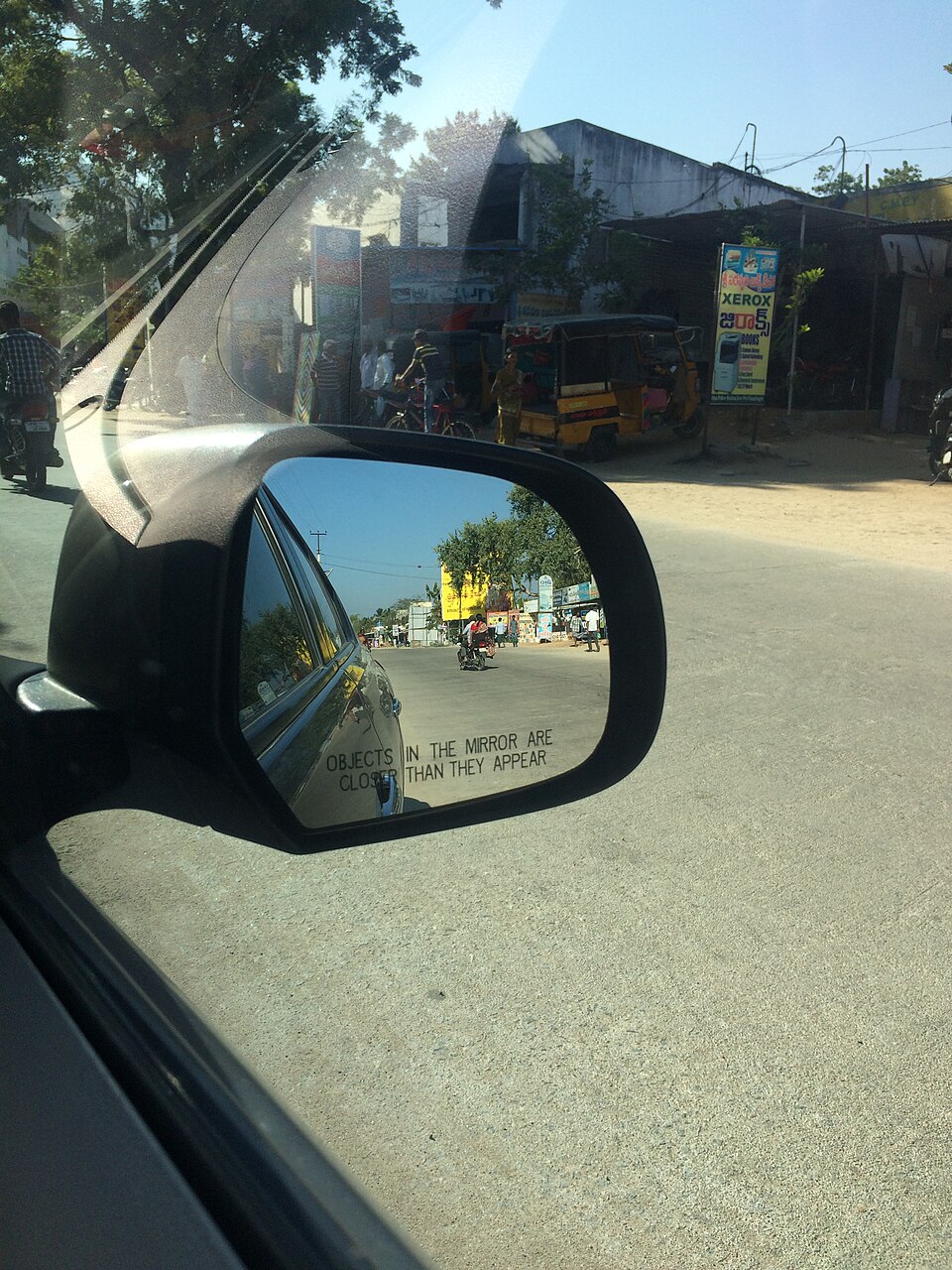
Correct: B, convex. A convex mirror bulges outwards towards the object, so the rays it reflects spread apart instead of meeting. The image is therefore always virtual, always erect and always smaller than the object, wherever the object is placed. Shrinking the image is precisely the point: squeezing a large scene into a small piece of glass is what gives the driver a wide view of the road behind and of the neighbouring lanes. The price paid is that everything looks smaller and therefore farther away than it really is, which is why many such mirrors carry a printed warning about the true distance of following traffic.
Why the others are wrong
- (a)concave: A concave mirror converges the light it reflects. For anything placed beyond its focus it makes a real, inverted image, and its field of view is narrower than that of a flat mirror of the same size: the opposite of what a driver needs. Concave mirrors are chosen where magnification matters, as in a shaving or dentist's mirror and in the reflector behind a torch bulb.
- (c)cylindrical: A cylindrical surface is curved in one direction and flat in the other, so it would widen the view sideways while leaving the vertical view unchanged, and would stretch the image. Vehicle mirrors are ground to a spherical shape so that the widening is the same in every direction and the image stays undistorted.
- (d)plane: A flat mirror returns an image the same size as the object, which sounds ideal, but its field of view is limited to roughly the width of the mirror itself. A driver would see only a narrow strip of road directly behind and would lose the adjacent lanes altogether.
Concept
A curved mirror's shape decides both the kind of image it makes and how much of the world it can show. A convex mirror, silvered on the inside of the bulge, has its focus behind the surface; reflected rays diverge, and the eye traces them back to a virtual, erect, diminished image that lies between the pole and the focus. Because the image is shrunk, a large angular slice of the scene is compressed into the mirror's area, which is what is meant by a wide field of view.
The quickest route to the answer is to ask what the driver actually wants: the widest possible view of the road behind, and an image that is the right way up so that a car approaching on the right still appears on the right. Only a diverging mirror delivers both, and only the convex mirror among the four options diverges light. Note also that the image is never inverted and never real for a convex mirror, so there is no position of the following vehicle at which the mirror could confuse the driver.
Key facts
- A convex mirror always forms a virtual, erect and diminished image, whatever the object distance.
- The image in a convex mirror lies between the pole and the focus, and it moves towards the focus as the object moves farther away.
- The focal length of a convex mirror is taken as positive in the usual sign convention, and it is half the radius of curvature.
- Convex mirrors are also used as security mirrors at blind corners in shops, corridors and narrow street junctions, for the same wide-field reason.
- Because the image is diminished, objects seen in a vehicle's convex mirror appear farther away than they really are.
Study next
Common traps
- Assuming a convex mirror can magnify because a convex lens can: the mirror always diminishes.
- Confusing the mirror's wide field of view with a large image; the view is wide precisely because the image is small.
- Reading 'rear view' as needing an inverted image, since the mirror is behind you: the image is erect and laterally reversed, not inverted.
NDA sets this either as a direct use question like this one or as a statement-based item about the nature of the image a given mirror forms.
Related PYQs
An object is placed in front of a convex mirror. Which one of the following statements is correct?
- (a) It will never form an inverted image.
- (b) The image moves towards the focus when the object moves towards the mirror.
- (c) Depending on the position of the object with respect to the mirror, the image can be inverted and real.
- (d) The size of the image becomes larger than that of the object when the object is placed at a distance equal to half the focal length.
Answer(a) It will never form an inverted image.
The same convex-mirror property tested one step deeper: the image is virtual and erect for every object position, which is exactly why the mirror is safe to use for the view behind a vehicle.
Practice
- practice, not a real PYQ
The image formed by a convex mirror is always
- (a)real and inverted
- (b)virtual and magnified
- (c)virtual, erect and diminished
- (d)real and of the same size
Answer(c) virtual, erect and diminished: this holds for every position of the object. - practice, not a real PYQ
A dentist uses which type of mirror to examine a tooth at close range?
- (a)Plane mirror
- (b)Convex mirror
- (c)Concave mirror
- (d)Cylindrical mirror
Answer(c) Concave mirror: held closer than its focus it gives an enlarged, erect, virtual image.