
Which of the following pairs of physical phenomenon and the discoverer is/are correctly matched? 1. James Chadwick : Photoelectric effect 2. Albert Einstein : Neutron 3. Marie Curie : Radium Select the correct answer using the code given below:
- (a)1, 2 and 3
- (b)1 and 2 only
- (c)2 and 3 only
- (d)3 only
Answer
Why
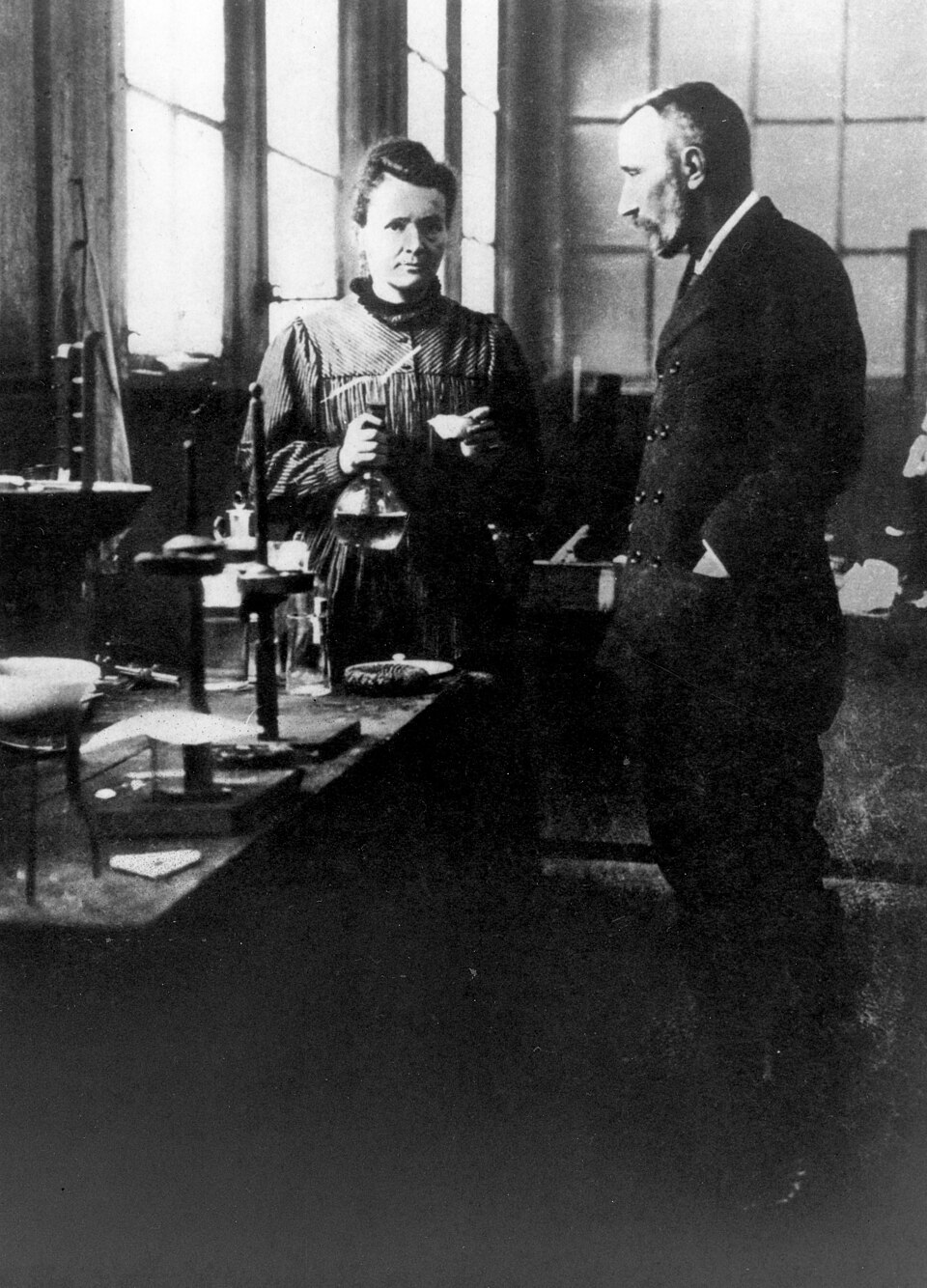
Correct — D, 3 only. Only the third pair is right: Marie Curie, with Pierre Curie, discovered radium (and polonium) in 1898. The first two pairs are deliberately swapped — James Chadwick discovered the neutron in 1932, not the photoelectric effect, and Albert Einstein explained the photoelectric effect in 1905, he did not discover the neutron. So only pair 3 is correctly matched.
Why the others are wrong
- (a)1, 2 and 3 — Pairs 1 and 2 are swapped (Chadwick discovered the neutron; Einstein explained the photoelectric effect), so all three cannot be correct.
- (b)1 and 2 only — These are exactly the two wrong pairings; the correctly matched pair is number 3 (Marie Curie : Radium).
- (c)2 and 3 only — Pair 2 (Albert Einstein : Neutron) is wrong — Einstein is linked to the photoelectric effect, and the neutron was discovered by Chadwick.
Concept
Landmark discoveries and their scientists: the photoelectric effect was explained by Albert Einstein, the neutron was discovered by James Chadwick, and radium and polonium were discovered by Marie and Pierre Curie through their study of radioactivity.
The question scrambles two famous pairs to see whether you swap them. Fix each name to its real work — Chadwick to the neutron, Einstein to the photoelectric effect, Curie to radium — and only Curie's pairing survives.
Key facts
- James Chadwick discovered the neutron in 1932 (Nobel Prize 1935).
- Albert Einstein explained the photoelectric effect in 1905 and won the 1921 Nobel Prize for it.
- Marie Curie discovered polonium and radium in 1898 and won Nobel Prizes in two sciences (Physics 1903, Chemistry 1911).
- The photoelectric effect — emission of electrons when light strikes a metal — supports the particle nature of light.
Study next
Common traps
- Swapping Chadwick and Einstein — Chadwick discovered the neutron, Einstein explained the photoelectric effect.
- Assuming 'all pairs correct' when only one match is right.
Given as a scientist-to-discovery matching set with two pairs deliberately swapped — verify each name against its real achievement.
Related PYQs
Neutrons were discovered by
- (a) James Chadwick
- (b) Ernest Rutherford
- (c) J. J. Thomson
- (d) John Dalton
Answer(a) James Chadwick
Same concept — matching a scientist to a discovery. That NDA item confirms James Chadwick discovered the neutron, which is exactly why pair 1 here (Chadwick : Photoelectric effect) is wrong.
Which one of the following particles in the nucleus of an atom was discovered by J. Chadwick?
- (a) Electron
- (b) Proton
- (c) Positron
- (d) Neutron
Answer(d) Neutron
Same concept — Chadwick's discovery. That NDA item asks which nuclear particle Chadwick found (the neutron), reinforcing that pairs 1 and 2 here are swapped.
Practice
- practice — not a real PYQ
The neutron was discovered by
- (a)J. J. Thomson
- (b)James Chadwick
- (c)Ernest Rutherford
- (d)Niels Bohr
Answer(b) James Chadwick — in 1932. - practice — not a real PYQ
Who is credited with the discovery of radium?
- (a)Albert Einstein
- (b)Henri Becquerel
- (c)Marie and Pierre Curie
- (d)Ernest Rutherford
Answer(c) Marie and Pierre Curie — in 1898.