
Consider the following statements pertaining to Coffee plantation in India : 1. Need warm and moist climate with a spell of dry weather during the ripening period 2. Rolling fields having good drainage 3. Strong sunshine over hilly slopes exceeding temperature 35°C 4. Karnataka is the leading producer in India Which of the statements given above are correct ?
- (a)1 and 4 only
- (b)1, 2 and 3
- (c)3 and 4
- (d)1, 2 and 4
Answer
Why
Correct — D, 1, 2 and 4. Statement 1 is right — coffee wants a warm, moist tropical climate, roughly 23 to 28 degrees Celsius with 1.5 to 2 metres of rain, followed by a dry spell of two to three months while the berries ripen and are picked. Statement 2 is right as well, because standing water rots the roots, so the crop is planted on rolling, well-drained slopes with slightly acidic soil rich in organic matter. Statement 4 is right too — Karnataka grows about seventy per cent of India's coffee, with Kodagu district alone contributing about a third of the national output, followed by Kerala and Tamil Nadu. Statement 3 is the false one, so the set that leaves it out is the answer.
Why the others are wrong
- (a)1 and 4 only — This drops statement 2, which is perfectly correct. Good drainage is one of the first conditions any textbook lists for coffee, because waterlogging kills the roots — that is why plantations sit on slopes.
- (b)1, 2 and 3 — It admits statement 3 and drops statement 4. Coffee in India is grown under two tiers of shade trees, not in strong direct sun, and temperatures above 35 degrees Celsius scorch the plant; meanwhile Karnataka's lead in production is beyond dispute.
- (c)3 and 4 — The only wrong statement in the list is kept, and two correct ones are thrown out. Statement 3 alone is enough to reject any option containing it.
Concept
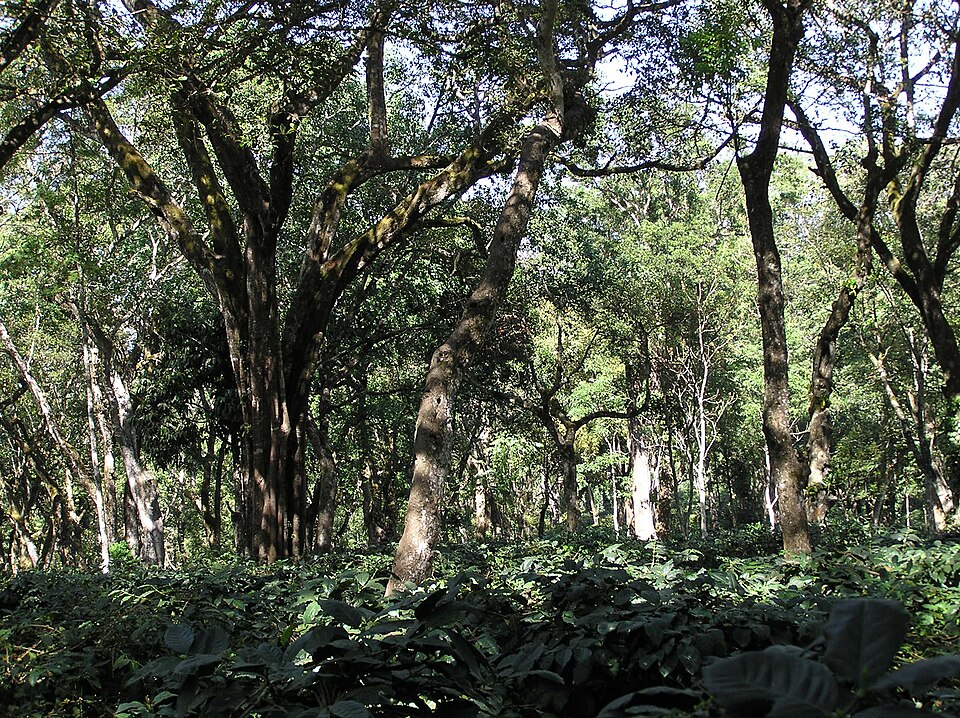
Coffee is a tropical plantation crop grown in India almost entirely on the hill slopes of the Western Ghats and, on a smaller scale, the Eastern Ghats. Arabica is planted at about 1,000 to 1,500 metres and Robusta lower down at about 500 to 1,000 metres. Indian coffee is distinctive for being shade-grown, usually under two tiers of canopy, and is commonly intercropped with pepper, cardamom, clove and nutmeg, which spreads the planter's risk.
Three of the four statements describe standard growing requirements and are easy to accept. The examiner's work is done by statement 3, which quietly contradicts the one thing that makes Indian coffee unusual — that it is a shade crop, not a full-sun crop. Once you reject statement 3, only option (d) survives. Karnataka has continued to lead national output in the years since the exam.
Key facts
- Karnataka produces about 71 per cent of India's coffee; Kerala follows with about 21 per cent and Tamil Nadu about 5 per cent.
- Kodagu district of Karnataka alone accounts for roughly a third of national output.
- All Indian coffee is grown under shade, commonly under two tiers of canopy trees.
- Robusta now makes up over 60 per cent of Indian production, with Arabica grown at the higher altitudes.
Study next
Common traps
- Treating coffee like tea — tea tolerates far more direct sun and stretches into subtropical hill areas, while Indian coffee is a shade crop.
- Accepting a statement that sounds technical because it carries a number; the 35 degrees Celsius in statement 3 is precisely what makes it false.
NDA sets crop questions either as a statement set on growing conditions or as a one-line question on the leading producer State, so learn both together for each crop.
Related PYQs
Though coffee and tea both are cultivated on hill slopes, there is some difference between them regarding their cultivation. In this context, consider the following statements : 1. Coffee plant requires a hot and humid climate of tropical areas whereas tea can be cultivated in both tropical and subtropical areas. 2. Coffee is propagated by seeds but tea is propagated by stem cuttings only. Which of the statements given above is/are correct ?
- (a) 1 only
- (b) 2 only
- (c) Both 1 and 2
- (d) Neither 1 nor 2
Answer(a) 1 only
The same crop, tested on the coffee-versus-tea contrast that this NDA question only implies. UPSC's statement 1 confirms the climate requirement in statement 1 of the NDA item.
Consider the following statements: 1. Chikmagalur is well-known for sugar production. 2. Mandya is well-known as a coffee-producing region. Which of the statements given above is/are correct?
- (a) 1 only
- (b) 2 only
- (c) Both 1 and 2
- (d) Neither 1 nor 2
Answer(d) Neither 1 nor 2
Coffee districts of Karnataka tested by deliberate swap — Chikmagalur is coffee country and Mandya is sugar country, the reverse of what the statements claim. Both exams expect the Karnataka coffee belt by name.
Which one of the following crops is generally benefitted by the rain caused by western disturbances in India ?
- (a) Rice
- (b) Wheat
- (c) Bajra
- (d) Cotton
Answer(b) Wheat
The same crop-and-climate pairing six years later. NDA keeps asking which weather a crop needs at which stage, so link every major crop to its rainfall and temperature window.
Which one of the following soils is ideal for growing cotton ?
- (a) Regur soil
- (b) Laterite soil
- (c) Desert soil
- (d) Mountainous soil
Answer(a) Regur soil
Crop and soil rather than crop and climate, but the same one-mark recall. Coffee's own requirement — well-drained, slightly acidic soil on slopes — belongs on the same revision sheet.
Practice
- practice — not a real PYQ
Which State is the largest producer of coffee in India?
- (a)Kerala
- (b)Tamil Nadu
- (c)Karnataka
- (d)Andhra Pradesh
Answer(c) Karnataka — about seventy per cent of national output, with Kodagu the leading district. - practice — not a real PYQ
Indian coffee is distinctive among the world's producers chiefly because it is
- (a)grown entirely in plains
- (b)grown under shade
- (c)grown without any rainfall
- (d)harvested before flowering
Answer(b) grown under shade — usually beneath two tiers of canopy trees on Western Ghats slopes.