
Which one of the following soils is ideal for growing cotton ?
- (a)Regur soil
- (b)Laterite soil
- (c)Desert soil
- (d)Mountainous soil
Answer
Why
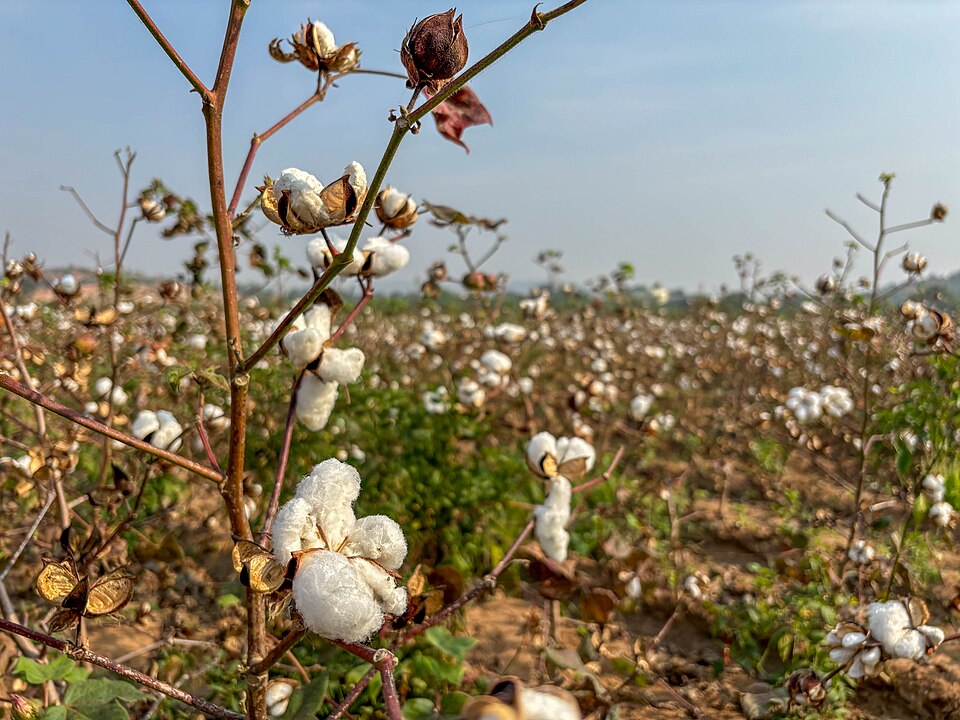
Correct — A, Regur soil. Regur is the black soil of the Deccan, and it is so closely tied to this one crop that its common name is black cotton soil. It forms in place by the weathering of the basalt of the Deccan Traps, so it is rich in clay, lime, magnesia and potash. That clay holds moisture tightly, which lets a long-duration crop like cotton ride out dry spells between rains, and the soil swells when wet and cracks deeply when dry, so it turns and aerates itself. Its main belt runs across Maharashtra, Gujarat and Madhya Pradesh.
Why the others are wrong
- (b)Laterite soil — Laterite forms under heavy rain and high temperature, where the rain leaches away the silica and leaves iron and aluminium behind. The result is acidic, poor in nitrogen, phosphate and lime, and low in moisture retention. It suits tea, coffee, cashew and rubber on the hill slopes, not cotton.
- (c)Desert soil — Arid soils are sandy, with very low clay and organic content and almost no moisture-holding capacity; salt content is often high and the horizon may carry kankar. Without heavy irrigation they cannot carry a crop that needs steady moisture through a long growing season.
- (d)Mountainous soil — Mountain or forest soils are thin, immature and coarse on the slopes, and they occupy cool high-altitude terrain. Cotton is a warm-weather crop needing a long frost-free season and bright sun at boll opening — the opposite of what a mountain profile offers.
Concept
Indian soils are classified by how they formed and what they can carry: alluvial in the plains and deltas, black or regur over the Deccan lava, red and yellow on the crystalline shields, laterite in the heavy-rain tropics, arid soils in the north-west, and forest and mountain soils in the hills. Black soil is the one whose parent rock is written into its behaviour — basalt weathering gives a fine clay that swells, cracks and retains water, and that water-holding property is what makes it the cotton soil.
The examiner is really testing one pairing, black soil with cotton, and the safest way to remember it is through the alternative name: regur is black cotton soil. If the name does not surface, reason from moisture. Cotton is largely a kharif crop that needs a long season with moderate rainfall in the 50 to 100 cm range, so the soil must store water between showers. Laterite has been leached, desert soil drains almost instantly and mountain soil is thin and cold — only regur banks moisture. Note too that leading cotton-YARN states are not always the leading black-soil states; the mills of Tamil Nadu run on skilled labour, not on local regur.
Key facts
- Regur, the black soil of the Deccan, is popularly called black cotton soil.
- It forms by the in-situ weathering of the basaltic lava of the Deccan Traps.
- It is clay-rich, retains moisture well, and develops deep cracks as it dries.
- Its main belt covers Maharashtra, Gujarat and Madhya Pradesh, extending into parts of the Deccan.
Study next
Common traps
- Assuming the leading producer of cotton yarn must also be the leading black-soil state.
- Confusing laterite, which is a product of leaching in heavy rain, with red soil formed on crystalline rock.
- Reading 'black' as high organic content — regur is dark because of its mineral composition, and it is generally low in nitrogen and organic matter.
Asked as a soil-to-crop pick like this one, or as a question on the parent rock from which black soil is formed.
Related PYQs
The black cotton soil of India has been formed due to the weathering of
- (a) brown forest soil
- (b) fissure volcanic rock
- (c) granite and achist
- (d) shale and limestone
Answer(b) fissure volcanic rock
The other half of the same fact. NDA asks which soil grows cotton; UPSC asks where that soil came from — the fissure-erupted basalt of the Deccan Traps. Learn the pair as one line.
Tamil Nadu is a leading producer of mill-made cotton yarn in the country. What could be the reason? 1. Black cotton soil is the predominant type of soil in the State. 2. Rich pool of skilled labour is available. Which of the above is/are the correct reasons?
- (a) 1 only
- (b) 2 only
- (c) Both 1 and 2
- (d) Neither 1 nor 2
Answer(b) 2 only
A warning against over-applying the pairing. Black soil grows cotton, but the mills that spin it cluster where skilled labour is — Tamil Nadu leads in yarn without being a black-soil state.
Which one of the following is not a soil forming factor?
- (a) Parent material
- (b) Topography
- (c) Climate
- (d) Human habitation
Answer(d) Human habitation
The general principle behind this question — parent material is one of the classic soil-forming factors, and regur is the textbook case of a soil whose character is inherited straight from its parent basalt.
Practice
- practice — not a real PYQ
The deep cracks that develop in black soil during the dry season are useful because they
- (a)increase the salt content of the soil
- (b)help the soil aerate itself, so it is self-ploughing to a degree
- (c)prevent any moisture from reaching the roots
- (d)convert the soil into laterite
Answer(b) help the soil aerate itself, so it is self-ploughing to a degree — the clay swells when wet and shrinks and cracks when dry. - practice — not a real PYQ
Which one of the following soils is best suited to plantation crops such as tea, coffee and cashew on hill slopes?
- (a)Regur soil
- (b)Alluvial soil
- (c)Laterite soil
- (d)Arid soil
Answer(c) Laterite soil — leached and acidic, it is poor for cereals but carries plantation crops with manuring.