
Which component of fertilizer is used for stimulating early growth purpose ?
- (a)Nitrogen
- (b)Potassium
- (c)Phosphorus
- (d)Oxygen
Answer
Why
Correct: C, Phosphorus. In the standard NPK division of labour taught in every agronomy text, each of the three primary nutrients owns a distinct job, and phosphorus owns root establishment, seedling vigour and early maturity. The reason is biochemical rather than descriptive. Phosphorus is a structural part of ATP and ADP, of the nucleotides that make up DNA and RNA, and of the phospholipids in every cell membrane. A germinating seedling is doing two things at maximum rate (dividing cells and transferring energy) and both of those processes consume phosphate directly, which is why a shortage of P at the two-to-four leaf stage stunts a plant permanently in a way a later shortage does not. There is a second, purely physical reason phosphorus is the 'early' nutrient. Phosphate ions are strongly fixed by soil minerals and are almost immobile in the soil solution; a nitrate ion moves with soil water to the root, but a phosphate ion must effectively be met by the root. A young seedling has a tiny root system and cannot go looking for it. That is exactly why 'starter' fertiliser is phosphatic and why it is drilled or banded next to the seed rather than broadcast over the field: di-ammonium phosphate, DAP, graded 18-46-0, meaning 18 per cent nitrogen and 46 per cent P2O5, is the fertiliser most Indian farmers use for basal application at sowing. The same immobility is why plants evolved mycorrhizal partnerships: fungal hyphae are far finer than root hairs, reach soil the root cannot, and secrete acids that release phosphate the root could never absorb by itself. Read the stem's three qualifiers together (a component of fertiliser, aimed at growth, and specifically early growth) and only phosphorus satisfies all three at once.
Why the others are wrong
- (a)Nitrogen: The intended trap, and it wins if you read only the word 'growth'. Nitrogen is the nutrient of vegetative growth: it builds amino acids, proteins and the chlorophyll molecule itself, so it drives leaf area and the deep green colour of a healthy crop, and India consumes more of it than of P and K combined. But it acts across the whole season, and nitrate is mobile in soil, so it is top-dressed in splits rather than placed under the seed.
- (b)Potassium: Potassium is the regulator rather than a builder: it is not incorporated into any structural molecule of the plant but stays as a free ion controlling stomatal opening, water balance, enzyme activation and the translocation of sugars, which is why K-sufficient crops resist drought, lodging and disease better. Its classic deficiency sign is scorching along the margins of the older leaves: a mid-to-late-season symptom, not a seedling one.
- (d)Oxygen: Oxygen is genuinely essential to a plant (roots respire and drown in waterlogged soil without it) but it is not a component of any fertiliser. Along with carbon and hydrogen it comes free from air and water, which is precisely why the three of them never appear on a fertiliser bag. Anything sold as fertiliser exists to supply what the atmosphere cannot.
Concept
Plants need seventeen elements to complete their life cycle. Three of them (carbon, hydrogen and oxygen) are taken from air and water and cost nothing. The remaining fourteen come from the soil and are split by the quantity required: the primary macronutrients nitrogen, phosphorus and potassium, which soils run short of first and which fertiliser exists to supply; the secondary macronutrients calcium, magnesium and sulphur; and the micronutrients (iron, manganese, zinc, copper, boron, molybdenum, chlorine and nickel) needed in traces but no less essential, since a plant starved of any one of them dies just as surely as one starved of nitrogen. Fertiliser grades are written as three numbers in the fixed order N–P–K, expressed as per cent N, per cent P2O5 and per cent K2O: urea is 46-0-0, di-ammonium phosphate is 18-46-0, and muriate of potash is 0-0-60. Reading a bag correctly is itself an examinable skill, because the middle number is the phosphate figure and the order never changes.
The question is decided by one word, and it is not 'growth': it is 'early'. Strip that word out and nitrogen is the natural answer, because nitrogen is what makes a crop grow big and green; that is exactly why (a) is placed first among the options. Put the word back and the answer flips, because the specific textbook attribution of root development, seedling vigour and early maturity is to phosphorus, and it is a claim with a mechanism behind it rather than a convention: cell division and energy transfer are what a seedling does, and both run on phosphate. A second filter clears the remaining two options quickly. Ask which of the four you would actually find written on a fertiliser bag, and oxygen falls out at once: it is supplied by air and water, never sold. Potassium is on the bag, but its functions are regulatory and its deficiency shows up late, at the leaf margins of mature plants. The most reliable way to hold all of this is by deficiency symptom: nitrogen shortage yellows the older leaves first, phosphorus shortage stunts the plant and turns leaves dark green to purplish, and potassium shortage scorches the leaf edges. Only the phosphorus picture is a seedling picture.
Key facts
- Seventeen elements are essential to plants; carbon, hydrogen and oxygen come from air and water, while nitrogen, phosphorus and potassium are the primary macronutrients that fertiliser is made to supply
- Phosphorus is a structural component of ATP and ADP, of DNA and RNA, and of membrane phospholipids: hence its role in energy transfer and cell division in a seedling
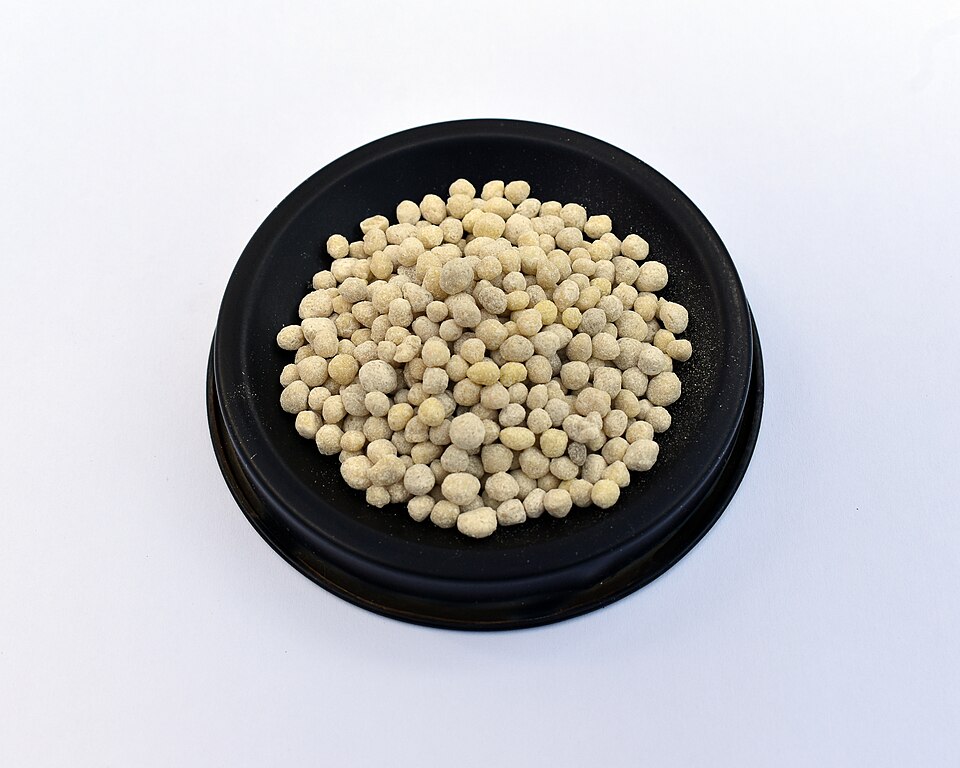
- Di-ammonium phosphate (DAP), formula (NH4)2HPO4, has the grade 18-46-0: 18 per cent nitrogen and 46 per cent P2O5, which makes it the standard basal or 'starter' fertiliser applied at sowing
- Phosphate is nearly immobile in soil, so phosphatic fertiliser is placed or banded near the seed; nitrate is mobile, so nitrogen is applied in split top-dressings through the season
- Deficiency signatures: nitrogen: yellowing of older leaves; phosphorus: stunting with dark green to purplish leaves; potassium: scorching of older leaf margins
- Mycorrhizal fungi supply the plant with phosphorus, nitrogen and zinc from soil the roots cannot reach, and colonisation is triggered by the plant's own phosphorus starvation
Study next
Common traps
- Answering nitrogen because it is the nutrient most associated with 'growth': the discriminating word in the stem is 'early'
- Assuming oxygen counts as a fertiliser component because plants need it; carbon, hydrogen and oxygen come from air and water and appear on no fertiliser bag
- Misreading a fertiliser grade: the three numbers are always N, then P2O5, then K2O, so 18-46-0 is a phosphatic fertiliser despite carrying nitrogen too
BPSC asks plant nutrition as a one-line function match (which nutrient does which job, which fertiliser is which) and answers turn on a single qualifying adjective in the stem, as 'early' does here. UPSC rarely asks the function directly; it comes at the same syllabus sideways, through biofertilisers, through why insectivorous plants trap insects, through which organism fixes nitrogen, or through the environmental consequences of fertiliser run-off, so the underlying nutrient cycles matter more than the bag labels.
Related PYQs
Which one of the following is NOT an essential micronutrient for plants?
- (a) Boron
- (b) Zinc
- (c) Sodium
- (d) Copper
Answer(c) Sodium
The same syllabus point from the other end of the nutrient list: BPSC tests what a primary macronutrient does, UPSC tests which elements qualify as essential micronutrients at all.
Some species of plants are insectivorous. Why ?
- (a) Their growth in shady and dark places does not allow them to undertake sufficient photosynthesis and thus they depend on insects for nutrition.
- (b) They are adapted to grow in nitrogen deficient soils and thus depend on insects for sufficient nitrogenous nutrition.
- (c) They cannot synthesize certain vitamins themselves and depend on the insects digested by them.
- (d) They have remained in that particular stage of evolution as living fossils, a link between autotrophs and heterotrophs.
Answer(b) They are adapted to grow in nitrogen deficient soils and thus depend on insects for sufficient nitrogenous nutrition.
Tests the same idea that each nutrient has a specific, non-interchangeable role: the insectivorous habit exists because nitrogen in particular is limiting, exactly as phosphorus in particular is what a seedling is short of.
In mycorrhizal association, the advantage of plant is :
- (a) Protection
- (b) Food
- (c) (A) and (B) both
- (d) Increased mineral absorption and diseases protection
Answer(d) Increased mineral absorption and diseases protection
The biological answer to the same problem the fertiliser bag solves: mycorrhizal hyphae exist largely to reach immobile soil phosphate, and colonisation is triggered by the plant's own phosphorus starvation.
Practice
- practice, not a real PYQ
A crop showing stunted growth with dark green to purplish leaves is most likely deficient in
- (a)Nitrogen
- (b)Phosphorus
- (c)Potassium
- (d)Magnesium
Answer(b) Phosphorus: P deficiency stunts the plant and produces purplish pigmentation; nitrogen deficiency yellows the older leaves and potassium deficiency scorches their margins. - practice, not a real PYQ
The fertiliser grade 18-46-0 refers to which of the following fertilisers ?
- (a)Urea
- (b)Muriate of potash
- (c)Di-ammonium phosphate
- (d)Single super phosphate
Answer(c) Di-ammonium phosphate: 18 per cent N and 46 per cent P2O5 with no potash; urea is 46-0-0 and muriate of potash is 0-0-60.