
In which of the following years the Bihar state Hydroelectric power corporation was established ?
- (a)1982
- (b)1992
- (c)1990
- (d)1998
Answer
Why
Correct: A, 1982. The corporation says so itself. The 'About us' page of the Bihar State Hydroelectric Power Corporation Limited opens: 'The Bihar State Hydroelectric Power Corporation (BHPC) was registered under the Companies Act as an undertaking of the Government of Bihar in 1982.' That is the company's own published account of its own incorporation, which is as close to a settled fact as a question of this kind can get, and it disposes of 1990, 1992 and 1998 together. Two things are worth noticing about the date. First, 1982 places the corporation in undivided Bihar: eighteen years before the Bihar Reorganisation Act carved out Jharkhand on 15 November 2000 and took with it the Damodar valley coalfields and most of the state's thermal and mining base. A body set up to develop the water power of the northern plains therefore survived the bifurcation with its assets intact, while the state's conventional generation did not. Second, the company was not created only for dams. Its stated objects run to 'all types of renewable power projects such as hydro-electric, solar, wind, biomass etc.', including investigation, design, construction, generation, transmission and sale of power: an unusually broad renewable mandate for a 1982 state undertaking, and the reason the same corporation now appears in Bihar's solar planning. What it actually built reflects Bihar's geography rather than its ambitions: thirteen commissioned stations totalling about 54 MW, the largest being Kataiya in Supaul at 19.2 MW and Valmikinagar in West Champaran at 15 MW, with six of the thirteen (Dehri, Dhelabagh, Nasriganj, Jainagra, Shrikhinda and Sebari) clustered in Rohtas district alone. These are small, low-head plants, not reservoir schemes, because a state that is mostly level alluvial plain has to take its hydro power from canal drops.
Why the others are wrong
- (b)1992: A decade late. 1992 is a plausible-looking guess because it sits in the early-liberalisation years when many state power entities were restructured and when independent power producers were first admitted to Indian generation, but the corporation was already ten years old by then and its registration document predates that whole phase.
- (c)1990: The nearest wrong option and the one a candidate half-remembering 'the eighties or nineties' is most likely to pick. Nothing in the corporation's record attaches to 1990 (no incorporation, no reconstitution) and the company's own site gives a single year of registration, 1982.
- (d)1998: The furthest from the mark. 1998 belongs to the era of the Electricity Regulatory Commissions Act, when states were setting up regulators and preparing to unbundle their electricity boards; a generating company created for the state's hydro potential belongs to the earlier, board-era phase, and by 1998 several of BSHPC's canal stations were already running.
Concept
Bihar's power sector is unusual among Indian states in how little of it is hydro, and the reason is physical. The corporation's own description of the state is the clearest statement of the problem: the northern portion 'consists almost entirely of a level tract traversed by a number of rivers originating from Nepal', and only the southern strip bordering Jharkhand has hilly terrain. Head (the vertical drop water falls through) is what generates hydro power, and a floodplain has almost none. What Bihar has instead is an exceptional density of rivers and of canals built for irrigation, and a canal that steps down a gradient creates artificial falls. So the Bihar State Hydroelectric Power Corporation's portfolio is a portfolio of small canal-based stations: thirteen commissioned plants aggregating roughly 54 MW, of which eight are one megawatt or smaller, plus nine more under construction. For comparison, a single unit at a large thermal station commonly exceeds 500 MW. The corporation matters less for the electricity it makes than as an example of a state matching an institution to a resource base, and, since its objects clause always covered solar, wind and biomass as well, of a hydro company positioned to become a general renewables company.
There is no reasoning route to 1982; this is a recall question, and the honest way to teach it is to give the student a hook rather than pretend a deduction exists. The usable hook is the bifurcation of 2000. Everything about Bihar's older industrial and mineral institutions splits into two groups: those founded before 15 November 2000, when Bihar still included the Chotanagpur plateau, and those founded after, when it did not. A hydro corporation founded for the water of the plains sits in the earlier group, and 1982 is the only option on offer that is comfortably pre-bifurcation in the sense that matters: an early-1980s state undertaking, of the same generation as the state electricity boards' expansion phase, rather than a product of the reform years. The three wrong options all cluster in the 1990s, which is exactly the decade in which Indian power policy was being rewritten: private generation opened in 1991, regulators arrived from 1998, and unbundling followed. If a state body's founding date is being asked and the options force a choice between 'board era' and 'reform era', check what the body actually does: a generation company built around a natural resource is usually board era, while a regulator, a holding company or a distribution company is usually reform era.
Key facts
- The corporation states on its own site that it 'was registered under the Companies Act as an undertaking of the Government of Bihar in 1982'
- Its objects extend beyond hydro to 'all types of renewable power projects such as hydro-electric, solar, wind, biomass etc.', covering investigation, design, construction, generation, transmission and sale
- Thirteen commissioned stations total about 54 MW; the largest are Kataiya in Supaul (19.2 MW) and Valmikinagar in West Champaran (15 MW), followed by Dehri in Rohtas (6.6 MW)
- Six of the thirteen commissioned plants (Dehri, Dhelabagh, Nasriganj, Jainagra, Shrikhinda and Sebari) are in Rohtas district; three more are in Arwal
- Nine further stations are under construction, including Dehri Escape at 6.6 MW, Tejpura in Aurangabad at 1.5 MW and Mathauli in West Champaran at 0.8 MW
- The corporation predates the Bihar Reorganisation Act, 2000, under which Jharkhand was created on 15 November 2000 and took the state's coalfield-based thermal and mining assets
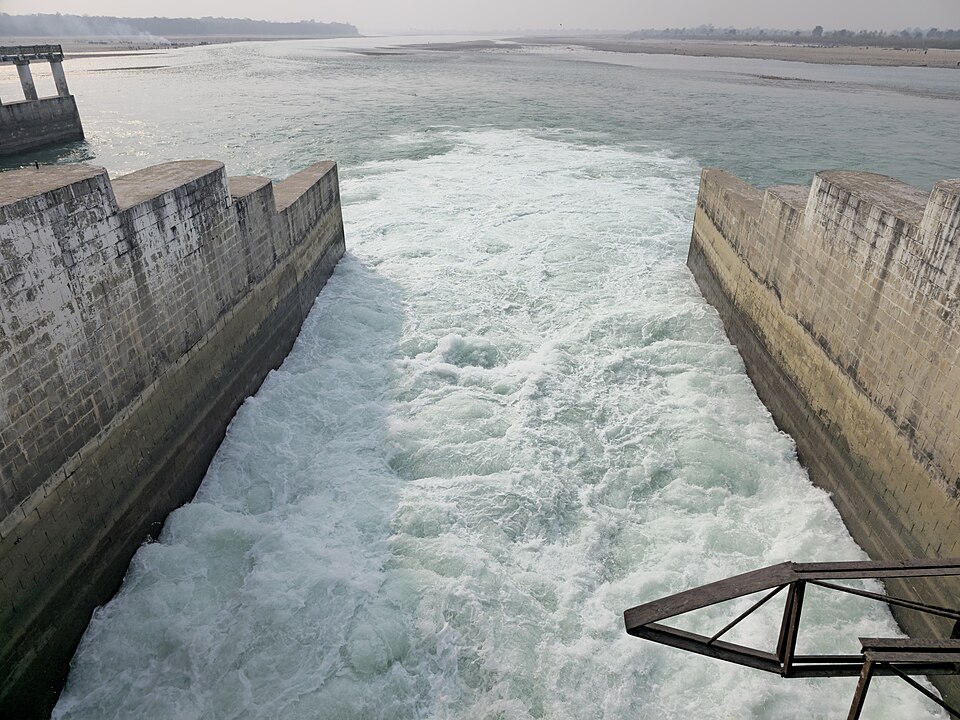
Study next
Common traps
- Guessing a 1990s date because state power restructuring is associated with that decade: the corporation is an early-1980s creation
- Assuming a state hydro corporation implies large dams; every one of Bihar's commissioned stations is small, the biggest 19.2 MW
- Confusing the hydro corporation with the state's distribution and transmission companies, which are separate and much later bodies
BPSC's Bihar section is heavy with establishment years (of universities, corporations, missions and institutes) asked as a bare four-date choice with no internal clue, so these have to be memorised rather than reasoned, and the state government's own websites are the safest source. UPSC almost never asks a state undertaking's founding year; when power appears there it is as basin geography, as which river a named station stands on, or as a statement pair about a corporation's functions.
Related PYQs
Consider the following statements: 1. Damodar Valley Corporation is the first multipurpose river valley project of independent India. 2. Damodar Valley Corporation includes thermal and gas power stations. Which of these statements given above is/are correct?
- (a) 1 only
- (b) 2 only
- (c) Both 1 and 2
- (d) Neither 1 nor 2
Answer(c) Both 1 and 2
The same institutional idea, and the closest historical parallel: a statutory corporation created to develop the power of a river basin, in a valley that lay in undivided Bihar until Jharkhand was separated in 2000.
The Dul Hasti Power Station is based on which one of the following rivers ?
- (a) Beas
- (b) Chenab
- (c) Ravi
- (d) Sutlej
Answer(b) Chenab
Hydro stations as pure recall, the same way BPSC asks the corporation's founding year, and a useful contrast, since a Himalayan run-of-the-river project has the head that Bihar's plains cannot supply.
In which year, the Nalanda University was re-established in Bihar?
- (a) 2005
- (b) 2007
- (c) 2008
- (d) 2014
Answer(d) 2014
The identical BPSC habit one edition later: a Bihar institution reduced to its founding year and four close dates, with nothing in the stem to reason from, which is why these have to be learnt from the institution's own record.
Practice
- practice, not a real PYQ
The Kataiya hydel power station, the largest commissioned station of the Bihar State Hydroelectric Power Corporation, is located in which district ?
- (a)Rohtas
- (b)Supaul
- (c)West Champaran
- (d)Aurangabad
Answer(b) Supaul: Kataiya's 19.2 MW makes it the corporation's largest commissioned station; Valmikinagar (15 MW) is in West Champaran and Dehri (6.6 MW) in Rohtas. - practice, not a real PYQ
Under which enactment was the State of Jharkhand carved out of Bihar in the year 2000 ?
- (a)The States Reorganisation Act, 1956
- (b)The Bihar Reorganisation Act, 2000
- (c)The Madhya Pradesh Reorganisation Act, 2000
- (d)The Uttar Pradesh Reorganisation Act, 2000
Answer(b) The Bihar Reorganisation Act, 2000: Jharkhand came into existence on 15 November 2000; the other two 2000 Acts created Chhattisgarh and Uttaranchal.