
In mycorrhizal association, the advantage of plant is :
- (a)Protection
- (b)Food
- (c)(A) and (B) both
- (d)Increased mineral absorption and diseases protection
Answer
Why
Correct — D, Increased mineral absorption and diseases protection. A mycorrhiza is the mutualistic association between a fungus and the root of a green plant, named in 1885 by the German botanist A. B. Frank, and the whole question turns on getting the direction of the exchange right. The plant photosynthesises and hands organic molecules — sugars and lipids — down to the root and on to its fungal partner; the fungus, which cannot photosynthesise at all, hands back water and mineral nutrients taken from the soil, phosphorus above all, and also nitrogen and zinc. So food travels from plant to fungus, and minerals from fungus to plant. Both halves of option (d) are on the plant's side of that ledger, and both are real. The mineral half works for two reasons, one physical and one chemical. Physically, fungal hyphae are much finer than the smallest root or root hair, so they thread into soil pores that a root can never enter and vastly extend the absorbing surface; the plant recruits them precisely when it senses phosphorus starvation. Chemically, fungal membranes and secretions differ from a root's — the hyphae release organic acids that dissolve or chelate ions and free nutrients that are physically or chemically immobilised, phosphate ions and micronutrients such as iron being the standard examples, so a mycorrhizal plant can obtain phosphate that an unaided root simply cannot reach. The protection half is equally well established: mycorrhizal plants are more resistant to soil-borne microbial disease, the fungus excretes enzymes toxic to soil organisms such as nematodes, and colonisation primes the plant's own immune system so that its defence responses fire faster and harder when a pathogen does arrive. That is exactly the ground on which the Commission upheld this key when it disposed of objections — the hyphal network supplying nutrients and water, and the fungus both shielding the root from pathogens and inducing systemic resistance in the plant. Alongside these come drought tolerance, relief from salinity stress and tolerance of heavy metals, which is why mycorrhizal inoculation is standard practice in rehabilitating degraded and mined land.
Why the others are wrong
- (a)Protection — True but incomplete, and in a question that offers a fuller correct option an incomplete one is wrong. The fungus does protect the root — a physical mantle in ectomycorrhizas, enzymes toxic to nematodes, and a primed immune response. But protection is the secondary service. The association is initiated by the plant's phosphorus hunger, and nutrient uptake is the benefit that explains why roughly four-fifths of all plant species maintain it.
- (b)Food — The direction is reversed, and this is the single misconception the question is built to expose. Fungi are heterotrophs with no chlorophyll; the mycorrhizal fungus gets its constant supply of carbohydrates — glucose and sucrose, translocated from the leaves down through the root — from the plant. The plant is the food provider here, not the beneficiary. Arbuscular mycorrhizal fungi are in fact obligate biotrophs, wholly dependent on their host for carbon.
- (c)(A) and (B) both — The designed trap: it welds one true item to one reversed item and therefore cannot stand. Protection is a genuine gain for the plant, but 'food' is what the plant gives up, not what it receives, so the pair is half wrong and the combination fails. Option (d) states both real plant-side benefits — mineral absorption and disease protection — without smuggling in the fungus's side of the bargain.
Concept
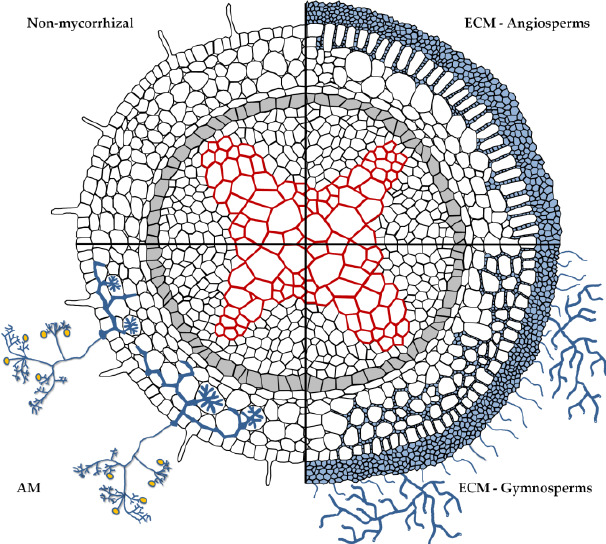
Mycorrhiza literally means 'fungus-root', and it is the rule rather than the exception: mycorrhizas are present in about 92% of the plant families that have been studied and in roughly 80% of plant species, and fossil and genetic evidence puts the partnership back 400 to 460 million years, to the moment plants colonised land, when fungi effectively served as the first root systems. Two structural types dominate. In an ectomycorrhiza the fungus never enters a living cell: it wraps the root tip in a hyphal sheath called the mantle and pushes a lattice of hyphae, the Hartig net, between the cortical cells, with an extensive mycelium spreading outward into soil and leaf litter. Ectomycorrhizas involve only about 10% of plant families and some 2% of plant species, but those species are the dominant woody ones — pine, oak, birch, eucalyptus, dipterocarps — so they account for a huge share of forest biomass. In an arbuscular mycorrhiza the hyphae do penetrate the cortical cells, invaginating the cell membrane to form finely branched, tree-like arbuscules that maximise the exchange surface, often with balloon-like storage vesicles as well. Arbuscular fungi belong to a single phylum, Glomeromycota, are obligate biotrophs, and occur in about 85% of plant families. Ericoid and orchid mycorrhizas are the specialised remainder — and every orchid is dependent on a fungus at some stage, because orchid seeds carry no food reserve at all.
Read the stem's last three words before anything else: the advantage of the PLANT. That instruction converts a vague recall question into a bookkeeping exercise, because a mutualism has two ledgers and the examiner has deliberately mixed them. Write out the exchange and the answer is forced — plant to fungus: carbohydrate; fungus to plant: water, minerals, protection. Now the options sort themselves. 'Protection' belongs on the plant's side but is only half the story. 'Food' belongs on the fungus's side and is therefore not an advantage of the plant at all. Their combination inherits the defect of its weaker half. Only option (d) lists two items that are both genuinely credited to the plant. The single discriminating fact, and the one worth carrying into the hall, is that the fungus has no chlorophyll and cannot feed itself: an arbuscular mycorrhizal fungus is an obligate biotroph that would starve without its host, which makes it structurally impossible for it to be feeding the plant. The trap is well built because option (c) rewards the instinct that a longer, more inclusive answer is safer — an instinct that works on many BPSC items and fails here. It is also worth knowing the one real exception, so that a future question does not catch you: in orchids, whose dust-like seeds contain no stored food, carbon does flow from fungus to seedling, and a few plants such as Monotropa stay mycoheterotrophic for life. That is a special case, not the general rule this question is asking about.
Key facts
- The term mycorrhiza was coined in 1885 by the German botanist A. B. Frank. In the association the plant supplies the fungus with sugars and lipids made by photosynthesis, while the fungus supplies the plant with water and mineral nutrients such as phosphorus, nitrogen and zinc taken from the soil.
- The mineral benefit is physical and chemical at once: fungal hyphae are much finer in diameter than the smallest root or root hair and reach soil that roots cannot, and they secrete organic acids that dissolve or chelate immobilised ions — phosphate and micronutrients such as iron being the standard cases. Colonisation is triggered when the plant senses phosphorus starvation.
- Ectomycorrhizas do not penetrate cells: a hyphal mantle sheathes the root tip and a Hartig net runs between the cortical cells. They occur in about 10% of plant families and only about 2% of plant species, but those include pine, oak, birch, eucalyptus and the dipterocarps — the dominant forest trees.
- Arbuscular mycorrhizas penetrate cortical cells to form branched arbuscules and storage vesicles, are formed only by the phylum Glomeromycota, and are found in about 85% of plant families and an estimated 78% of plant species; the partnership dates back 400–460 million years. Mycorrhizas overall occur in 92% of plant families studied.
- Protection is measurable, not decorative: mycorrhizal plants resist soil-borne microbial disease better, the fungi excrete enzymes toxic to soil organisms such as nematodes, and colonisation primes the plant's immune system so defence responses are stronger. Mycorrhizal fungi also confer drought, salinity and heavy-metal tolerance — Pisolithus tinctorius has been used to establish pine on contaminated sites.
Study next
Common traps
- Reversing the exchange — the plant gives the carbohydrate and the fungus gives minerals and protection, so any option offering the plant 'food' is describing the fungus's benefit
- Choosing the longer combination option because it looks more inclusive — a combination is only as good as its weakest component, and here one component is the wrong way round
- Over-correcting with the orchid exception — orchid seeds really do draw carbon from their fungus, but that is a special case and not the general mycorrhizal bargain the question describes
BPSC asks it as a single direct line with a combination option planted as the trap, so the mark turns on whether you can state who gives what rather than on any deeper botany; the same template recurs across this paper wherever an 'A and B both' choice appears. UPSC asks the identical biology applied: in 1999 it wanted the name of the fungus-root association, and in 2013 it asked why mycorrhizal biotechnology is used to rehabilitate degraded sites, with drought resistance, pH tolerance and disease resistance offered as separate statements to be judged one by one.
Related PYQs
Mycorrhizal biotechnology has been used in rehabilitating degraded sites because mycorrhiza enables the plants to 1. Resist drought and increase absorptive area 2. Tolerate extremes of pH 3. Resist disease infestation Select the correct answer using the codes given below:
- (a) 1 only
- (b) 2 and 3 only
- (c) 1 and 3 only
- (d) 1, 2 and 3
Answer(d) 1, 2 and 3
The same benefits, itemised: UPSC lists increased absorptive area with drought resistance, tolerance of extreme pH and resistance to disease, and accepts all three — the identical plant-side ledger this BPSC question asks you to separate from the fungus's side.
Which one of the following is a useful functional association between fungi and the roots of higher plants?
- (a) Biofertilizer
- (b) Coralloid root
- (c) Lichen
- (d) Mycorrhiza
Answer(d) Mycorrhiza
The definitional half of the same topic — UPSC asks for the name of the useful functional association between fungi and the roots of higher plants, and BPSC, having assumed you know the name, asks what the higher plant actually gets out of it.
Practice
- practice — not a real PYQ
In an ectomycorrhizal association, the network of fungal hyphae that grows between the cortical cells of the root without penetrating them is called the
- (a)Arbuscule
- (b)Hartig net
- (c)Vesicle
- (d)Mantle
Answer(b) Hartig net — the lattice of hyphae running between the cortical cells. The mantle is the sheath covering the root tip from outside, while arbuscules and vesicles belong to arbuscular mycorrhizas, in which the hyphae do enter the cells. - practice — not a real PYQ
The uptake of which one of the following nutrients is most improved for a plant by an arbuscular mycorrhizal association ?
- (a)Sodium
- (b)Chlorine
- (c)Phosphorus
- (d)Silicon
Answer(c) Phosphorus — phosphate is immobile in soil and quickly exhausted around a root, and the fungal hyphae both reach beyond that depleted zone and chemically free bound phosphate. Colonisation is in fact triggered when the plant detects phosphorus starvation.