
According to Chinese source, Meghavarman, the ruler of Sri Lanka, sent a missionary to which of the following Gupta Kings for permission to build a Buddhist temple at Gaya?
- (a)Chandragupta I
- (b)Samudragupta
- (c)Chandragupta II
- (d)None of them
Answer
Why
Correct: B, Samudragupta. The episode survives in Chinese writing and not in any Indian text, which is exactly why the stem says 'according to Chinese source'. Xuanzang (Hiuen Tsang), who compiled the Si-yu-ki in 646 CE after years in Magadha, writes in Book VIII of Bodh Gaya: 'Outside the northern gate of the wall of the Bodhi tree is the Mahabodhi sangharama. It was built by a former king of Simhala (Ceylon).' He then gives the whole back-story. The Sinhalese king's own brother, a monk, had toured India's holy places and at every convent 'was treated with disdain as a foreigner (a frontier countryman)'; he came home so bitter that at first he could not speak, and then asked his brother to 'build convents throughout all India'. The king sent 'all the jewels of his country' in tribute to the king of India, and his envoy delivered the request: 'The king of Simhala salutes the king of India (Maha Sri raja)': asking for a house where Sinhalese pilgrims could find 'a place of rest between their journey there and back'. The Indian king granted a fraction of what was asked: 'I permit your royal master to take one of the places in which Tathagata has left the traces of his holy teaching.' The Sinhalese monks then deliberated and chose the Bodhi tree, 'the place where all the past Buddhas have obtained the holy fruit and where the future ones will obtain it'. What went up was substantial: six halls, towers of three storeys, a defence wall thirty to forty feet high, a Buddha image cast of gold and silver, and more than a thousand resident monks who, Xuanzang notes with care, 'study the Great Vehicle and belong to the Sthavira school'. The foundation deed was 'engraved on copper': 'And now I, unworthy descendant in the royal line, have undertaken to found this sangharama, to enclose the sacred traces... Let this privilege be handed down from generation to generation without interruption.' Xuanzang names neither ruler. Identifying the Sinhalese king as Meghavarna (Meghavarman) and the Indian emperor as Samudragupta (c. 335-375 CE) is the standard identification in Indian historiography, not a phrase in the Chinese text, and it is corroborated from India's own side. Line 23 of Samudragupta's Allahabad (Prayag) Prashasti, as edited by J. F. Fleet, lists 'the people of Simhala and all (other) dwellers in islands' among those rendering acts of respectful service and 'soliciting (his) commands'; Fleet's palaeography note records that the Sanskrit word standing behind that phrase, saimhalaka, is read in that very line.
Why the others are wrong
- (a)Chandragupta I: The founder of the imperial Gupta line, c. 319-335 CE. He is the first of the family whom the Prayag Prashasti dignifies as Maharajadhiraja (his father Ghatotkacha and grandfather Gupta get only the lesser Maharaja) and he is the husband of the Lichchhavi princess Kumaradevi, named beside him on the Chandragupta-Kumaradevi gold coin type, with the prashasti calling their son 'the daughter's son of the Lichchhavi'. But his reign is a generation too early for the Bodh Gaya foundation, and it is his son's record, not his, that reports island powers courting a Gupta emperor.
- (c)Chandragupta II: The most tempting wrong answer, because Chandragupta II Vikramaditya (c. 375-415 CE) is the Gupta most firmly attached to a Chinese visitor: Fa-hien left Chang'an in 399 CE, travelled in India through the years 399-414 CE, and spent three years at Pataliputra transcribing manuscripts and learning Sanskrit. But Fa-hien is a different Chinese source about a different reign. At the place of the Enlightenment he counts three monasteries and attributes none of them to a king of Ceylon; the royal Sinhalese foundation appears only in Xuanzang, more than two centuries later, and belongs to Chandragupta II's father.
- (d)None of them: A 'none of them' option only works if all three named kings can be excluded. Here one of them is supported from two independent directions: Xuanzang's account of a Sinhalese royal embassy that was granted a site at the Bodhi tree, and the Simhala clause in Samudragupta's own eulogy, so choosing (d) means discarding the only evidence the question rests on. Treat 'none of them' as a claim that needs its own proof, not as a safe hedge for a stem that feels unfamiliar.
Concept
Gupta history is reconstructed from two very different bodies of evidence, and this question sits exactly where they meet. From India come inscriptions and coins: above all the Allahabad (Prayag) Prashasti, which J. F. Fleet published in Corpus Inscriptionum Indicarum Vol. III under the title 'Allahabad posthumous stone pillar inscription of Samudragupta'. 'Posthumous' is a point Fleet had to establish against the record's first editors, Captain Troyer (1834) and the Revd Dr Mill, who both missed it: the eulogy was cut after Samudragupta's death, and Fleet reads its closing homage to 'these same feet' as pointing at the reigning Chandragupta II. It runs to 33 lines of Sanskrit in mixed verse and prose, composed by Harishena, who names himself at the close as sandhivigrahika (minister for peace and war), kumaramatya and mahadandanayaka, and son of the mahadandanayaka Dhruvabhuti; line 33 credits the carrying out of the work to a second mahadandanayaka, Tilabhattaka. It was engraved on a polished sandstone monolith thirty-five feet high, of the third century BCE, that already carried Ashoka's edicts, and which Cunningham argued had first stood at Kausambi (the village of Kosam, about twenty-eight miles west by south of Allahabad) before a Delhi sultan moved it. From outside India come the Chinese: Fa-hien (399-414 CE), Xuanzang (c. 630-644 CE), Yijing (from 671 CE) and the Tang envoy Wang Xuance. They preserve social, religious and diplomatic detail Indian sources simply do not record, and the Sinhalese monastery at Bodh Gaya is the textbook case: the Indian record is silent, so the story reaches us only through Xuanzang.
Two moves settle this. First, ask which Gupta the sources connect to a foreign embassy rather than to a foreign traveller: it is Samudragupta, because his is the inscription that names Simhala among the powers rendering service. Second, notice the trap. Almost every candidate has memorised exactly one Gupta-plus-Chinese pairing (Fa-hien with Chandragupta II) and option (c) sits there to catch the reflex. The discriminating fact is that the Bodh Gaya episode is diplomacy, not travel writing: a king sends jewels and an envoy, and receives a grant of a specific site in reply. Reading lines 22 and 23 of the Prashasti together shows why that matters. Line 22 lists rulers actually made to obey: the frontier kings of Samatata, Davaka, Kamarupa, Nepala and Kartripura, and tribal polities such as the Malavas, Arjunayanas, Yaudheyas and Madrakas. Line 23 lists a quite different and softer category: 'Daivaputras, Shahis, Shahanushahis, Sakas, and Murundas, and the people of Simhala and all (other) dwellers in islands', whose relation to the emperor is described not as defeat but as 'acts of respectful service': self-surrender, gifts of maidens, Garuda-tokens, and 'soliciting (his) commands'. A permission asked for and granted is precisely the kind of transaction that clause describes. Now be honest about the limits. Xuanzang writes only 'a former king of Simhala' and 'the king of India'; Fleet notes that a few letters near the beginning of line 23 have peeled off the stone, though he restores them without doubt; and the dates the Sinhalese chronicles give for Sirimeghavanna, the son and successor of Mahasena, are argued over by several decades. Meghavarman and Samudragupta are a scholarly identification the stem takes for granted: a strong one, but not two names written in the Chinese text.
Key facts
- Samudragupta reigned c. 335-375 CE; the record of his reign is the 33-line Allahabad (Prayag) Prashasti, composed by Harishena and engraved on a 35-foot Ashokan sandstone pillar now standing inside Allahabad Fort
- Fleet catalogues it in Corpus Inscriptionum Indicarum Vol. III as a POSTHUMOUS inscription: cut after Samudragupta's death, its closing homage pointing to the reigning Chandragupta II: a reading the first two editors, Troyer (1834) and Mill, both missed
- Fleet's line 23 lists the 'Daivaputras, Shahis, Shahanushahis, Sakas, and Murundas, and the people of Simhala and all (other) dwellers in islands' among those offering respectful service, Garuda-tokens and the surrender of the enjoyment of their own territories; the Sanskrit word he reads in that line is saimhalaka
- Xuanzang's Si-yu-ki, Book VIII (646 CE), places the Mahabodhi Sangharama outside the northern gate of the Bodhi-tree enclosure and describes six halls, towers of three storeys, a wall 30-40 feet high, a Buddha image cast of gold and silver, and more than 1,000 monks of the Sthavira school
- In that account the Sinhalese king first asks to build convents 'throughout all India' and is granted only 'one of the places in which Tathagata has left the traces of his holy teaching'; the foundation deed was engraved on copper and reserved the house for monks of Ceylon 'from generation to generation'
- Cunningham's Mahabodhi (1892) notes that as late as c. 670 CE the pilgrim Hwui Lun still called the Vajrasana Mahabodhi monastery 'the same as the one built by a king of Ceylon, in which priests of that country formerly dwelt'
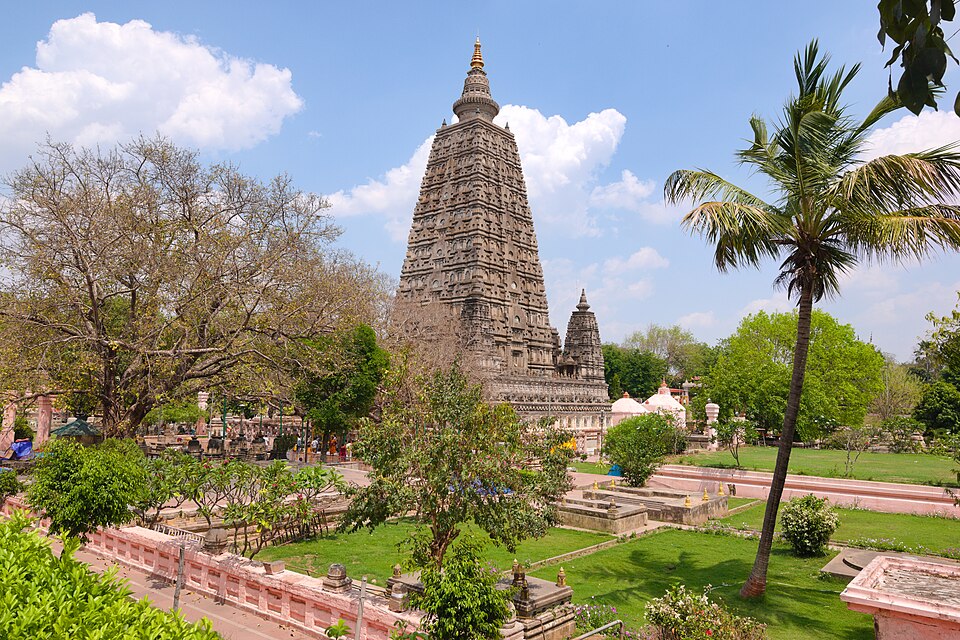
- The Mahabodhi Temple Complex at Bodh Gaya, Gaya district, Bihar, was inscribed on the UNESCO World Heritage List in 2002; the surviving brick temple is one of the earliest wholly brick Buddhist temples still standing in India and is largely of the late Gupta period
Study next
Common traps
- Attaching the Sri Lankan embassy to Chandragupta II because Fa-hien travelled in his reign: Fa-hien is a different Chinese source about a different king, and he records three monasteries at Bodh Gaya without naming a Sinhalese founder for any of them
- Assuming Xuanzang actually writes the names 'Meghavarman' and 'Samudragupta': he writes only 'a former king of Simhala' and 'the king of India'
- Reading the stem's 'Gaya' as Gaya town's Vishnupad temple rather than Bodh Gaya, where the Mahabodhi monastery stood
BPSC anchors ancient history in Bihar's own soil and hands you the source inside the stem: 'according to Chinese source', 'permission to build a Buddhist temple at Gaya', so the answer is one name attached to one place and the whole task is remembering which Gupta. UPSC prefers to interrogate the source itself: which pilgrim travelled under which king (2025), what the Allahabad pillar is associated with (2006), and which specific observations Xuanzang did and did not record about roads, ordeals and tolls (2013). Learn the pairing table in both directions (king to pilgrim and pilgrim to king) because each exam tests a different direction.
Related PYQs
The Allahabad Pillar inscription is associated with which one of the following?
- (a) Mahapadma Nanda
- (b) Chandragupta Maurya
- (c) Ashoka
- (d) Samudragupta
Answer(d) Samudragupta
The same emperor identified through the same record, and it is line 23 of this very inscription, listing 'the people of Simhala and all (other) dwellers in islands' among those seeking his commands, that corroborates the Sri Lankan embassy in the BPSC question.
Fa-hien (Faxian), the Chinese pilgrim, travelled to India during the reign of
- (a) Samudragupta
- (b) Chandragupta II
- (c) Kumaragupta I
- (d) Skandagupta
Answer(b) Chandragupta II
The mirror image of the BPSC trap: here the Chinese source belongs to Chandragupta II and Samudragupta is the distractor, so the two questions together fix which Gupta goes with which Chinese account.
Who among the following was not an Acharya in The Nalanda Vishvavidyalaya?
- (a) Nagarjuna
- (b) Kautilya
- (c) Sheelbhadra
- (d) Shantirakshit
Answer(b) Kautilya
BPSC returned two years later to the same idea: Bihar's Buddhist monastic institutions known chiefly through Chinese pilgrim accounts. Shilabhadra is remembered almost entirely because Xuanzang studied under him at Nalanda, just as the Bodh Gaya monastery is remembered only because Xuanzang described it.
Practice
- practice, not a real PYQ
The Allahabad Pillar inscription (Prayag Prashasti) recording the achievements of Samudragupta was composed by
- (a)Harishena
- (b)Vasubandhu
- (c)Virasena
- (d)Amarasimha
Answer(a) Harishena: he names himself at the end of the record as sandhivigrahika, kumaramatya and mahadandanayaka, and son of the mahadandanayaka Dhruvabhuti. - practice, not a real PYQ
The Mahabodhi Temple Complex at Bodh Gaya was inscribed on the UNESCO World Heritage List in the year
- (a)1989
- (b)2002
- (c)2007
- (d)2014
Answer(b) 2002: the complex in Gaya district, Bihar was inscribed that year; 2014 is the year the new Nalanda University began functioning, not a World Heritage date.