
Who among the following was not an Acharya in The Nalanda Vishvavidyalaya?
- (a)Nagarjuna
- (b)Kautilya
- (c)Sheelbhadra
- (d)Shantirakshit
Answer
Why
Correct — B, Kautilya. When BPSC disposed of objections and published its final revised key on 31 October 2025, it gave exactly this reasoning: Nagarjuna, Sheelbhadra and Shantirakshit are all named among the acharyas of the Nalanda Mahavihara, and Kautilya was not an acharya there. The chronology settles it before any list of names is needed. Nalanda Mahavihara was a Gupta foundation — built in 427 CE under Kumaragupta I, on a 12-hectare site in what is now Nalanda district of Bihar. Kautilya — also called Chanakya and Vishnugupta — belongs to the fourth century BCE, to the court of Chandragupta Maurya at Pataliputra, and by tradition to Takshashila in the north-west. Even the most conservative modern dating of the Arthashastra, which pushes its compilation forward into the early centuries CE, still leaves the text and its author centuries earlier than the first brick of Nalanda. More than that, Kautilya's world is a different intellectual world altogether: he is the theorist of danda, saptanga, the mandala theory of interstate relations and revenue administration — a treatise on statecraft written for a king, not a Buddhist monastic curriculum of Yogachara metaphysics, Madhyamaka dialectics, pramana logic and vinaya. Nalanda was a mahavihara, a Buddhist monastic university, and its acharyas were Buddhist masters. Its teaching roll as recorded in the scholarship includes Dharmapala, Nagarjuna, Dharmakirti, Asanga, Vasubandhu, Chandrakirti, Shilabhadra, Vajrabodhi and Dharmasvamin, and its most famous student was the Chinese pilgrim Xuanzang, who was given the Indian name Mokshadeva. Kautilya appears on no such list, in no traveller's account of the site, and in no inscription from it. He is the only name among the four options whose life, place and subject matter all sit outside Nalanda — which is precisely why the paper chose him.
Why the others are wrong
- (a)Nagarjuna — Not the answer — the Commission expressly names Nagarjuna as one of Nalanda's acharyas, and he is on the standard list of faculty associated with the mahavihara. Honesty requires one caveat a candidate should know: Nagarjuna, the Madhyamaka philosopher, is dated to roughly the 2nd century CE and so predates Nalanda's 427 CE foundation, which makes his link with the site traditional rather than documented. That does not change the marked answer.
- (c)Sheelbhadra — Not the answer — Shilabhadra is the best-attested Nalanda acharya of all. He was the venerable head of the institution when Xuanzang arrived, and Xuanzang, who visited in 637 and 642 CE and spent roughly two years there, studied Yogachara under him and described him as the incomparable teacher for whose sake the overland journey had been worth making.
- (d)Shantirakshit — Not the answer — Shantarakshita was an 8th-century scholar of Nalanda and is the reason Nalanda's learning reached the Himalayas. Invited by the Tibetan king Trisong Detsen (Khri-sron-deu-tsan), he established the monastery at Samye and served as its first abbot; his disciple Kamalashila, also of Nalanda, followed him to Tibet.
Concept
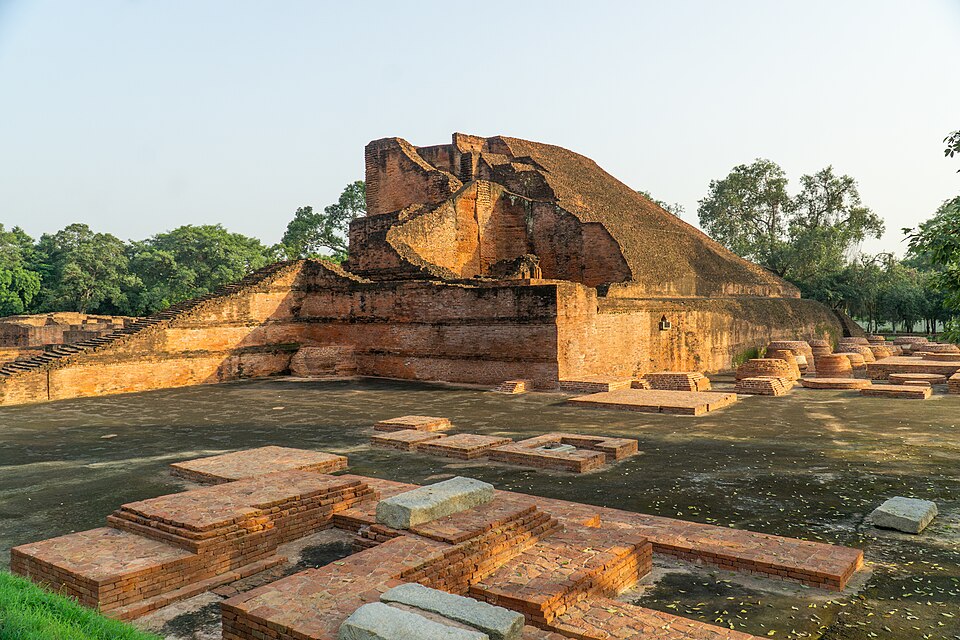
Nalanda Mahavihara was a Buddhist monastic university in Magadha, built in 427 CE under the Gupta emperor Kumaragupta I and sustained for some seven centuries by royal endowment rather than fees. Inscriptions from the site record grants of villages: Harsha alone gave 100 villages and directed 200 households in each of them to supply the monks with rice, butter and milk. That endowment is said to have supported over 1,500 teachers and 10,000 student monks — figures worth quoting with the scholars' own caution attached, since the Chinese pilgrim Yijing, visiting a few decades after Xuanzang, gives a much lower figure of somewhat over 3,000, and the excavated area is not large enough for the higher number. The excavated ruins cover about 12 hectares, roughly 490 metres by 240, with Temple 3 the most imposing structure and the monasteries laid out facing west with their drains running east. What was taught there was Buddhist: Yogachara idealism, Madhyamaka dialectics, pramana logic, vinaya discipline, and alongside them grammar, medicine and astronomy. The site was likely attacked and ransacked around 1200 CE, traditionally attributed to Muhammad Bakhtiyar Khalji, and was abandoned by about 1400. It was inscribed on the UNESCO World Heritage List in 2016 as the 'Archaeological Site of Nalanda Mahavihara at Nalanda, Bihar' — property 1502, criteria iv and vi, a 23-hectare core with a 57.88-hectare buffer.
Do not try to recall a roll of names. Date the institution, then date the man, and the odd one out falls out arithmetically. Nalanda begins in 427 CE; Kautilya belongs to the 4th century BCE; nothing else is needed. The single discriminating fact is that gap of roughly seven centuries. The trap works on two different kinds of candidate. The first is the candidate who reasons geographically: Kautilya served Chandragupta Maurya at Pataliputra, Pataliputra is Patna, Nalanda is ninety kilometres away in the same state, so surely a Bihar sage belongs to the Bihar university. The proximity is real and the inference is wrong — Nalanda simply did not exist in his lifetime. The second is the candidate who does not recognise Shantirakshit or Sheelbhadra and picks an unfamiliar name as the odd one out, which is exactly backwards: on a 'who was NOT' item, the unfamiliar names are usually the genuine specialists and the famous name is the plant. Note also the shape of the question. BPSC did not ask who WAS an acharya, which would need one fact; it asked who was NOT, which needs three. The efficient route is to find the one name whose subject is not Buddhism — Kautilya writes on kingship, taxation, espionage and war, and the other three are Buddhist philosophers. Subject matter alone gets you there in five seconds.
Key facts
- Nalanda Mahavihara was built in 427 CE under Kumaragupta I; the excavated site covers about 12 hectares (roughly 490 m by 240 m), was likely ransacked around 1200 CE and abandoned by about 1400 CE.
- Kautilya (Chanakya / Vishnugupta), 4th century BCE, was the minister of Chandragupta Maurya at Pataliputra and the author of the Arthashastra — a manual of statecraft, not a Buddhist monastic text; tradition attaches him to Takshashila, never to Nalanda.
- Shilabhadra was head of Nalanda when the Chinese pilgrim Xuanzang studied there in 637 and 642 CE, spending about two years and receiving the Indian name Mokshadeva; he learned Yogachara from Shilabhadra.
- Shantarakshita, an 8th-century Nalanda scholar, was invited to Tibet by King Trisong Detsen (Khri-sron-deu-tsan), founded the monastery at Samye and became its first abbot; his pupil Kamalashila, also of Nalanda, followed him.
- Harsha endowed Nalanda with 100 villages, with 200 households of each supplying rice, butter and milk; the site was inscribed as a UNESCO World Heritage Site in 2016 (property 1502, criteria iv and vi, 23 ha core plus a 57.88 ha buffer).
Study next
Common traps
- Assuming that because Kautilya and Nalanda are both Magadhan he must belong there — Pataliputra's Mauryan court is seven centuries earlier than Nalanda's Gupta foundation
- Treating Nagarjuna's Nalanda link as documented — he is traditionally listed among its acharyas, but he is dated to about the 2nd century CE, before the mahavihara was built
- Confusing Nagarjuna the Madhyamaka philosopher with Nagasena, the monk of the Milindapanho dialogue with King Menander — UPSC has tested the pair directly
BPSC asks Bihar's ancient institutions as a one-line odd-one-out with three genuine specialists and one famous outsider, so the marks go to whoever can date the institution rather than to whoever has memorised its roll. UPSC handles the same material obliquely: it pairs Nalanda with 'great seat of Buddhist learning' inside a matching set, asks what the Chinese pilgrims actually recorded, or tests Kautilya through the content of the Arthashastra rather than through his biography.
Related PYQs
Which of the following pairs are correctly matched? I. Lothal: Ancient dockyard II. Sarnath: First Sermon of Buddha III. Rajgir: Lion capital of Asoka IV. Nalanda: Great seat of Buddhist learning Select the correct answer using the codes given below: Codes:
- (a) I, II, III and IV
- (b) III and IV
- (c) I, II and IV
- (d) I and II
Answer(c) I, II and IV
The same identification the BPSC item depends on — Nalanda as a Buddhist seat of learning, and therefore a place whose acharyas were Buddhist masters. UPSC also plants the Rajgir–Lion capital error, which is the same technique BPSC used with Kautilya: a real Bihar place attached to the wrong thing.
Among the following, who was not a proponent of bhakti cult ?
- (a) Nagarjuna
- (b) Tukaram
- (c) Tyagaraja
- (d) Vallabhacharya
Answer(a) Nagarjuna
The identical exam move on the identical name: a 'who was NOT' item solved by noticing that one teacher belongs to a different tradition from the other three. Here Nagarjuna is the odd one out because he is a Buddhist Madhyamaka philosopher among bhakti saints; in the BPSC item he is one of the three Buddhists and Kautilya is the outsider.
Practice
- practice — not a real PYQ
The Nalanda Mahavihara was founded during the reign of which ruler?
- (a)Ashoka
- (b)Kanishka
- (c)Kumaragupta I
- (d)Harshavardhana
Answer(c) Kumaragupta I — Nalanda was built in 427 CE under the Gupta emperor Kumaragupta I. Harshavardhana was a later patron who endowed it with 100 villages, not its founder; Ashoka and Kanishka are centuries earlier. - practice — not a real PYQ
Which Nalanda scholar was invited to Tibet, where he founded the monastery at Samye and became its first abbot?
- (a)Shilabhadra
- (b)Dharmakirti
- (c)Atisha Dipankara
- (d)Shantarakshita
Answer(d) Shantarakshita — the 8th-century Nalanda scholar invited by the Tibetan king Trisong Detsen, who established Samye and was its first abbot. Shilabhadra headed Nalanda in Xuanzang's time; Atisha Dipankara went to Tibet in the 11th century and is associated with Vikramshila.