
Which of the following is not a UNESCO World Heritage Site?
- (a)Qutb Minar
- (b)Red Fort
- (c)India Gate
- (d)None of the above
Answer
Why
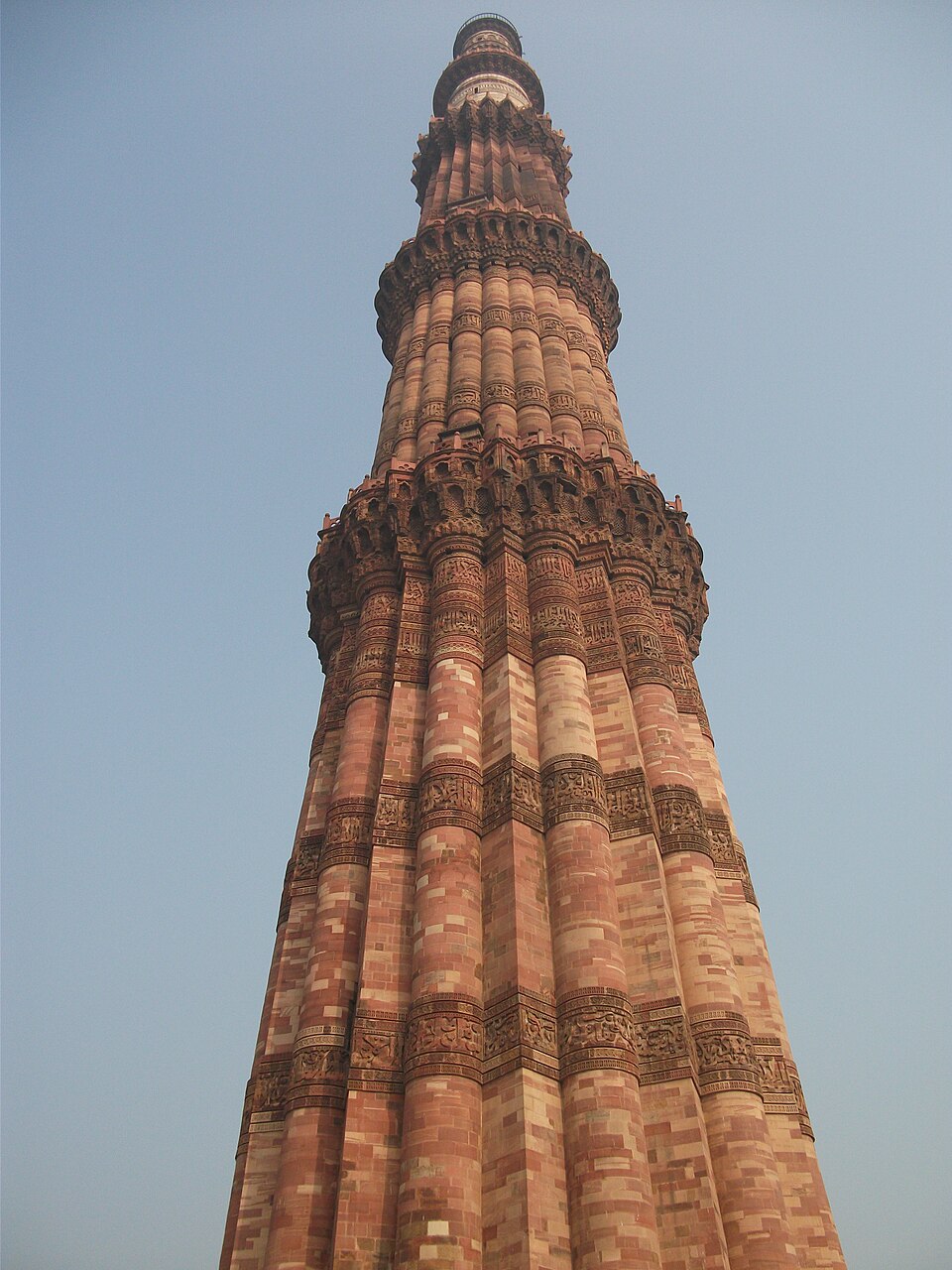
Correct: C, India Gate. Two of the three named structures sit on UNESCO's World Heritage List and the third does not, and the List itself settles it. 'Qutb Minar and its Monuments, Delhi' was inscribed in 1993 as property number 233 under cultural criterion (iv); UNESCO's own citation describes a red sandstone tower 72.5 m high, tapering from 14.32 m in diameter at its base to 2.75 m at the top, standing in an archaeological area that also holds the Alai Darwaza of 1311 and the Quwwatu'l-Islam, the oldest mosque in northern India, built of material reused from some twenty Brahman temples. The 'Red Fort Complex' was inscribed in 2007 as property number 231 under criteria (ii), (iii) and (vi); the inscribed property is not the fort alone but Shah Jahan's palace fort of Shahjahanabad together with the adjoining Salimgarh, built by Islam Shah Suri in 1546, and the citation singles out the Nahr-i-Behisht, the water channel running through the private pavilions. India Gate appears nowhere on that List. It is the All India War Memorial on Kartavya Path in New Delhi, designed by Sir Edwin Lutyens and raised for the Indian soldiers who died in the First World War and the Third Anglo-Afghan War: a national memorial of the first rank, but a memorial that has never been nominated for World Heritage inscription. Inscription is not a prize for fame, scale or age: under the 1972 World Heritage Convention, which India ratified on 14 November 1977, a property must first be placed on its country's Tentative List, then formally nominated by the State Party, then evaluated by ICOMOS (for cultural property) or IUCN (for natural property), and finally judged by the 21-member World Heritage Committee to carry Outstanding Universal Value against at least one of ten criteria. India Gate has never entered that pipeline. Because (c) names a genuine non-listed structure, option (d) cannot stand.
Why the others are wrong
- (a)Qutb Minar: Qutb Minar has been a World Heritage Site since 1993: one of India's earliest inscriptions and one of Delhi's three. The option tempts candidates in two ways: a negative stem invites you to tick the first famous name you see, and the listed property is technically 'Qutb Minar and its Monuments', the whole Mehrauli complex, which makes some candidates wonder whether the tower on its own qualifies. It does; the tower is the core of the inscribed property.
- (b)Red Fort: The Red Fort Complex was inscribed in 2007, fourteen years after Qutb Minar and Humayun's Tomb, so a candidate whose mental list of Delhi sites was formed from an older textbook may genuinely not have it. It is also the site of the Prime Minister's Independence Day address, which makes it feel like a political landmark rather than a heritage property. Both intuitions are wrong: it is property number 231 on the List.
- (d)None of the above: Choosing this asserts that all three named structures are World Heritage Sites. That fails on India Gate, which is not on the List and has never been nominated to it. BPSC offers 'None of the above' as option (d) throughout this paper, and it is correct only when every named item satisfies the stem: here one plainly does not, so the option collapses.
Concept
The World Heritage List is created by the Convention Concerning the Protection of the World Cultural and Natural Heritage, adopted by the UNESCO General Conference in 1972; India ratified it on 14 November 1977. A property enters only through a fixed sequence: the country places it on its national Tentative List, nominates it, an advisory body evaluates it (ICOMOS for cultural sites, IUCN for natural ones, ICCROM advising on conservation), and the 21-member World Heritage Committee decides. The test is Outstanding Universal Value, established against ten criteria: (i) to (vi) are cultural, covering human creative genius, interchange of values, testimony to a tradition, an outstanding type of building or landscape, traditional settlement, and association with living traditions or ideas; (vii) to (x) are natural, covering natural beauty, earth history, ecological processes and biodiversity. Properties are accordingly classed as cultural, natural or mixed. The List today holds 1,273 properties (991 cultural, 240 natural and 42 mixed) of which 61 are also on the separate List of World Heritage in Danger. India has 45 inscribed properties, sixth in the world behind Italy (62), China (61), France (56), Germany (55) and Spain (50).
The first move on this item is to notice the word 'not': a negative stem, and BPSC uses them freely. The second move is to recall that Delhi's World Heritage properties form a small, closed set of exactly three: Qutb Minar and its Monuments (1993), Humayun's Tomb (1993) and the Red Fort Complex (2007). Two of those three are sitting in the options, which means the odd one out is the item that is not in the set: India Gate. That is the single discriminating fact, and it is more reliable than reasoning from the character of the building. In particular, do not eliminate India Gate on the ground that it is colonial or twentieth-century, because that reasoning fails elsewhere: Chhatrapati Shivaji Terminus, built by the British in 1887, was inscribed in 2004; the Victorian Gothic and Art Deco Ensembles of Mumbai were inscribed in 2018; and Le Corbusier's Capitol Complex at Chandigarh, completed in the 1950s, is part of a seven-country transnational property inscribed in 2016. India Gate is absent for the procedural reason, not an aesthetic one: India has simply never nominated it. Finally, treat 'None of the above' as a claim to be tested rather than a safe hedge: it is right only if every named item is on the List, and one demonstrably is not.
Key facts
- Delhi's three World Heritage properties: Qutb Minar and its Monuments (inscribed 1993, ref. 233, criterion iv), Humayun's Tomb (1993, ref. 232, criteria ii and iv) and the Red Fort Complex (2007, ref. 231, criteria ii, iii and vi)
- Bihar has two: the Mahabodhi Temple Complex at Bodh Gaya, inscribed in 2002 under criteria (i), (ii), (iii), (iv) and (vi), and the Archaeological Site of Nalanda Mahavihara, inscribed in 2016 under criteria (iv) and (vi)
- India ratified the 1972 World Heritage Convention on 14 November 1977 and now has 45 inscribed properties, sixth-highest in the world after Italy (62), China (61), France (56), Germany (55) and Spain (50)
- India's tally stood at 42 when this paper was set: Santiniketan and the Sacred Ensembles of the Hoysalas were both inscribed at the extended 45th session in September 2023, with the Moidams of the Ahom dynasty following in 2024 and the Maratha Military Landscapes of India in 2025
- The World Heritage List holds 1,273 properties worldwide (991 cultural, 240 natural, 42 mixed) of which 61 are on the List of World Heritage in Danger
- UNESCO's citation for Qutb Minar records a 72.5 m red sandstone tower, 14.32 m in diameter at the base narrowing to 2.75 m at the top, with the Alai Darwaza of 1311 and the Quwwatu'l-Islam, northern India's oldest mosque, in the same complex
- Colonial and modern buildings are not excluded from the List: Chhatrapati Shivaji Terminus (2004), Le Corbusier's Chandigarh Capitol Complex within a seven-country transnational property (2016) and the Victorian Gothic and Art Deco Ensembles of Mumbai (2018) are all inscribed
Study next
Common traps
- Reading past the word 'not' in a negative stem and answering with the site you recognise best
- Treating UNESCO's four separate designations as one list: a Biosphere Reserve, a Ramsar site, an Intangible Cultural Heritage element and a World Heritage property are four different things with four different procedures
- Assuming colonial-era or twentieth-century architecture cannot be inscribed, when Chhatrapati Shivaji Terminus, the Mumbai Art Deco ensembles and Chandigarh's Capitol Complex all are
BPSC asks this as one-line recognition (is this named place on the List, in which district does it lie, in which year was it added) usually with 'None of the above' waiting as option (d) to punish a half-remembered list. UPSC almost never asks a bare yes-or-no: it builds counting and matching items instead, as in 2024 when it asked how many of Shantiniketan, Rani-ki-Vav, the Hoysala ensembles and Mahabodhi were inscribed specifically in 2023, and in 2005 when it asked which of four named properties were on the List. The UPSC skill is the exact inscription year; the BPSC skill is spotting the famous name that was never listed at all.
Related PYQs
Consider the following statements: 1. Champaner - Pavagadh Archaeological Park 2. Chhatrapati Shivaji Railway Station, Mumbai 3. Mamallapuram 4. Sun Temple (Konark Temple) Which of the above are included in the World Heritage List of UNESCO?
- (a) 1, 2 and 3
- (b) 1, 3 and 4
- (c) 2 and 4
- (d) 1, 2, 3 and 4
Answer(d) 1, 2, 3 and 4
The same test of whether a named Indian monument actually carries World Heritage inscription, run in the positive direction. It also makes the point the BPSC item depends on: Chhatrapati Shivaji Terminus, a British-built railway station of 1887, is on the List, so being colonial is no bar: India Gate's absence is about nomination, not about who built it.
Consider the following properties included in the World Heritage List released by UNESCO: 1. Shantiniketan 2. Rani-ki-Vav 3. Sacred Ensembles of the Hoysalas 4. Mahabodhi Temple Complex at Bodhgaya How many of the above properties were included in 2023?
- (a) Only one
- (b) Only two
- (c) Only three
- (d) All four
Answer(b) Only two
The same list, one year later and one level harder: UPSC assumes you know these are all inscribed and asks for the inscription years instead. Bihar's Mahabodhi Temple Complex is in the set, dated 2002, which is exactly the kind of year a BPSC candidate is expected to carry.
What is the name of the 16th-century stepwell that the Archaeological Survey of India recently conserved in collaboration with the World Monuments Fund India?
- (a) Agrasen ki Baoli
- (b) Rajon ki Baoli
- (c) Chauki Bavdi
- (d) More than one of the above
Answer(b) Rajon ki Baoli
BPSC returning two years later to the same skill, which specific named monument carries a specific heritage designation or intervention. The overlap is unusually close: Rajon ki Baoli stands in the Mehrauli Archaeological Park, the same stretch of south Delhi as the inscribed Qutb complex, and the two questions punish the same candidate, the one who knows the monuments by name but has never checked which formal status attaches to which.
Practice
- practice, not a real PYQ
Which of the following UNESCO World Heritage Sites is located in Bihar?
- (a)Khajuraho Group of Monuments
- (b)Mahabodhi Temple Complex
- (c)Sun Temple, Konark
- (d)Rock Shelters of Bhimbetka
Answer(b) Mahabodhi Temple Complex: at Bodh Gaya, inscribed in 2002; Bihar's other World Heritage property is the Archaeological Site of Nalanda Mahavihara, inscribed in 2016. Khajuraho and Bhimbetka are in Madhya Pradesh and Konark is in Odisha. - practice, not a real PYQ
In which year was the Red Fort Complex inscribed on the UNESCO World Heritage List?
- (a)1983
- (b)1993
- (c)2007
- (d)2016
Answer(c) 2007: Delhi's other two properties, Qutb Minar and its Monuments and Humayun's Tomb, were both inscribed in 1993.