
What is the name of the 16th-century stepwell that the Archaeological Survey of India recently conserved in collaboration with the World Monuments Fund India?
- (a)Agrasen ki Baoli
- (b)Rajon ki Baoli
- (c)Chauki Bavdi
- (d)More than one of the above
Answer
Why
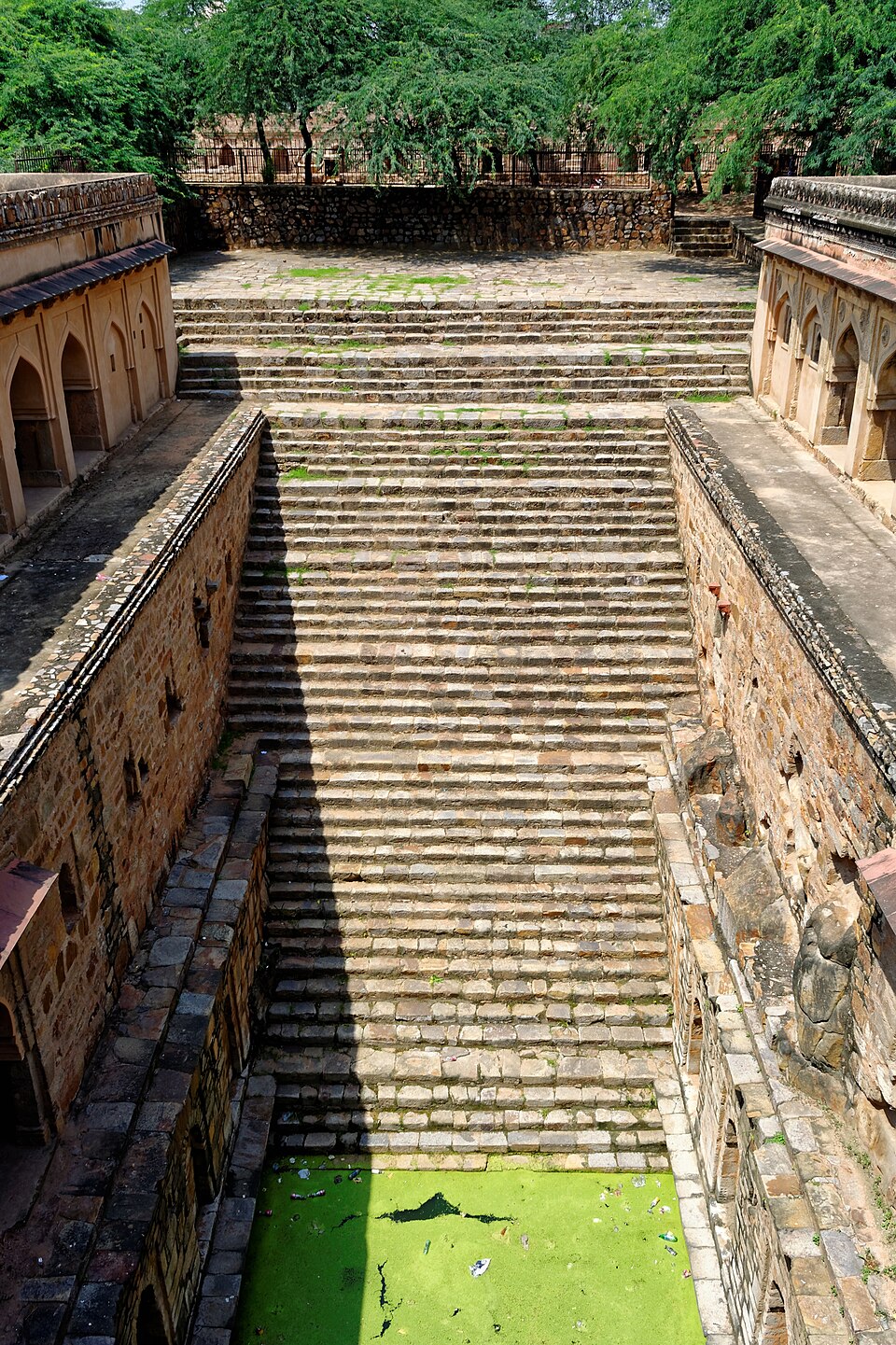
Correct — B, Rajon ki Baoli. This is the stepwell inside the Mehrauli Archaeological Park in south Delhi, and it satisfies both halves of the stem exactly. The date: it was commissioned in 1506 CE by Daulat Khan, an administrator of the Lodi dynasty, in the reign of Sikandar Lodi — the sixteenth century, and the last generation of Delhi Sultanate rule before Babur. The project: the Archaeological Survey of India announced on 16 May 2025, four months before this paper was set, that it had completed the conservation of the baoli in collaboration with World Monuments Fund India and the TCS Foundation, under WMF India's 'Historic Water Systems of India' initiative, which is itself aligned to the World Monuments Fund's Climate Heritage Initiative. The monument is on the ASI's list of Monuments of National Importance, registered as 'Rajon-ki-Bain with Mosque and Chhatri', reference N-DL-152. What the work involved is worth knowing, because it explains why a 500-year-old well became news: it was cleaned and desilted, connected to a proper drainage system, structurally repaired and had its water quality restored — fish were introduced to help keep the water healthy — with traditional lime plaster and lime mortar used throughout so that the Lodi-era character of the masonry survived the repair, and with local communities brought in through education and participatory conservation programmes. ASI's own description gives the scale: a four-tiered stepwell spread over 1,610 square metres, descending 13.4 metres, with a main tank measuring 23 by 10 metres at its base, its arched colonnades carrying stucco medallions in floral and geometric patterns. It is open to the public again. The name, incidentally, has nothing to do with any ruler: 'Rajon' comes from the raj-mistris, the masons who settled at the site in the early twentieth century.
Why the others are wrong
- (a)Agrasen ki Baoli — Delhi's most famous stepwell, and therefore the option the item is built to draw — but it is the wrong monument on both of the stem's tests. It stands on Hailey Road near Connaught Place and Jantar Mantar, not in Mehrauli; it measures about 60 metres by 15 metres, with 108 steps and three visible levels; and no historical record names its builder, tradition merely crediting the Aggarwal community's legendary ancestor Agrasen, with the surviving fabric placed loosely in the Tughlaq–Lodi range rather than at a documented sixteenth-century commission. Decisively, it was not the monument in the ASI–World Monuments Fund India project. Its fame is cinematic rather than archaeological — PK, Sultan, Mom and Kabhi Alvida Naa Kehna were all shot there — which is exactly why the name surfaces first from memory.
- (c)Chauki Bavdi — No stepwell of this name figures in the ASI–World Monuments Fund India project, and none of Delhi's documented baolis carries it — the city's known survivors are Rajon ki Baoli and Gandhak ki Baoli in Mehrauli, Agrasen ki Baoli off Hailey Road, and the baolis inside the Red Fort and Purana Qila complexes. The option is built to sound right: 'bavdi', 'bawdi', 'baori', 'baoli' and 'vav' are all genuine regional words for the same stepped well, descended from the Sanskrit vapi, so an unfamiliar name from that family reads as plausible to anyone who knows the vocabulary but not the monument list.
- (d)More than one of the above — The stem is doubly specific — one sixteenth-century stepwell, one named collaboration between the ASI and World Monuments Fund India — and only Rajon ki Baoli satisfies both conditions. Agrasen ki Baoli fails the project test outright and has no securely documented sixteenth-century date, and the third name is not a monument in that project at all. With exactly one option true, this one cannot be. Note how BPSC uses the fourth option here: not to reward partial knowledge but to punish it, because the candidate who correctly recognises that both 'Agrasen' and 'Rajon' are real Delhi baolis is precisely the one tempted to combine them and lose 1/3 mark.
Concept
A baoli — bawdi in parts of the Deccan, vav or vavdi in Gujarat and Rajasthan, all descended from the Sanskrit vapi — is a well reached by a descending flight of steps, so that water can be drawn by hand at whatever level the water table happens to stand. That one design idea solves a problem an ordinary well cannot: in a monsoon climate the depth to water swings by many metres between the end of the rains and the end of summer, and a stepwell simply lets the drawer walk further down. Everything else follows from the steps. Because the shaft is deep, wide and shaded, air at the bottom stays markedly cooler than at the surface, so the baoli doubled as a place of rest, assembly and shelter for travellers; and because water in India was never purely utilitarian, the form attracted architecture — colonnaded galleries, arched niches, carved brackets and, in the grandest examples, sculpture on every tier. That is why stepwells cluster along old caravan routes and beside mosques, temples and tombs, and why Rajon ki Baoli sits within an enclosure that also holds a mosque and a chhatri tomb. The tradition runs from the reservoirs of Harappan Dholavira, through the Solanki masterpiece of Rani-ki-Vav at Patan (a UNESCO World Heritage property since 2014) and Chand Baori at Abhaneri, to the Sultanate baolis of Delhi. Bihar solved the same problem differently: the ahar-pyne system of the Magadh region, in which pynes divert hill streams into ahars, embanked catchment reservoirs. Piped supply made all of these redundant in the twentieth century; falling urban water tables are now making them useful again, which is precisely the premise of the Climate Heritage Initiative under which this restoration was funded.
The stem hands you two independent filters, and applying both in order is the whole technique. Filter one is the century. 'Sixteenth-century' is not decoration: Rajon ki Baoli carries a firm 1506 commission under Sikandar Lodi, whereas Agrasen ki Baoli has neither a documented builder nor a documented date — its fabric is placed loosely across the Tughlaq–Lodi range, and no question-setter would describe an undated monument as sixteenth-century. Filter two is the partner. World Monuments Fund India's stepwell work in Delhi runs under its 'Historic Water Systems of India' programme with the TCS Foundation, and Rajon ki Baoli is the project the ASI announced under it on 16 May 2025. Either filter alone leaves Rajon ki Baoli standing; both together make it certain, and since only one option can then be true, (d) falls with the rest. If you carry a single discriminating line into the hall, make it this: the ASI–WMFI stepwell is the Mehrauli one, not the Connaught Place one. The trap is pure name recognition, and it is strong. Agrasen ki Baoli is the stepwell of Delhi photo-walks and of half a dozen Hindi films, so it is what memory offers the instant the word 'baoli' appears, while Rajon ki Baoli sits inside an archaeological park most Delhi residents have never walked through. A candidate who answers from familiarity rather than from the two conditions actually printed in the stem loses a mark and a third under the paper's negative marking. Anchor the timing too: 'recently' here means as of the 13 September 2025 exam, and the conservation had been completed and publicised four months earlier; the baoli has been open to visitors since.
Key facts
- Rajon ki Baoli — formally 'Rajon-ki-Bain with Mosque and Chhatri', ASI Monument of National Importance N-DL-152 — was commissioned in 1506 CE by Daulat Khan, an administrator of the Lodi dynasty, and stands in the Mehrauli Archaeological Park, Delhi, close to Jamali-Kamali, Adham Khan's tomb and Gandhak ki Baoli.
- The ASI announced completion of the conservation on 16 May 2025, working with World Monuments Fund India and the TCS Foundation under WMFI's 'Historic Water Systems of India' initiative, aligned with the World Monuments Fund's Climate Heritage Initiative.
- The work covered cleaning, desilting, connection to a proper drainage system, structural repair and water-quality improvement — fish were introduced to help keep the water healthy — using traditional lime plaster and lime mortar to retain the Lodi-era character; the baoli has reopened to the public.
- ASI's own figures for the monument: a four-tiered stepwell spread over 1,610 square metres, descending to a depth of 13.4 metres, with a main tank measuring 23 by 10 metres at its base, and arched colonnades bearing stucco medallions in floral and geometric patterns.
- The name derives from the raj-mistris or masons who settled at the site in the early twentieth century, not from a ruler; by contrast Agrasen ki Baoli on Hailey Road is about 60 m by 15 m with 108 steps and three visible levels, protected under the Ancient Monuments and Archaeological Sites and Remains Act, 1958, with no recorded builder or date.
Study next
Common traps
- Answering with the most famous stepwell (Agrasen ki Baoli) instead of the one that satisfies the two conditions actually printed in the stem — the century and the named partner.
- Assuming every heritage project in Delhi belongs to the same body — INTACH, the DDA, the Aga Khan Trust for Culture and World Monuments Fund India all run distinct projects in and around Mehrauli.
- Treating 'baoli', 'bavdi' and 'vav' as different kinds of structure; they are regional names for the same stepped well, which is exactly what makes an invented third name look credible.
- Reading 'Rajon' as a royal reference — it comes from raj-mistris, masons, and the naming is only about a century old.
BPSC treats heritage as current affairs rather than as art history: it takes a monument that appeared in a government press release in the same year, attaches one identifying tag — the century, the conserving agency, the foreign partner — and offers three names from the same family. Nothing about the architecture is tested; what is tested is whether you read the PIB feed between May and September 2025. UPSC does close to the opposite. It rarely names a conserving agency and almost never a single recent project; instead it asks the idea behind the monument — which ancient town ran bunds, check-dams and connected reservoirs (Dholavira, 2021), or how many of four listed properties entered the World Heritage List in 2023 — so the UPSC candidate has to know why stepwells and reservoir systems exist at all, while the BPSC candidate has to know which one was in the news.
Related PYQs
Which one of the following ancient towns is well-known for its elaborate system of water harvesting and management where a series of bunds created check-dams and canals carried the water to connected reservoirs?
- (a) Dholavira
- (b) Kalibangan
- (c) Rakhigarhi
- (d) Ropar
Answer(a) Dholavira
The same subject — historic water architecture in India — asked the way UPSC asks it. Dholavira in the Rann of Kachchh is the Harappan end of the tradition that Rajon ki Baoli sits in the medieval middle of: both are engineered answers to a climate where the water available swings enormously between seasons, and both are now read as heritage worth restoring for that reason.
Consider the following properties included in the World Heritage List released by UNESCO: 1. Shantiniketan 2. Rani-ki-Vav 3. Sacred Ensembles of the Hoysalas 4. Mahabodhi Temple Complex at Bodhgaya How many of the above properties were included in 2023?
- (a) Only one
- (b) Only two
- (c) Only three
- (d) All four
Answer(b) Only two
Item 2 is Rani-ki-Vav at Patan, the stepwell that carries India's stepwell tradition onto the World Heritage List, and the item as a whole tests exactly what the BPSC question tests — attaching the right protection status, agency and year to a named monument rather than merely recognising the name.
Practice
- practice — not a real PYQ
Rani-ki-Vav, the stepwell inscribed on the UNESCO World Heritage List, is located in which State?
- (a)Rajasthan
- (b)Gujarat
- (c)Madhya Pradesh
- (d)Maharashtra
Answer(b) Gujarat — Rani-ki-Vav stands on the bank of the Saraswati at Patan in Gujarat, was built in the Solanki period and was inscribed on the UNESCO World Heritage List in 2014. Rajasthan's best-known stepwell is Chand Baori at Abhaneri, which is not a World Heritage property. - practice — not a real PYQ
The ahar-pyne system, a traditional method of water harvesting and irrigation, is chiefly associated with which region?
- (a)South Bihar
- (b)Coastal Kerala
- (c)The Kashmir Valley
- (d)The Konkan coast
Answer(a) South Bihar — pynes are diversion channels taken off hill streams and ahars are embanked catchment reservoirs, long used together across the Magadh region of south Bihar. Kashmir's traditional channels are kuhls, and Rajasthan's are johads and tankas.