
What is the name of the deep-sea submersible that imploded during an underwater voyage to the Titanic wreckage?
- (a)Alvin
- (b)Falcon
- (c)Trident
- (d)Titan
Answer
Why
Correct: D, Titan. Titan was the five-person submersible operated by the American expedition company OceanGate, and it imploded on 18 June 2023 during a dive to the wreck of the Titanic in the North Atlantic off Newfoundland. The dive began that morning after the craft was launched from its support ship, the MV Polar Prince; communication was lost 1 hour and 33 minutes into the descent, and when Titan failed to surface at the appointed time an international search led by the US Coast Guard, the US Navy and the Canadian Coast Guard began. It was already over. US Navy acoustic sensors had picked up a signature consistent with an implosion at about the time contact was lost, and on 22 June a remotely operated vehicle located a debris field roughly 500 metres from the bow of the Titanic. All five aboard died: Stockton Rush, OceanGate's chief executive, who was piloting; the French deep-sea explorer and Titanic expert Paul-Henri Nargeolet; the British businessman Hamish Harding; and Shahzada Dawood with his nineteen-year-old son Suleman. The engineering is the part worth carrying away. The Titanic lies about 3,800 metres down, where the sea presses in at roughly 380 atmospheres: close to 5,600 pounds on every square inch. Titan was 6.7 metres long and weighed about 10.4 tonnes, and its pressure hull was an unusual one: a wound carbon-fibre cylinder capped with titanium hemispheres, where crewed deep submersibles are conventionally built as titanium or steel spheres. It carried life support for five people for 96 hours and was steered with a modified wireless game controller. Crucially, it had never been classed or certified by any regulatory authority or classification society, and while operating in international waters and carrying 'mission specialists' rather than passengers it was not required to be. When a hull fails at that pressure the collapse is inward and effectively instantaneous. The US Coast Guard convened a Marine Board of Investigation, its highest level of marine casualty inquiry, and the National Transportation Safety Board ran a parallel investigation.
Why the others are wrong
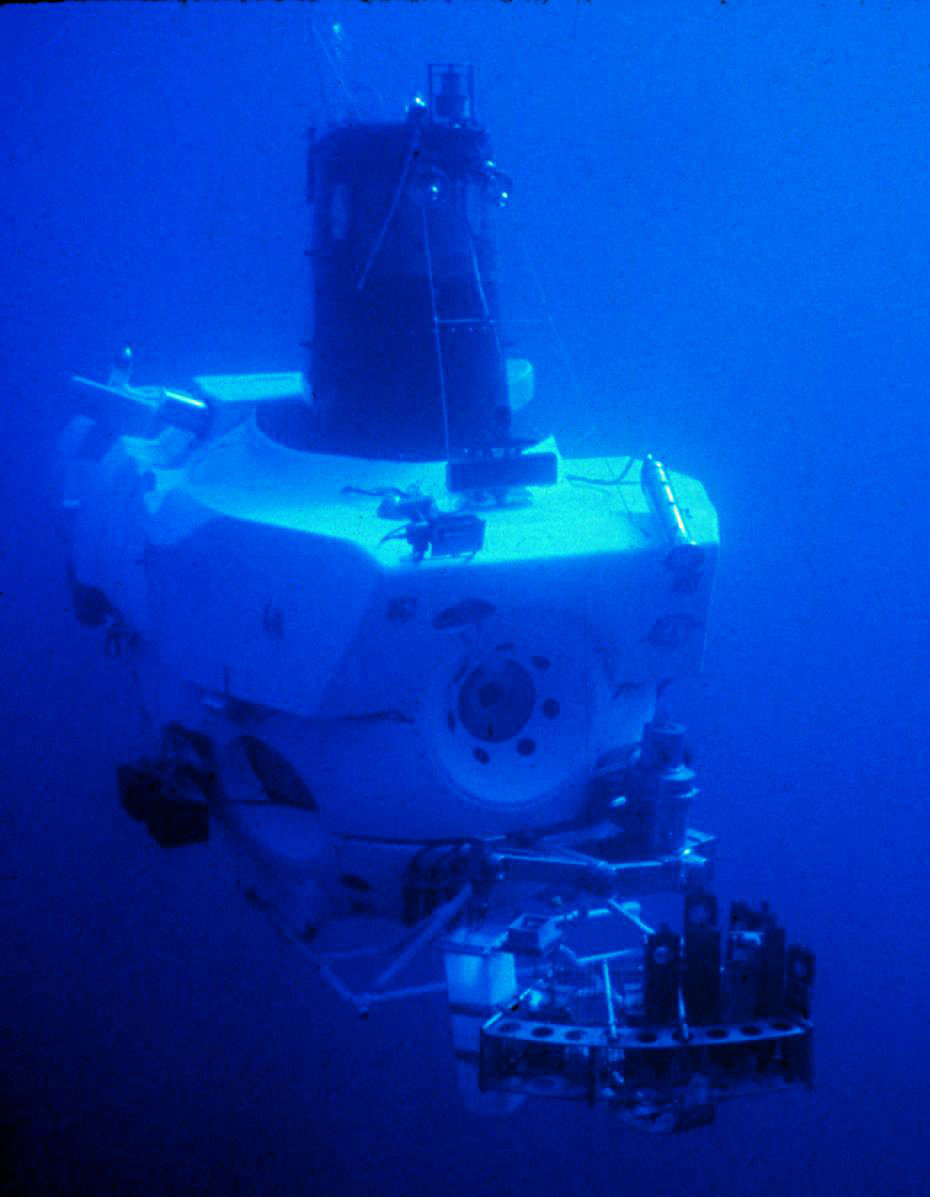
- (a)Alvin: The one distractor a well-read candidate can genuinely fall for, because Alvin is a real deep-sea submersible with a real Titanic connection. DSV Alvin is owned by the United States Navy and operated by the Woods Hole Oceanographic Institution; commissioned on 5 June 1964, it carried Robert Ballard and two companions down to the Titanic wreck in 1986: the first crewed visit to the wreck, made with the small tethered robot Jason Jr. and produced the photographs that fixed the site in the public imagination. Alvin also took scientists to the first deep-sea hydrothermal vents on the Galapagos Rift in 1977. It is a titanium-sphere craft, rebuilt over the last decade and certified to 6,500 metres, and it had nothing whatever to do with the 2023 accident.
- (b)Falcon: Borrowed from a different corner of the vehicle world. The name is familiar from aviation and spaceflight: Dassault's Falcon business jets, SpaceX's Falcon 9 launcher, which is exactly why it reads as a plausible name for a research craft when it appears in a list of four. Nothing called Falcon was the submersible lost on the Titanic dive, and the option survives on nothing more than the general sense that it sounds like a machine.
- (c)Trident: Also borrowed, and from closer to the water, which is what makes it tempting. Trident is best known as the submarine-launched ballistic missile system carried by American Ohio-class and British Vanguard-class submarines, so the word already sits in the undersea register; a trident is also the three-pronged spear of Poseidon, god of the sea. Neither association attaches it to OceanGate, and no crewed submersible of that name was diving on the Titanic in June 2023.
Concept
Pressure in the sea rises by roughly one atmosphere for every 10 metres of depth, so at the Titanic's 3,800 metres a hull is holding back about 380 atmospheres: the weight of nearly four kilometres of water on every part of its surface. That is why crewed deep submersibles are built the way they are: a sphere, because a sphere distributes uniform external pressure evenly and has no flat face to buckle, and usually in titanium or high-strength steel, metals that behave predictably under repeated compression. A failure under those conditions is an implosion, not an explosion: the surroundings collapse into the void inside the hull, and at that pressure the collapse is over in milliseconds. Composite materials such as carbon fibre are superb in tension, which is why aircraft and rockets use them, but under thousands of cycles of compression they can accumulate invisible damage: fibres micro-buckle, layers separate, and the hull's margin quietly shrinks with each dive. The industry's answer to that risk is classification: independent survey and certification by a body such as the American Bureau of Shipping, DNV or Lloyd's Register, which Titan never had. India's counterpart programme is the Deep Ocean Mission, cleared by the Cabinet Committee on Economic Affairs on 16 June 2021, with the Ministry of Earth Sciences as nodal ministry, at an estimated ₹4,077 crore over five years, whose Samudrayaan component is building the crewed submersible Matsya-6000 at the National Institute of Ocean Technology to carry three people to 6,000 metres with 72 hours of endurance.
This is a straight current-affairs recall item, and the way to reason through it is to ask which of the four names actually belongs to a crewed deep-sea submersible in a tourism operation, not merely which one sounds nautical. Two of the four (Falcon and Trident) are names from aviation, spaceflight and naval weaponry that a setter can drop in confident that they will feel plausible. The genuine competition is between Alvin and Titan, and here the trap is well designed: Alvin is a real submersible that really did dive on the Titanic, in 1986, with Robert Ballard aboard. The single fact that discriminates is ownership and purpose. Alvin is a US Navy-owned, WHOI-operated research submersible built in 1964 and still working; Titan was a privately built, uncertified carbon-fibre craft operated commercially by OceanGate to take paying 'mission specialists' to the wreck at about US$250,000 a seat. The accident of June 2023 belongs to the second. A candidate who missed the news can still get there by the name-echo (Titan against Titanic, a pairing that was widely remarked on at the time) although it is worth knowing that the craft was originally christened Cyclops 2 and renamed before the Titanic dives began, so the resemblance was chosen, not coincidental. Note also what the stem gets right, which examiners often get wrong: it says imploded, not sank or exploded. That verb is the physics of the event.
Key facts
- Titan, operated by OceanGate, imploded on 18 June 2023 on a dive to the Titanic wreck off Newfoundland; contact with the support ship MV Polar Prince was lost 1 hour 33 minutes into the descent, and a debris field was found about 500 metres from the Titanic's bow on 22 June 2023.
- The five who died were Stockton Rush (OceanGate's chief executive, piloting), Paul-Henri Nargeolet, Hamish Harding, Shahzada Dawood and Suleman Dawood.
- Titan's specification: 6.7 m long, about 10,432 kg, a carbon-fibre pressure cylinder with titanium end domes, rated by its operator to 4,000 m, 96-hour life support for five, steered by a modified wireless game controller, and never certified by any classification society or regulator.
- The Titanic sank on 15 April 1912 after striking an iceberg, with more than 1,500 deaths; the wreck was found in 1985 and lies about 3,800 m (12,500 ft) deep, where pressure is roughly 380 atmospheres or about 5,600 psi.
- DSV Alvin, the other Titanic submersible, is US Navy-owned and WHOI-operated, was commissioned on 5 June 1964, took Robert Ballard to the wreck in 1986, and is now certified to 6,500 m.
- India's Deep Ocean Mission was cleared by the Cabinet Committee on Economic Affairs on 16 June 2021 with the Ministry of Earth Sciences as nodal ministry, at an estimated ₹4,077 crore over five years (₹2,823.4 crore for the first phase, 2021–24); its Samudrayaan leg is developing Matsya-6000, a three-person submersible for 6,000 m built by the National Institute of Ocean Technology.
Study next
Common traps
- Choosing Alvin because it is associated with the Titanic: Alvin took Robert Ballard to the wreck in 1986 and is still in service; Titan is the craft lost in 2023
- Writing that the submersible 'sank' or 'exploded': at 3,800 metres a hull failure is an inward implosion, which is also why no rescue was ever possible
- Assuming an international safety regulator had cleared the craft: Titan was uncertified, and operating in international waters kept it outside the rules that govern passenger vessels
BPSC asks current affairs as flat proper-noun recall (name the craft, name the city, name the trophy) with three plausible-sounding decoys and no reasoning route for a candidate who simply did not read the news that year; this paper carries a run of such items in the forties. UPSC almost never asks for the name of a news object. It converts the same story into a testable concept: the objectives of the Deep Ocean Mission, what polymetallic nodules are, which body allots seabed exploration rights, or how pressure varies with depth: questions a candidate can reason towards even without the headline.
Related PYQs
Which of the following pairs is/are correctly matched? Inventor : Invention 1. Christopher Cockerell : Hovercraft 2. David Bushnell : Submarine 3. J. C. Perrier : Steamship Select the correct answer using the code given below:
- (a) 1, 2 and 3
- (b) 1 and 2 only
- (c) 2 and 3 only
- (d) 1 and 3 only
Answer(b) 1 and 2 only
The same subject (crewed craft that carry people under water) approached from its origins rather than its news. David Bushnell's Turtle of 1775 was the first submarine built for combat, and the line from that one-man wooden barrel to a carbon-fibre cylinder at 3,800 metres is the same engineering problem: keeping a person alive inside a pressure hull.
What is the primary objective of the Lunar Trailblazer mission?
- (a) To detect and map water on the Moon’s surface
- (b) To create a 3D model of the entire Moon
- (c) To test new lunar rovers
- (d) More than one of the above
Answer(a) To detect and map water on the Moon’s surface
Two years later the Commission asked the same kind of item: one named exploration craft from the previous year's international news, decided purely on whether the candidate followed the story. Titan was the deep-sea version; Lunar Trailblazer is the space version, and both reward the aspirant who tracks named missions and vehicles month by month.
Practice
- practice, not a real PYQ
Under which mission is India developing the crewed submersible 'Matsya-6000' to carry a crew to a depth of 6,000 metres?
- (a)Deep Ocean Mission
- (b)Sagarmala
- (c)O-SMART
- (d)Blue Revolution
Answer(a) Deep Ocean Mission: cleared by the Cabinet Committee on Economic Affairs on 16 June 2021 with the Ministry of Earth Sciences as nodal ministry; its Samudrayaan component is building Matsya-6000 at the National Institute of Ocean Technology to take three people to 6,000 m. Sagarmala is a port-led development programme and Blue Revolution concerns fisheries. - practice, not a real PYQ
The wreck of the Titanic lies at a depth of about 3,800 metres. The pressure of sea water at that depth is closest to
- (a)38 atmospheres
- (b)380 atmospheres
- (c)3,800 atmospheres
- (d)38,000 atmospheres
Answer(b) 380 atmospheres: pressure in the sea increases by roughly one atmosphere for every 10 metres of depth, so 3,800 m gives about 380 atmospheres, close to 5,600 pounds per square inch.