
What is the primary objective of the Lunar Trailblazer mission?
- (a)To detect and map water on the Moon’s surface
- (b)To create a 3D model of the entire Moon
- (c)To test new lunar rovers
- (d)More than one of the above
Answer
Why
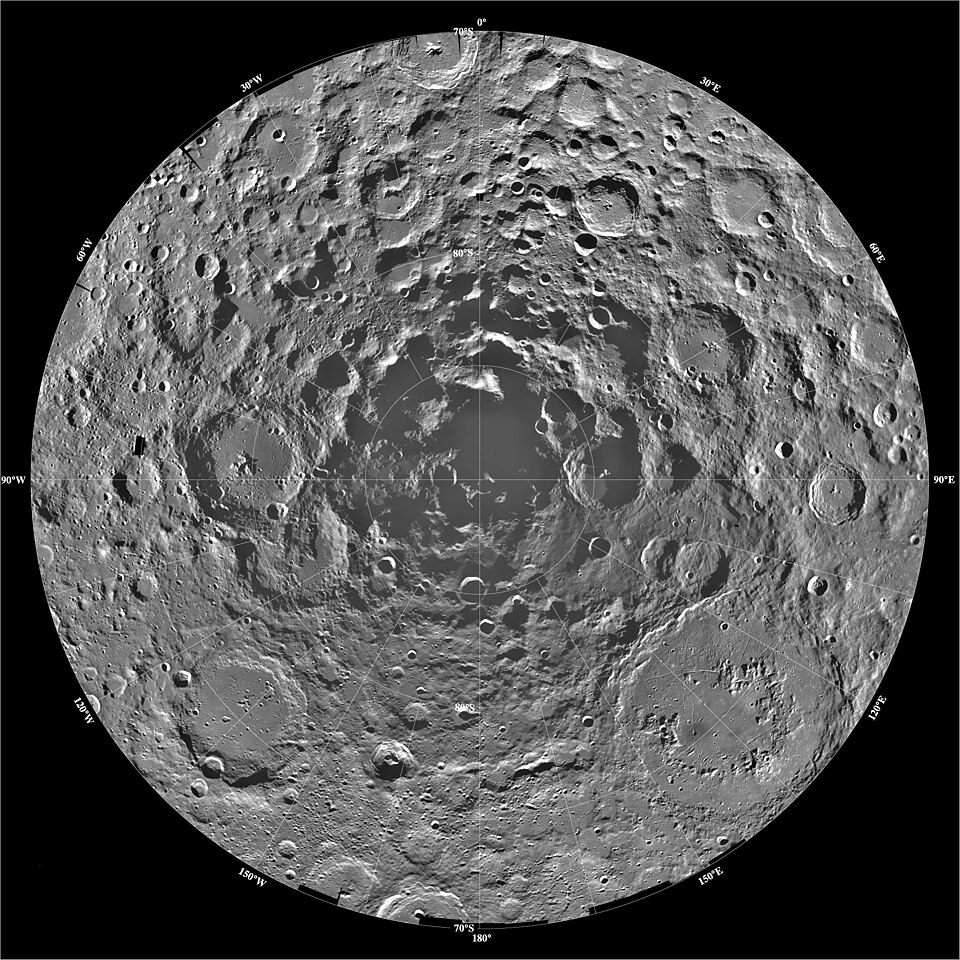
Correct — A, To detect and map water on the Moon’s surface. NASA states the objective in a single line: Lunar Trailblazer was to orbit the Moon to detect and map water on the surface, determining the form, the abundance and the distribution of water across the lunar surface. Each of those three words is a separate open question. Form — lunar water may sit as ice on the floors of permanently shadowed polar craters, or be chemically locked as hydroxyl (OH) and H2O inside rock and regolith, or condense briefly as frost that the moving shadow line drives back into the exosphere to settle somewhere colder. Abundance — nobody yet knows within an order of magnitude how much is there. Distribution — the mission was built to pinpoint 'micro-cold traps' smaller than a football field, shadow pockets far below the resolution of earlier orbiters. The payload settles the matter, because there are only two instruments and both serve that one aim. HVM3, the High-resolution Volatiles and Minerals Moon Mapper built at NASA's Jet Propulsion Laboratory, is an imaging spectrometer sensitive to the distinct spectral fingerprints of each form of water. The Lunar Thermal Mapper, built by the University of Oxford in the United Kingdom, measures the surface's temperature properties — necessary both because the surface's own thermal emission sits on top of the near-infrared water bands and because temperature decides where frost can survive at all. There is no altimeter, no stereo camera, no lander, no rover. The mission was selected in 2019 under NASA's SIMPLEx (Small Innovative Missions for Planetary Exploration) competition, was managed by JPL with the science investigation led by Caltech, and the spacecraft was built by Lockheed Martin. One honest note for anyone reading this after the exam: the mission itself failed. It launched on 26 February 2025, controllers lost contact the very next day, and NASA formally ended the mission on 31 July 2025 — roughly six weeks before this paper was set. The question asks what it was designed to do, and that answer does not change.
Why the others are wrong
- (b)To create a 3D model of the entire Moon — Global 3D shape modelling of the Moon is the work of laser altimeters and stereo cameras — LOLA on NASA's Lunar Reconnaissance Orbiter, or the terrain camera and laser altimeter on Japan's SELENE/Kaguya, which produced the first full global lunar topographic model. Lunar Trailblazer carried neither instrument type. It was a box-shaped smallsat about 3.5 m across with its solar arrays open, flying to revisit selected water-bearing targets under changing illumination rather than to close a uniform global grid. A spectrometer plus a thermal radiometer cannot generate topography at all.
- (c)To test new lunar rovers — Lunar Trailblazer was an orbiter and only an orbiter — no lander, no descent stage, no wheels, no surface mobility hardware of any kind. Rover technology on the Moon is demonstrated by surface missions: ISRO's Pragyan, which rolled off the Vikram lander near the south pole in August 2023, China's Yutu rovers, and NASA's water-prospecting VIPER. The pull of this option comes entirely from the mission's name, which sounds like a trail being physically blazed; NASA's sense of 'Trailblazer' is that it pioneered a low-cost class of planetary smallsat, not that it drove anywhere.
- (d)More than one of the above — This option holds only if at least two of (a), (b) and (c) describe the mission's primary objective. Only (a) does. Options (b) and (c) describe capabilities the spacecraft physically lacked — no altimeter or stereo camera, and no rover or lander. BPSC attaches this fourth option to almost every item in this section of the paper, and it works as a confidence test: candidates who half-recognise a mission name reach for it as a hedge. The discipline is to disprove each statement against a concrete fact — here, the two-instrument payload — before treating the combined option as safe.
Concept
For two centuries the Moon was assumed to be bone-dry. The Apollo samples returned between 1969 and 1972 showed no water, and with no atmosphere and no magnetic shield anything volatile on the sunlit surface should be baked off or stripped away by the solar wind. That consensus broke in 2008–09, and India broke it: the Moon Mineralogy Mapper (M3), a NASA imaging spectrometer flown on ISRO's Chandrayaan-1, found a roughly 3-micrometre absorption feature across wide areas of the surface — the fingerprint of hydroxyl and water bound in the top few millimetres of regolith — while Chandrayaan-1's Moon Impact Probe sensed water in the tenuous lunar exosphere. Since then lunar water has been understood in three physically distinct states, and telling them apart is what every modern lunar mission chases. First, ice, thermally stable only inside permanently shadowed regions near the poles, where crater floors have not seen direct sunlight for extremely long periods and temperatures stay low enough that a water molecule which arrives essentially never leaves — a cold trap. Second, hydroxyl and water chemically bound into minerals and impact glass, produced in part by solar-wind protons reacting with oxygen already in the regolith. Third, a transient frost that forms in cold shadow, sublimates as the shadow sweeps through the lunar day, hops through the exosphere and re-condenses somewhere colder. Only an imaging spectrometer can separate these, because each leaves a different absorption band; and only a simultaneous temperature measurement makes that reading trustworthy, since the surface's own thermal emission overlaps the same wavelengths. The stakes are not purely scientific. Polar water means drinking water, breathable oxygen and hydrogen–oxygen propellant manufactured in place rather than lifted out of Earth's gravity well, which is why Artemis, VIPER and Chandrayaan all point at the south pole.
Three moves get you to the answer even if you never followed the news. First, discount the name. 'Trailblazer' does all the misleading work here — it sounds like a rover, a pathfinder, a scout for a landing site. NASA's own sense of the word is that the mission blazed a trail for cheap planetary smallsats. In space questions a mission's name is the weakest evidence available and its instruments are the strongest. Second, ask what a spacecraft of this class can physically do. SIMPLEx missions are small, cost-capped and rideshare-launched; Lunar Trailblazer went up on a secondary-payload adapter ring, not on a rocket of its own. A vehicle at that scale flies one focused investigation. Building a 3D model of the entire Moon is a flagship-scale global survey, and testing rovers requires a lander first — neither is available to a box roughly 3.5 metres across with its arrays deployed. Third, apply the discriminator that decides the question outright: the payload. Two instruments, an imaging spectrometer tuned to the spectral fingerprints of water and a thermal mapper to read surface temperature. No altimeter, no stereo camera, no descent stage. A spacecraft carrying only those two things can only be a water-mapping mission — which is also precisely why (d) fails, since it needs a second true statement and none exists. Two habits are worth carrying away. Anchor 'recent' to the exam date: as of 13 September 2025 Lunar Trailblazer had already been declared over, so BPSC was asking about design intent rather than results, and the phrase 'primary objective' signals exactly that. And treat BPSC's 'More than one of the above' as a claim to be disproved item by item, never as a refuge when memory is hazy.
Key facts
- Lunar Trailblazer was selected in 2019 under NASA's SIMPLEx (Small Innovative Missions for Planetary Exploration) competition; the mission was managed by NASA's Jet Propulsion Laboratory with the science investigation led by Caltech, and the spacecraft itself was built by Lockheed Martin.
- The payload was exactly two instruments: HVM3, the High-resolution Volatiles and Minerals Moon Mapper, a JPL imaging spectrometer sensitive to the spectral fingerprints of the different forms of water; and the Lunar Thermal Mapper (LTM) from the University of Oxford, UK, which characterises the temperature properties of the lunar surface.
- It launched on 26 February 2025 as a rideshare secondary payload carried on an EELV Secondary Payload Adapter (ESPA) ring; controllers lost contact on 27 February 2025, the day after launch, and NASA formally ended the mission on 31 July 2025 — about six weeks before the 13 September 2025 BPSC paper.
- The spacecraft was a box-shaped smallsat measuring about 3.5 metres (11.5 feet) across with its two solar arrays deployed, and its mapping goal extended to pinpointing 'micro-cold traps' smaller than a football field.
- The discovery that made the mission worth flying came largely from India: the Moon Mineralogy Mapper (M3), a NASA instrument aboard ISRO's Chandrayaan-1 launched on 22 October 2008, detected the roughly 3-micrometre absorption signature of hydroxyl and water in the lunar regolith.
Study next
Common traps
- Reading 'Trailblazer' as a rover, lander or landing-site scout — the word refers to pioneering a low-cost smallsat class; the spacecraft was an orbiter with no surface hardware.
- Choosing 'More than one of the above' whenever two options sound broadly space-related, instead of testing each against a concrete fact such as the instrument list.
- Confusing a targeted smallsat with a global mapping mission — whole-Moon topography belongs to Lunar Reconnaissance Orbiter and SELENE/Kaguya, which carried laser altimeters and stereo cameras.
- Assuming a 2025 mission in the news must have succeeded — this one had already been formally ended on 31 July 2025, before the exam was held.
BPSC asks current-affairs science as flat one-line recall — name the mission's objective, its agency, its instrument — and then drops it into a run of 'More than one of the above' items, where the real test is whether you can rule the fourth option out. UPSC almost never asks a mission's objective in isolation: it either matches a set of missions to their agencies or targets, or buries the science inside a statement-based item ('Consider the following statements regarding water on the Moon'), so the UPSC candidate must know why polar cold traps hold ice, not merely that Lunar Trailblazer was about water. Both reward the same habit — read the payload, not the poster.
Related PYQs
Selene-1, the lunar orbiter mission belongs to which one of the following?
- (a) China
- (b) European Union
- (c) Japan
- (d) USA
Answer(c) Japan
The same skill in UPSC's own phrasing — a named lunar orbiter is put on the table and you must place it. Selene-1 (Kaguya), launched by JAXA in September 2007, is also the mission that built the first full global topographic model of the Moon, which is precisely the capability Lunar Trailblazer did NOT have and which makes option (b) wrong in the BPSC item.
India has recently landed its Moon Impact Probe on the Moon. Among the following countries, which one landed such probe on the Moon earlier ?
- (a) Australia
- (b) Canada
- (c) China
- (d) Japan
Answer(d) Japan
Set on the Chandrayaan-1 Moon Impact Probe — the same 2008 Indian mission whose Moon Mineralogy Mapper produced the hydroxyl-and-water detection that Lunar Trailblazer was designed to follow up. Both items test whether a candidate can track which agency flew which lunar mission, in what order, and to what scientific end.
Practice
- practice — not a real PYQ
Which instrument aboard India's Chandrayaan-1 provided the data that indicated the presence of hydroxyl and water molecules on the lunar surface?
- (a)Moon Mineralogy Mapper (M3)
- (b)Terrain Mapping Camera
- (c)Chandra's Altitudinal Composition Explorer
- (d)Lunar Laser Ranging Instrument
Answer(a) Moon Mineralogy Mapper (M3) — the NASA-supplied imaging spectrometer on Chandrayaan-1, whose infrared spectra showed the roughly 3-micrometre absorption feature associated with OH and H2O in the lunar surface. - practice — not a real PYQ
Lunar water ice is expected to survive mainly in which type of location on the Moon?
- (a)The floors of permanently shadowed craters near the poles
- (b)The centres of the large equatorial maria
- (c)The sunlit peaks of the lunar highlands
- (d)The far-side surface facing away from the Earth
Answer(a) The floors of permanently shadowed craters near the poles — these cold traps never receive direct sunlight, so temperatures stay low enough for ice to persist for very long periods. The far side is not permanently dark; it receives as much sunlight as the near side.