
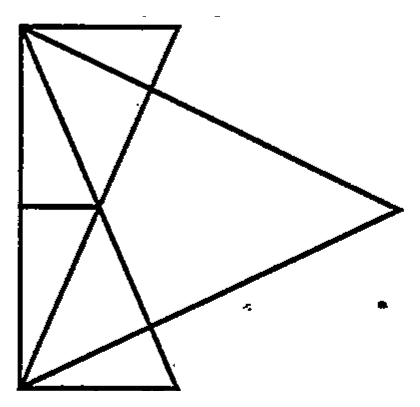
How many triangles are there in the following figure ?
- (1)12
- (2)14
- (3)16
- (4)18
Answer
Why
Correct — option (3), 16.
Label the drawing first. A and C are the top-left and bottom-left corners. B and D are the right ends of the short top and bottom lines. M is the middle of the left edge, where the short middle line starts.
The diagonals A–D and B–C cross at O, the right end of the middle line. P is the apex on the far right, joined to A and to C.
E is where line AP crosses line BC; F is where line CP crosses line AD. That makes eight straight lines: A–M–C, AB, CD, MO, A–O–F–D, B–E–O–C, A–E–P and C–F–P.
Group 1 — the whole left edge AC as one side:
ABC, AOC, ADC
AEC, AFC, APC
Count = 6
Group 2 — half of the left edge as one side:
AMO (upper half), CMO (lower half)
Running total = 6 + 2 = 8
Group 3 — the top line AB or the bottom line CD as one side:
ABE, ABO, CDF, CDO
Running total = 8 + 4 = 12
Group 4 — sides only on the four slanting lines AD, BC, AP and CP:
AEO, CFO, AFP, CEP
Running total = 12 + 4 = 16
Check by size: the 6 smallest triangles are AMO, CMO, ABE, AEO, CFO and CDF. The 10 larger ones are AOC, ABO, CDO, AEC, AFC, ABC, ADC, AFP, CEP and APC. Again 6 + 10 = 16.
The idea to remember: name every corner and crossing point, then count triangles group by group by the line each one stands on, so that none is counted twice or missed.
Why the others are wrong
- (1)12 — 12 is the running total after Groups 1 to 3. It leaves out the four triangles whose sides lie only on the slanting lines: AEO, CFO, AFP and CEP.
Two of these, AFP and CEP, reach the apex P; the other two, AEO and CFO, are small triangles touching the crossing point O.
- (2)14 — 14 falls two short of the 16 triangles listed in the four groups, and each of those 16 has all three sides on drawn lines.
Three of them, AFP, CEP and APC, contain the four-sided region E–O–F–P, so they do not appear when small triangles alone are joined together.
- (4)18 — 18 overcounts by two. Every side of a triangle must lie along a drawn line, and O and P are not joined by any line, so AOP and COP are not triangles in this figure.
Three points on one straight line are not a triangle either: A, M and C lie on the left edge, and A, O and D lie on one diagonal.
Concept
A triangle in a line figure is formed by three drawn lines that meet in pairs at three different points. Three lines passing through one point form no triangle, and three points on one straight line are not the corners of a triangle.
A reliable count starts by labelling every corner and every crossing point, then listing the straight lines through them.
Triangles are then counted in groups that cannot overlap, such as by the line one side lies on, or by size: single regions first, then shapes made of two, three or more regions.
If several lines each cross all the others at separate points, any three of them make one triangle.
RPSC's 2024 syllabus for Reasoning & Mental Ability lists "Shapes and their sub sections" under Mental Ability, alongside "Mirror / Water images".
Counting figures is combinatorics applied to a drawing. The count depends on which points are joined by lines, not on how large the shapes look, which is why a labelled list of points and lines settles it.
The same habit of splitting a count into non-overlapping cases runs through permutation and combination in the Basic Numeracy part of the syllabus.
Key facts
- Three drawn lines that meet in pairs at three different points form one triangle; three lines through a single point form none.
- Points lying on one straight line, such as A, M and C on this figure's left edge, cannot be the corners of a triangle.
- If n lines each cross all the others at separate points, they form n(n − 1)(n − 2) ÷ 6 triangles; here AD, BC, AP and CP give 4.
- If k points on a triangle's base, endpoints included, are each joined to the apex, the figure holds k(k − 1) ÷ 2 triangles.
- This figure has 9 labelled points, 8 straight lines, 7 enclosed regions (6 triangles and one four-sided region) and 16 triangles.
A, C: top-left and bottom-left corners; B, D: right ends of the top and bottom lines; M: middle of the left edge; O: where the diagonals cross; P: apex; E: AP meets BC; F: CP meets AD.
Study next
Common traps
- Treating three points on one straight line as a triangle, such as A, M and C on the left edge or A, O and D on one diagonal.
- Joining two points that no drawn line connects. O and P are not joined, so AOP and COP are not triangles.
- Building larger triangles from small triangles alone. AFP, CEP and APC each contain the four-sided region E–O–F–P, so that method misses all three.
A question can ask for the number of triangles, squares, rectangles or rhombuses in a line drawing.
A question can draw a grid, a triangle cut by lines from its corners, or a shape with crossing diagonals like this one.
Related PYQs
UnlockIAS will link similar questions from RAS Pre 2021 and 2016 here once those papers are published on this site.
Practice
- practice — not a real PYQ
In triangle PQR, points S and T lie on side QR between Q and R, and both are joined to P. How many triangles are there in the figure?
- (a)3
- (b)5
- (c)6
- (d)7
Answer(3) — The base has 4 points (Q, S, T, R), and any 2 of them with P make a triangle: 4 × 3 ÷ 2 = 6 (PQS, PST, PTR, PQT, PSR, PQR). Option (1) counts only the three smallest; option (2) misses one; option (4) overcounts. - practice — not a real PYQ
A square ABCD has both of its diagonals drawn. How many triangles are there in the figure?
- (a)4
- (b)6
- (c)8
- (d)10
Answer(3) — The diagonals cross at O, giving 4 small triangles (AOB, BOC, COD, DOA) and 4 large ones (ABC, BCD, CDA, DAB): 8 in all. Option (1) counts only the small triangles; options (2) and (4) match neither group.