
Which one of the following Ashokan Minor Rock Edicts, contains the personal name of the king - Ashoka ?
- (a)Maski
- (b)Bahapur
- (c)Bairat
- (d)Sahasram
Answer
Why
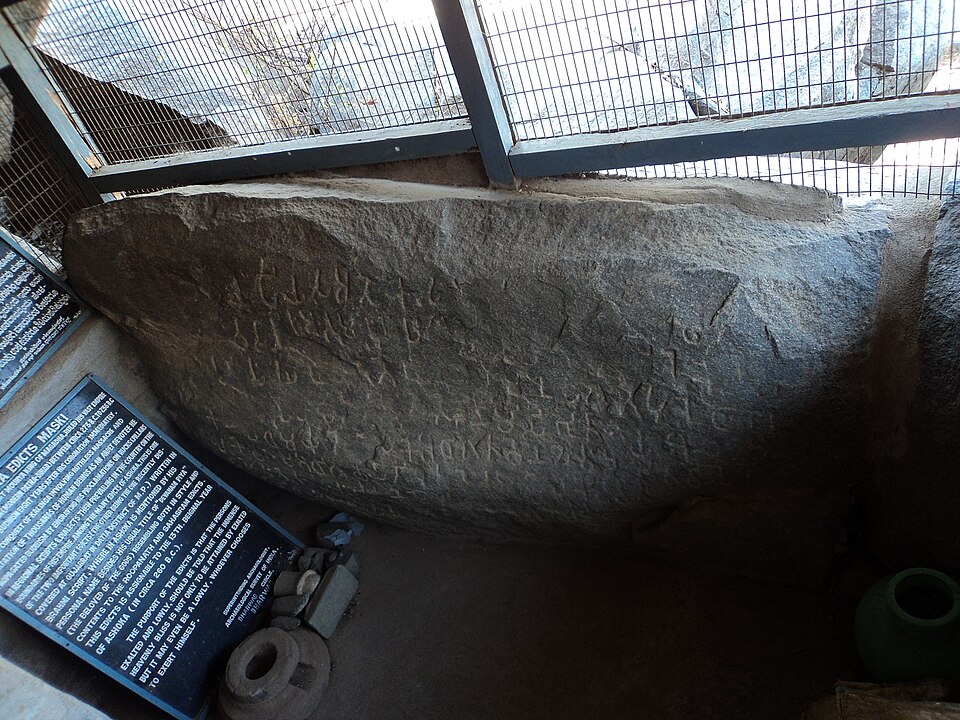
Correct — A, Maski. In almost every one of his inscriptions the emperor calls himself only by his titles, above all Devanampiya Piyadasi, the Beloved of the Gods. The version of Minor Rock Edict I found at Maski, in what is now Raichur district in Karnataka, is the exception that mattered historically: it uses the title together with the personal name Asoka, and so confirmed that the Devanampiya of the edicts and the Ashoka of the literary tradition were one and the same king. The personal name has since been read at Gujarra as well, but among the four sites offered here only Maski carries it.
Why the others are wrong
- (b)Bahapur — Bahapur is the minor rock edict site in Delhi. Like the great majority of Ashokan inscriptions its text uses only the royal titles, so it cannot be the one that settled the king's identity.
- (c)Bairat — Bairat in Rajasthan is famous for something else entirely — the edict found there lists the Buddhist texts Ashoka commended to the monastic community, including the Buddha's admonition to Rahula on false speech. It records his religious programme, not his personal name.
- (d)Sahasram — Sahasram in Bihar is another minor rock edict site, and it too keeps to the titles. Being an early and well-known find makes it a plausible guess, but the identification of the king does not rest on it.
Concept
Ashoka's inscriptions are grouped into major and minor rock edicts and pillar edicts, cut across the subcontinent from the north-west to Karnataka. The great majority speak in the first person but name the speaker only by title. That is why the edicts, when James Prinsep deciphered them in the 1830s, at first yielded a king called Devanampiya Piyadasi whose identity had to be argued rather than read. Finding the personal name in a handful of minor rock edicts closed that gap.
The examiner is testing one specific fact against three sites that are all genuinely Ashokan, which is what makes the question hard: none of the distractors is an invented place. The safe way to hold it is to remember what each site is known for — Maski for the personal name, Bairat for the list of Buddhist texts, and Bahapur and Sahasram as further minor rock edict findspots. It is also worth knowing that Maski is not literally unique any more; Gujarra carries the name too, and other readings have been proposed. The question is answerable because only one of the four options is in that group at all.
Key facts
- The Maski version of Minor Rock Edict I confirmed the association of the title Devanampiya with the name Asoka.
- The Gujarra version also uses the name of Ashoka together with his full title.
- Ashoka usually refers to himself in the inscriptions as Devanampiya, the Beloved of the Gods, and his full formal style runs Devanampiya Piyadasi Asokaraja.
- Maski lies in the present Raichur district of Karnataka; Bahapur is the Delhi site, Bairat is in Rajasthan and Sahasram in Bihar.
Study next
Common traps
- Assuming the best-known edict site must be the answer; Sahasram and Bairat are famous for other reasons.
- Treating Maski as the only inscription with the personal name — Gujarra carries it too, though Maski is the one the textbooks name.
- Mixing the title Piyadasi up with a separate king; it is Ashoka's own self-designation.
Asked as a one-from-four site-and-fact item, with every distractor a genuine Ashokan findspot.
Related PYQs
Which one of the following edicts mentions the personal name of Asoka?
- (a) Kalsi
- (b) Rummindei
- (c) Special Kalinga Edict
- (d) Maski
Answer(d) Maski
The same question with a different set of distractors, and proof of how durable this fact is as an examinable item across both examinations.
The name by which Asoka is generally referred to in his inscriptions is
- (a) Chakravarti
- (b) Dharmadeva
- (c) Dharmakirti
- (d) Priyadarshini
Answer(d) Priyadarshini
Supplies the other half of the story — the title used almost everywhere else, which is why one inscription carrying the personal name was so important.
Which one of the following was not a part of the dhamma of King Ashoka?
- (a) Honouring the king
- (b) Tolerance of religions other than one's own
- (c) Respecting Brahmanas
- (d) Promoting the welfare of his subjects
Answer(a) Honouring the king
Tests the content of the same inscriptions rather than their attribution, and shows the other angle from which the NDA papers approach the edicts.
Practice
- practice — not a real PYQ
The title by which Ashoka refers to himself in almost all his inscriptions is
- (a)Chakravartin
- (b)Devanampiya Piyadasi
- (c)Maharajadhiraja
- (d)Dharmaraja
Answer(b) Devanampiya Piyadasi — the Beloved of the Gods, He who looks with kindness; the personal name appears at only a few sites such as Maski. - practice — not a real PYQ
The Ashokan edict at Bairat is best known for
- (a)listing Buddhist texts recommended to the monastic community
- (b)recording the conquest of Kalinga
- (c)naming the king's personal name
- (d)describing the appointment of provincial governors
Answer(a) listing Buddhist texts recommended to the monastic community — among them the Buddha's admonition to Rahula on false speech.