
Who among the following is known as the architect of Indian planning ?
- (a)V.K.R.V. Rao
- (b)Sukhamoy Chakravarty
- (c)P.C. Mahalanobis
- (d)John Mathai
Answer
Why
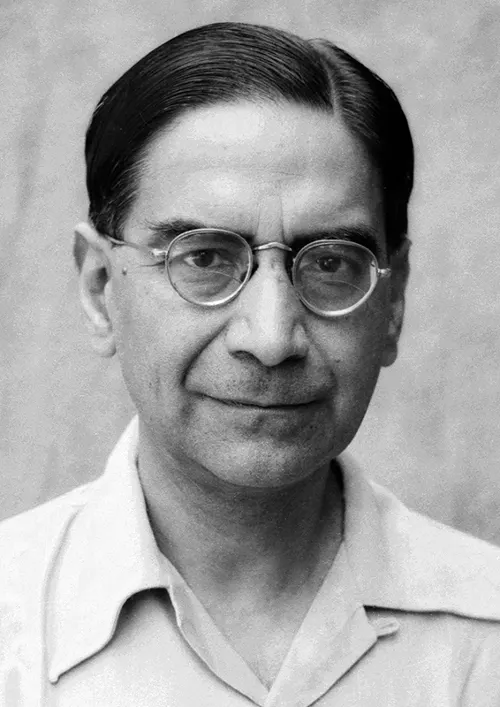
Correct — C, P.C. Mahalanobis. Prasanta Chandra Mahalanobis was the statistician who supplied Indian planning with its analytical frame. He sat on the Planning Commission and contributed to the five-year plans from the second onward, and the model that carries his name was the one employed in the Second Five Year Plan of 1956 to 1961, the plan built around rapid industrialisation and the priority given to heavy and capital-goods industries. He had already given Indian statistics its institutional base by founding the Indian Statistical Institute, registered in April 1932, and had proposed the Mahalanobis distance in 1930. The description in the question is a textbook epithet rather than an office he held, and it points to the authorship of that plan model.
Why the others are wrong
- (a)V.K.R.V. Rao — A major Indian economist and himself a member of the Planning Commission from 1963 to 1966, but he is remembered for pioneering the estimation of India's national income and for building institutions such as the Institute of Economic Growth — not for the model on which the plans were framed.
- (b)Sukhamoy Chakravarty — A distinguished development economist of a later generation, associated with planning work well after the strategy had been set. The framework that defines Indian planning is the one built for the Second Plan, and that was not his.
- (d)John Mathai — He is very nearly the opposite of the answer. Mathai was Railway Minister and then Finance Minister in the early years of the republic, and he resigned after the 1950 Budget in protest at the growing power of the Planning Commission and of Mahalanobis himself.
Concept
Indian planning after independence had two layers. The Planning Commission, set up in 1950, was the institution; the intellectual content came from a model of how a poor economy should allocate its investment. Mahalanobis's answer was to put resources first into the industries that make machines, on the argument that a country which can build its own capital goods can then raise output everywhere else. The Second Five Year Plan translated that into steel, heavy engineering and public-sector plants, and it is the plan by which Indian planning is usually characterised.
The phrase 'architect of Indian planning' is a textbook label, not a designation anyone was appointed to, so the question is really asking whose ideas the plans were built on. Each distractor is a real figure from the same world, which is what makes the item work: Rao was a Planning Commission member, Chakravarty an economist of planning, and Mathai the Finance Minister of the period. The way to separate them is to ask who supplied the model rather than who held the post. The apparatus itself is now history — the Planning Commission was replaced by NITI Aayog at the start of 2015 and the five-year plan cycle was discontinued, both well before the September 2023 exam, so the question is asked about a system that no longer runs.
Key facts
- The Mahalanobis model was employed in the Second Five Year Plan of 1956 to 1961, which worked towards rapid industrialisation.
- Mahalanobis was a member of the Planning Commission and contributed to the five-year plans from the second onward.
- He founded the Indian Statistical Institute, formally registered on 28 April 1932, and proposed the Mahalanobis distance in 1930.
- He lived from 29 June 1893 to 28 June 1972, and India observes National Statistics Day on 29 June, his birth anniversary.
Study next
Common traps
- Choosing the person who held the highest office rather than the person who supplied the model.
- Confusing pioneering work on national-income estimation with authorship of the plan strategy.
- Assuming the Finance Minister of the period must have designed the plans; Mathai in fact resigned over the Planning Commission's power.
Asked as a one-from-four attribution item on Indian planning, with three genuine economists of the same era as distractors.
Related PYQs
With reference to India's Five-Year Plans, which of the following statements is/are correct? 1. From the Second Five-Year Plan, there was a determined thrust towards substitution of basic and capital good industries. 2. The Fourth Five-Year Plan adopted the objective of correcting the earlier trend of increased concentration of wealth and economic power. 3. In the Fifth Five-Year Plan, for the first time, the financial sector was included as an integral part of the Plan. Select the correct answer using the code given below.
- (a) 1 and 2 only
- (b) 2 only
- (c) 3 only
- (d) 1, 2 and 3
Answer(a) 1 and 2 only
Its first statement is the Mahalanobis model stated as policy — the thrust from the Second Plan towards basic and capital-goods industries is exactly what the model prescribed.
The Government of India has established NITI Aayog to replace the
- (a) Human Rights Commission
- (b) Finance Commission
- (c) Law Commission
- (d) Planning Commission
Answer(d) Planning Commission
Marks the end of the institution Mahalanobis worked through, and is the fact that makes this a historical question rather than a current one.
The principal component(s) of Nehru-Mahalanobis strategy of economic development was/were 1. Restructuring economic dependency on metropolitan capitalism into independent economic development. 2. Transition from semi-feudal agriculture to capitalist farming. Select the correct answer using the code given below:
- (a) 1 only
- (b) 2 only
- (c) Both 1 and 2
- (d) Neither 1 nor 2
Answer(c) Both 1 and 2
Names the strategy directly and sets out what it aimed at, which is the substance behind calling Mahalanobis the architect of Indian planning.
The idea of Planning in Independent India was drawn from
- (a) the Bombay Plan
- (b) the demand made by peasants
- (c) the demand made by workers' unions
- (d) the Gandhian vision of India’s future
Answer(a) the Bombay Plan
Traces where the impulse to plan came from, a useful companion to the question of who supplied the model once planning began.
Practice
- practice — not a real PYQ
The Mahalanobis model formed the basis of which Five Year Plan?
- (a)First
- (b)Second
- (c)Fourth
- (d)Sixth
Answer(b) Second — the plan of 1956 to 1961, built around rapid industrialisation and priority for heavy and capital-goods industries. - practice — not a real PYQ
The institution founded by P.C. Mahalanobis, and the body that replaced the Planning Commission in 2015, are respectively
- (a)Indian Statistical Institute and NITI Aayog
- (b)Institute of Economic Growth and NITI Aayog
- (c)Indian Statistical Institute and the Finance Commission
- (d)Delhi School of Economics and NITI Aayog
Answer(a) Indian Statistical Institute and NITI Aayog — Mahalanobis founded the former in the early 1930s, and NITI Aayog took the place of the Planning Commission from the start of 2015.