
Which of the following statements about the technological innovations during the Industrial Revolutions are correct ? 1. Mule was the nickname for a machine invented in 1779, that allowed the spinning of strong and fine yarn. 2. Water Frame, invented in 1769 by Richard Arkwright, made it possible to weave pure cotton clothes. 3. Power loom, invented by Edmund Cartwright in 1787, could be used to weave any kind of materials. Select the correct answer using the code given below :
- (a)1 and 2 only
- (b)1, 2 and 3
- (c)2 and 3 only
- (d)3 only
Answer
Why
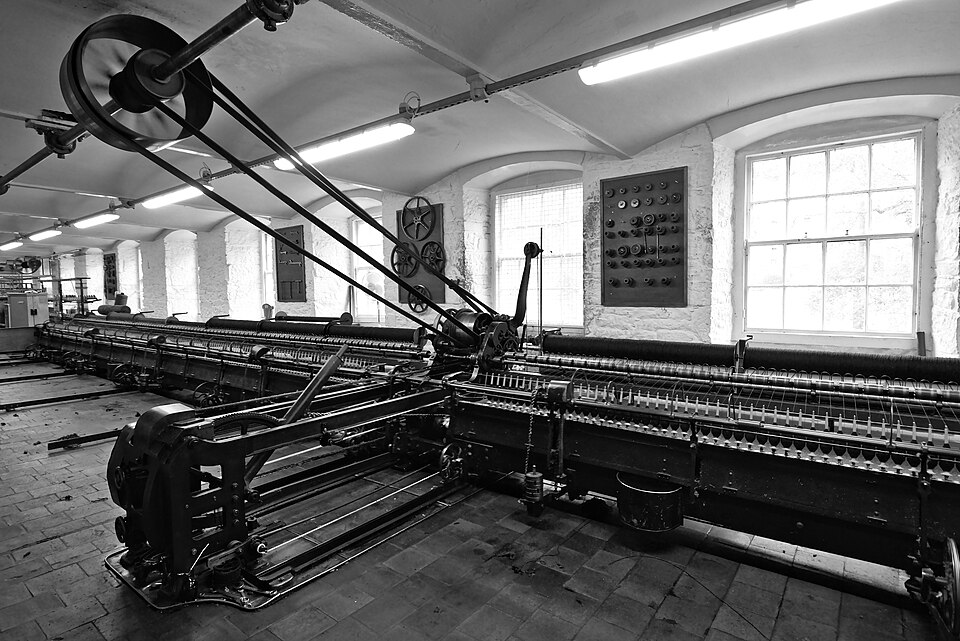
Correct — B, 1, 2 and 3. All three attributions are the standard textbook ones. The mule was Samuel Crompton's 1779 machine, and the nickname is the point of the name — it was a cross between Hargreaves's spinning jenny and Arkwright's water frame, and like the animal it was named after it inherited from both, spinning a yarn that was at once strong and fine. Richard Arkwright patented the water frame in 1769; it spun a harder, stronger thread than the jenny could, and the textbook credits that strength with making all-cotton cloth possible, since a weak cotton yarn had previously been unsuitable for the warp. Edmund Cartwright's power loom mechanised the other half of the trade, weaving, and by 1787 was running in improved water-powered versions able to handle any kind of material. No statement fails, so the answer takes all three.
Why the others are wrong
- (a)1 and 2 only — This rejects the power loom statement, but Cartwright's machine is exactly what mechanised weaving, and the improved water-driven versions were working by the year the statement names.
- (c)2 and 3 only — This rejects the mule, which is the best-attested of the three — Crompton's machine of 1779, named for being a hybrid, and valued precisely because its yarn was both strong and fine.
- (d)3 only — It discards two standard attributions in favour of one. Nothing in statements 1 and 2 is out of line with the usual account of the inventions or their dates.
Concept
The mechanisation of the British cotton trade ran as a chain of bottlenecks. John Kay's flying shuttle of 1733 let one weaver work faster and wider, which meant weavers could out-produce the spinners feeding them. Hargreaves's spinning jenny of 1764 and Arkwright's water frame answered that shortage of yarn, and Crompton's mule of 1779 combined their strengths. With yarn now plentiful, the pressure moved back to weaving, and Cartwright's power loom mechanised that step in turn.
Statements items on the Industrial Revolution usually work by moving an invention to the wrong person or the wrong decade, so the instinct is to hunt for the planted error. Here there is none, and a candidate who is determined to find one will talk himself out of the right answer. It is worth knowing that the printed dates sit at the edge of what different sources give. Arkwright's water-frame patent is 1769, which is the year printed, while some accounts date the machine from his mill a couple of years later. Cartwright patented the power loom in 1785 and had the improved water-powered version by 1787, which is the year printed here. Neither wrinkle changes the attribution, and the key marks all three statements correct.
Key facts
- Samuel Crompton's spinning mule of 1779 combined the spinning jenny and the water frame, which is why it was nicknamed the mule.
- Richard Arkwright patented the water frame in 1769; it spun a harder and stronger yarn than the jenny.
- Edmund Cartwright patented the power loom in 1785 and had improved water-powered versions running by 1787.
- The sequence before these two was John Kay's flying shuttle in 1733 and James Hargreaves's spinning jenny in 1764.
Study next
Common traps
- Assuming every statements question must contain a planted error; sometimes all the statements are correct.
- Swapping Crompton and Arkwright, whose two machines the mule was built from.
- Treating a single printed date as decisive when patent, prototype and working mill are often a year or two apart.
Asked as an attribution-and-date check — inventor, year and function of each machine, in a statements-and-code format.
Related PYQs
Which of the following statements correctly explains the impact of Industrial Revolution on India during the first half of the nineteenth century?
- (a) Indian handicrafts were ruined.
- (b) Machines were introduced in the Indian textile industry in large numbers.
- (c) Railway lines were laid in many parts of the country.
- (d) Heavy duties were imposed on the imports of British manufactures.
Answer(a) Indian handicrafts were ruined.
Follows the same machines to their consequence for India — the cheap cloth these inventions made possible is what displaced the Indian handloom.
During the Industrial Revolution, who among the following designed the ‘flying shuttle loom’?
- (a) Samuel Crompton
- (b) Edmund Cartwright
- (c) John Kay
- (d) Richard Arkwright
Answer(c) John Kay
Tests the first link in the same chain and uses three of the four names in this question, so the two together fix who invented what.
Which among the following was/were among the factors for England to experience the Industrial Revolution first? 1. The scientific inventions had paved the way for Industrial Revolution. 2. It had favourable social and political structures in place. 3. Navigable rivers had made inland transport easier. 4. It had seen the ascendancy of capitalist practices. Select the correct answer using the code given below:
- (a) 1 and 3 only
- (b) 1, 3 and 4 only
- (c) 4 only
- (d) 1, 2, 3 and 4
Answer(d) 1, 2, 3 and 4
Widens the frame from the machines to why Britain produced them first, and is another instance of an all-statements-correct answer on this topic.
Practice
- practice — not a real PYQ
The spinning mule of 1779 was so named because it
- (a)was worked by mules rather than by water
- (b)combined features of the spinning jenny and the water frame
- (c)was slower than the machines it replaced
- (d)was first used in a mill named after a mule
Answer(b) combined features of the spinning jenny and the water frame — a hybrid of two earlier machines, which is what the nickname records. - practice — not a real PYQ
Which one of the following mechanised weaving rather than spinning?
- (a)Spinning jenny
- (b)Water frame
- (c)Power loom
- (d)Spinning mule
Answer(c) Power loom — Cartwright's machine mechanised weaving, while the other three all produced yarn.