
During the Industrial Revolution, who among the following designed the 'flying shuttle loom'?
- (a)Samuel Crompton
- (b)Edmund Cartwright
- (c)John Kay
- (d)Richard Arkwright
Answer
Why
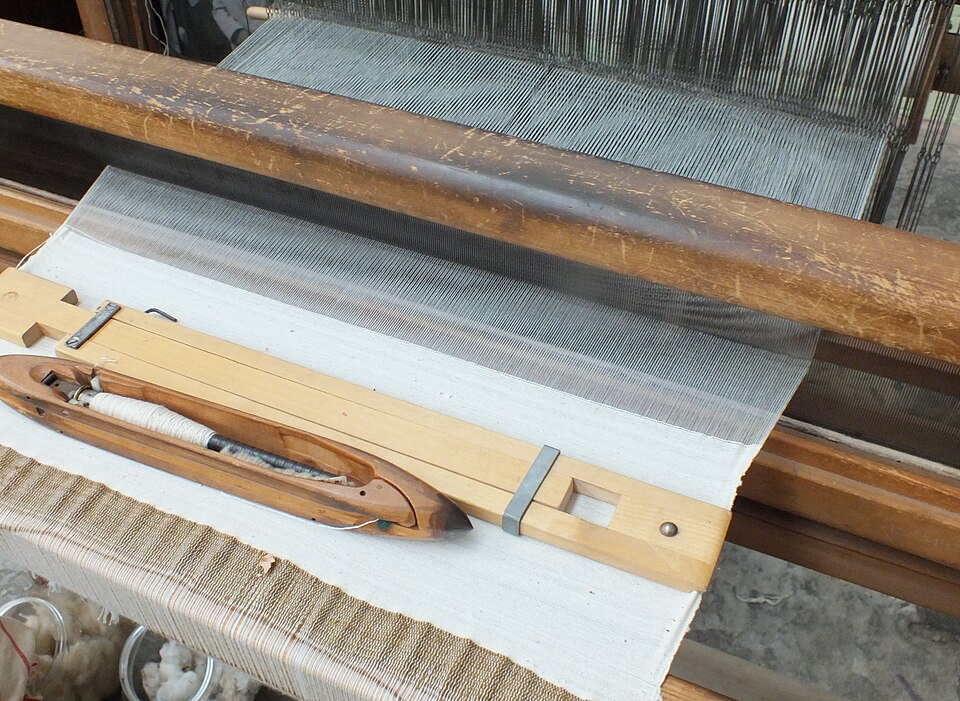
Correct — C, John Kay. The flying shuttle, patented by John Kay in 1733, let a single weaver send the shuttle across the loom mechanically, roughly doubling weaving speed and allowing wider cloth to be woven by one worker. It was one of the first great mechanical inventions of the Industrial Revolution's textile phase. Crompton, Cartwright and Arkwright were all textile inventors too, but of other machines — spinning mule, power loom and water frame respectively.
Why the others are wrong
- (a)Samuel Crompton — He invented the spinning mule (1779), a spinning machine, not the flying shuttle.
- (b)Edmund Cartwright — He invented the power loom (1785), a later machine that mechanised weaving itself — not the flying shuttle.
- (d)Richard Arkwright — He invented the water frame (1769), a water-powered spinning machine, not the flying shuttle.
Concept
The textile industry led Britain's Industrial Revolution through a chain of inventions. The flying shuttle sped up weaving; because weavers now needed far more yarn, spinning was mechanised next (spinning jenny, water frame, spinning mule); finally the power loom mechanised weaving fully. Matching each machine to its inventor is a common exam demand.
Sort the names into 'weaving' versus 'spinning' inventions. The flying shuttle is a weaving device, and among the options only John Kay is its inventor.
Key facts
- Flying shuttle — John Kay, 1733 (weaving).
- Spinning jenny — James Hargreaves, 1764 (spinning).
- Water frame — Richard Arkwright, 1769 (spinning).
- Spinning mule — Samuel Crompton, 1779; power loom — Edmund Cartwright, 1785.
Study next
Common traps
- Swapping the flying shuttle (weaving) with spinning inventions.
- Confusing John Kay with Cartwright (power loom).
Asked as who invented the flying shuttle — John Kay (1733).
Related PYQs
Which one of the following statements about the Industrial Revolution is correct?
- (a) Thomas Savery invented astrolabe
- (b) Thomas Newcomen invented chemical dyes
- (c) James Watt’s invention converted the steam engine from being a mere pump into one which would provide energy to power machines in factories
- (d) Mathew Boulton discovered the technique of refining gold of impurities
Answer(c) James Watt’s invention converted the steam engine from being a mere pump into one which would provide energy to power machines in factories
Same topic — inventors and inventions of the Industrial Revolution. This item tests James Watt's steam engine; the 2021 question tests John Kay's flying shuttle, both landmark machines of the age.
Which among the following was/were among the factors for England to experience the Industrial Revolution first? 1. The scientific inventions had paved the way for Industrial Revolution. 2. It had favourable social and political structures in place. 3. Navigable rivers had made inland transport easier. 4. It had seen the ascendancy of capitalist practices. Select the correct answer using the code given below:
- (a) 1 and 3 only
- (b) 1, 3 and 4 only
- (c) 4 only
- (d) 1, 2, 3 and 4
Answer(d) 1, 2, 3 and 4
Sets the wider context for inventions like the flying shuttle: why the Industrial Revolution — and its wave of textile machines — began in England, driven by scientific inventions, social/political conditions, transport and capitalism.
Practice
- practice — not a real PYQ
The 'spinning jenny', which allowed several threads to be spun at once, was invented by
- (a)John Kay
- (b)James Hargreaves
- (c)Edmund Cartwright
- (d)Samuel Crompton
Answer(b) James Hargreaves — his spinning jenny (1764) mechanised spinning. - practice — not a real PYQ
The 'power loom', which mechanised the process of weaving, was invented by
- (a)Richard Arkwright
- (b)John Kay
- (c)Edmund Cartwright
- (d)Samuel Crompton
Answer(c) Edmund Cartwright — his power loom (1785) mechanised weaving.