
In which one of the following devices, the light energy is converted into the electrical energy?
- (a)Light-emitting diode
- (b)Laser diode
- (c)Solar cell
- (d)Transistor
Answer
Why
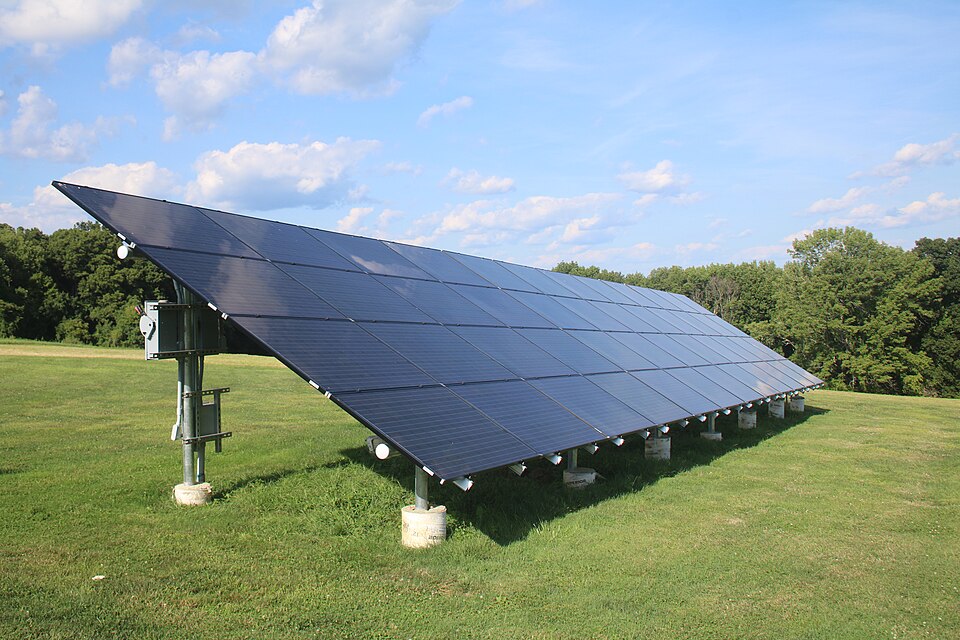
Correct — C, solar cell. A solar cell is a semiconductor p-n junction built so that light can reach the junction. Photons with enough energy knock electrons free, the built-in electric field at the junction sweeps the freed electrons one way and the holes the other, and that separation of charge appears as a voltage across the terminals. Connect a load and a current flows, so light energy has been turned directly into electrical energy. This is the photovoltaic effect, and it is the only device in the list whose input is light and whose output is electricity.
Why the others are wrong
- (a)Light-emitting diode — An LED runs the conversion in the opposite direction — it is a forward-biased junction in which electrons and holes recombine and give up their energy as photons, so electrical energy becomes light. It is the exact inverse of a solar cell, which is why it is the most tempting wrong answer.
- (b)Laser diode — A laser diode is also an emitter. It is driven by an electric current and produces a coherent light beam, so once again electrical energy is converted into light energy rather than the other way about.
- (d)Transistor — A transistor is a three-terminal semiconductor device used to amplify or switch electrical signals. It takes electrical input and gives electrical output; light is not part of its normal operation at all.
Concept
Devices are often classified by the energy conversion they perform, and semiconductor devices come in matched pairs that run the same physics in opposite directions. A solar cell (photovoltaic cell) absorbs photons at a p-n junction and delivers electrical energy; an LED or a laser diode is driven electrically and delivers photons. A photodiode and a photoresistor are the other common light-to-electrical devices, though a photodiode is normally used to sense light rather than to power a load. A single solar cell of crystalline silicon produces only a fraction of a volt, so cells are wired in series into modules and modules into arrays.
Three of the four options are semiconductor devices, so the option set is designed to punish anyone who reasons 'semiconductor, therefore light'. The discriminator is the direction of conversion, not the material. Fix the pair in your head — a solar cell takes light in and pushes current out, an LED takes current in and pushes light out — and the item collapses in a second. It also helps to remember that a solar cell is a source: it appears in a circuit as a supply, whereas an LED, a laser diode and a transistor all have to be supplied.
Key facts
- A solar cell converts light energy directly into electrical energy through the photovoltaic effect at a semiconductor p-n junction.
- An LED converts electrical energy into light; a laser diode does the same but produces a coherent beam.
- A transistor is an amplifying and switching device with electrical input and electrical output.
- Solar cells are connected in series and parallel to form modules and arrays because a single cell gives only a small voltage.
- Solar photovoltaic generation is direct conversion; solar thermal generation instead uses the sun's heat to raise steam and drive a turbine.
Study next
Common traps
- Choosing the LED because it is the device most associated with light.
- Assuming any semiconductor device must involve light.
- Confusing the photovoltaic effect with the photoelectric effect, in which electrons are ejected from a metal surface.
As a one-line device-to-conversion match, or as a statement item contrasting photovoltaic with solar-thermal technology.
Related PYQs
With reference to technologies for solar power production, consider the following statements: 1. 'Photovoltaics' is a technology that generates electricity by direct conversion of light into electricity, while 'Solar Thermal' is a technology that utilizes the Sun's rays to generate heat which is further used in electricity generation process. 2. Photovoltaics generates Alternating Current (AC), while Solar Thermal generates Direct Current (DC). 3. India has manufacturing base for Solar Thermal technology, but not for Photovoltaics. Which of the statements given above is/are correct?
- (a) 1 only
- (b) 2 and 3 only
- (c) 1, 2 and 3
- (d) None
Answer(a) 1 only
Statement 1 of the CSE item is the same fact this NDA question turns on — photovoltaics means the direct conversion of light into electricity, as against the solar-thermal route through heat.
LED (a semi-conductor device) is an abbreviation that stands for
- (a) Licence for Energy Detector.
- (b) Light Energy Device.
- (c) Light Emitting Diode.
- (d) Lost Energy Detector.
Answer(c) Light Emitting Diode.
The same junction physics from the emitting side, and it names the very device that is the tempting wrong option here — an LED sends light out, a solar cell takes light in.
Practice
- practice — not a real PYQ
Which one of the following devices converts electrical energy into light energy?
- (a)Solar cell
- (b)Photodiode
- (c)Light-emitting diode
- (d)Thermocouple
Answer(c) Light-emitting diode — a forward-biased LED emits photons when electrons and holes recombine at the junction. - practice — not a real PYQ
The working of a solar cell is based on
- (a)the photovoltaic effect
- (b)thermionic emission
- (c)electromagnetic induction
- (d)piezoelectricity
Answer(a) the photovoltaic effect — light absorbed at a p-n junction generates charge carriers that the junction field separates, producing a voltage.