
LED (a semi-conductor device) is an abbreviation that stands for
- (a)Licence for Energy Detector.
- (b)Light Energy Device.
- (c)Light Emitting Diode.
- (d)Lost Energy Detector.
Answer
Why
Correct — C, Light Emitting Diode. LED stands for Light Emitting Diode — a semiconductor diode that gives out light when an electric current passes through it in the forward direction. The other expansions ('Licence for Energy Detector', 'Light Energy Device' and 'Lost Energy Detector') are invented phrases that are not what the abbreviation means.
Why the others are wrong
- (a)Licence for Energy Detector. — Not a real term — an LED is a light-emitting component, not a licence or a detector.
- (b)Light Energy Device. — A plausible-sounding decoy, but the standard expansion is 'Light Emitting Diode', not 'Light Energy Device'.
- (d)Lost Energy Detector. — Meaningless as an electronics term — an LED emits light; it does not detect 'lost energy'.
Concept
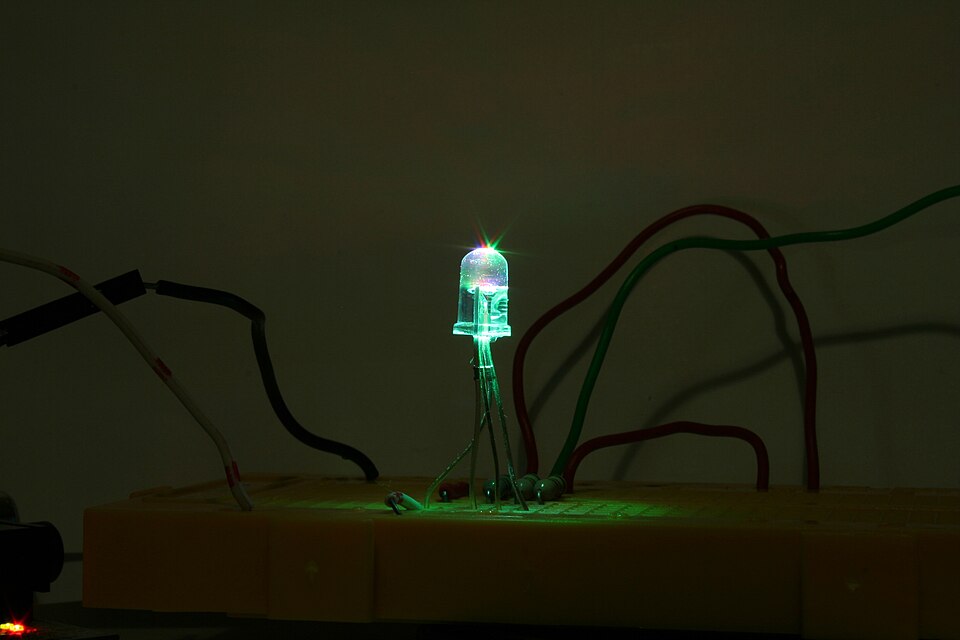
An LED is a p-n junction semiconductor diode that converts electrical energy directly into light by electroluminescence when it is forward-biased. Being a diode, it conducts — and lights up — in only one direction.
This is a straight full-form question; the only trick is that all four options begin with 'L'. Recall that an LED is a diode and the expansion follows — Light Emitting Diode.
Key facts
- LED expands to Light Emitting Diode; it emits light when forward-biased.
- It works by electroluminescence in a semiconductor p-n junction.
- LEDs are energy-efficient and long-lasting, used in lighting, displays and indicators.
- The blue LED earned Akasaki, Amano and Nakamura the 2014 Nobel Prize in Physics, enabling white LED lighting.
Study next
Common traps
- Falling for another 'L' word option such as 'Light Energy Device'.
- Forgetting that an LED is a diode (a one-way device), not a detector.
Asked as a straight abbreviation expansion with look-alike 'L' decoys — recall that LED means Light Emitting Diode.
Related PYQs
No directly related past PYQ was found.
Practice
- practice — not a real PYQ
An LED emits light when it is
- (a)reverse biased
- (b)forward biased
- (c)unbiased
- (d)short-circuited
Answer(b) forward biased — current then flows through the junction and it glows. - practice — not a real PYQ
An LED mainly converts electrical energy into
- (a)heat
- (b)sound
- (c)light
- (d)chemical energy
Answer(c) light — by electroluminescence.