
A simple pendulum having bob of mass m and length of string l has time period of T. If the mass of the bob is doubled and the length of the string is halved, then the time period of this pendulum will be
- (a)T
- (b)T/√2
- (c)2T
- (d)√2 T
Answer
Why
Correct — B, T/√2. The time period of a simple pendulum is T = 2π√(l/g). The mass of the bob does not appear anywhere in that expression, so doubling it changes nothing at all. Only the length matters here, and the period goes as the square root of the length — so halving l to l/2 multiplies the period by √(1/2), giving T/√2. Written out, the new period T′ = 2π√((l/2)/g) = (1/√2) × 2π√(l/g) = T/√2, which is about 0·71 T. The pendulum swings faster because a shorter string means a stronger restoring effect per unit displacement.
Why the others are wrong
- (a)T — This is the answer you get if you assume the two changes cancel each other out — mass doubling lengthening the period and the shorter string shortening it. They do not cancel, because mass has no effect whatsoever; the length change is the only one that acts, and it must change the period.
- (c)2T — This treats the period as directly proportional to something that has doubled — most often the mass. Neither reading survives the formula: mass is absent from it, and the length went down rather than up, so the period must fall below T, not rise to twice it.
- (d)√2 T — This is the right square-root factor applied the wrong way round. Multiplying by √2 is what happens when the length is doubled. Here the length is halved, so the factor is 1/√2, and the period gets shorter rather than longer.
Concept
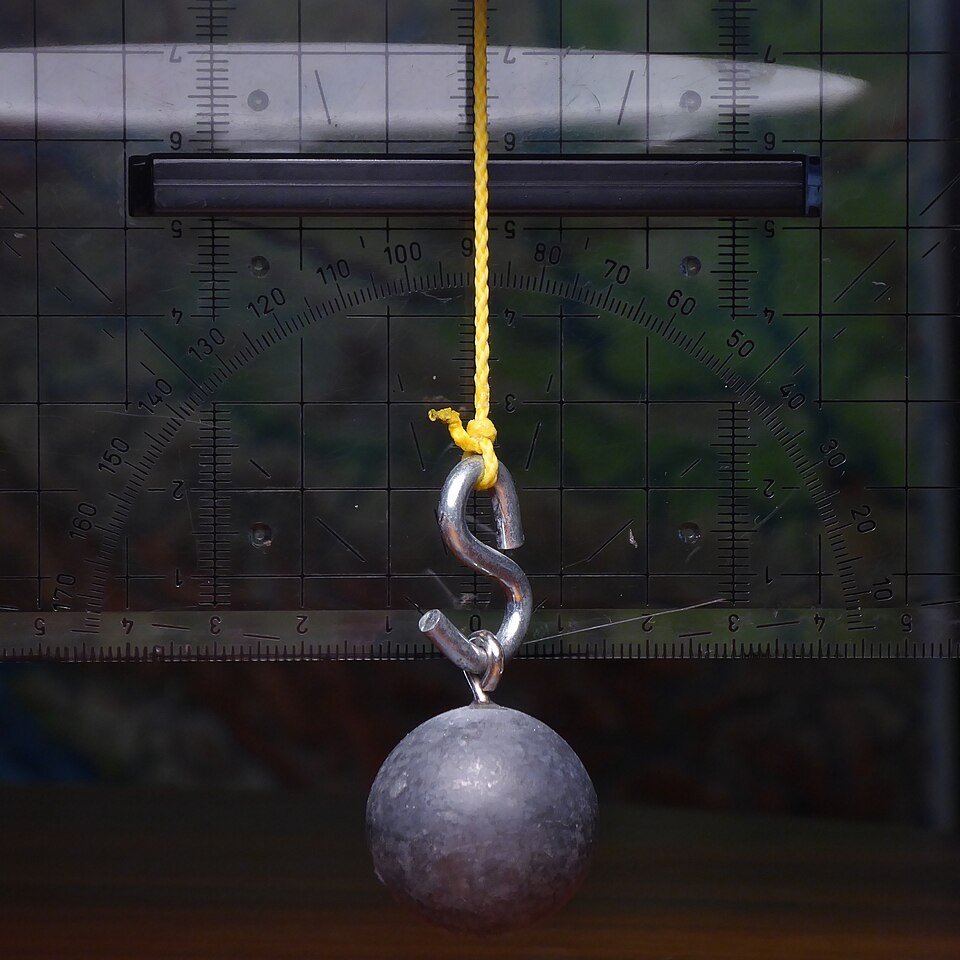
For small angular displacements a simple pendulum executes simple harmonic motion with time period T = 2π√(l/g), where l is the length from the point of suspension to the centre of the bob and g the acceleration due to gravity. Two features of that expression carry almost every question ever asked on the topic — the period is independent of the mass of the bob and independent of the amplitude, and it varies as the square root of the length. The mass drops out because gravity supplies both the restoring force (which grows with mass) and the inertia resisting it (which grows with mass by exactly the same factor).
Examiners load the stem with an irrelevant change so that a student who has memorised the formula loosely will feel obliged to use every number given. Doubling the mass is pure decoration. Once you strike it out, the arithmetic is a single square root, and the direction of the change is the second trap — a shorter string always means a quicker swing, so the answer has to be smaller than T, which immediately rules out two of the four options. The same square-root dependence explains why a pendulum clock taken up a mountain, where g is smaller, runs slow, and why a clock's rate is corrected by moving the bob up or down the rod rather than by changing its weight.
Key facts
- The time period of a simple pendulum is T = 2π√(l/g) for small oscillations.
- The period does not depend on the mass of the bob or, for small swings, on the amplitude.
- Period varies as the square root of length — quadrupling the length only doubles the period.
- Period varies inversely as the square root of g, so a pendulum clock runs slow where gravity is weaker.
- A pendulum about 1 m long has a period of roughly 2 seconds at the earth's surface.
Study next
Common traps
- Using the mass given in the stem simply because it was given.
- Applying the square-root factor in the wrong direction — √2 instead of 1/√2 when the length is halved.
- Forgetting that l is measured to the centre of the bob, not to the top of it.
As a ratio problem in which one relevant quantity and one irrelevant quantity are changed together, or as a statement-based item on what the period does and does not depend on.
Related PYQs
Consider the following statements: A simple pendulum is set into oscillation. Then I. The acceleration is zero when the bob passes through the mean position. II. In each cycle the bob attains a given velocity twice. III. Both acceleration and velocity of the bob are zero when it reaches its extreme position during its oscillation. IV. The amplitude of oscillation of the simple pendulum decreases with time. Which of these statements are correct?
- (a) I and II
- (b) III and IV
- (c) I, II and IV
- (d) II, III and IV
Answer(c) I, II and IV
The CSE version tested the motion of the same pendulum rather than its period — acceleration vanishes at the mean position, velocity vanishes at the extremes, and real pendulums damp down over time.
A pendulum clock is lifted to a height where the gravitational acceleration has a certain value g. Another pendulum clock of same length but of double the mass of the bob is lifted to another height where the gravitational acceleration is g/2. The time period of the second pendulum would be (in terms of period T of the first pendulum)
- (a) √2 T
- (b) 1/√2 T
- (c) 2√2 T
- (d) T
Answer(a) √2 T
Almost the same trick three years earlier — a doubled bob mass is planted as a distraction while the real change is in the other quantity inside the square root, there g instead of l.
The time period of a 1 m long pendulum approximates to
- (a) 6 s
- (b) 4 s
- (c) 2 s
- (d) 1 s
Answer(c) 2 s
The companion numerical from the earlier 2022 sitting — the same formula, used to get an absolute value instead of a ratio.
Practice
- practice — not a real PYQ
The length of a simple pendulum is made four times its original value while the bob is replaced by one of half the mass. Its new time period will be
- (a)half the original
- (b)the same as the original
- (c)twice the original
- (d)four times the original
Answer(c) twice the original — period goes as √l, so four times the length doubles the period, and the change of mass has no effect. - practice — not a real PYQ
A pendulum clock that keeps correct time at sea level is carried to the top of a high mountain. It will
- (a)gain time, because g is larger there
- (b)lose time, because g is smaller there
- (c)keep correct time, because the length is unchanged
- (d)stop oscillating
Answer(b) lose time, because g is smaller there — with T = 2π√(l/g), a smaller g means a longer period, so each swing takes more than a second and the clock falls behind.