
Which one of the following is called dry ice?
- (a)Solid carbon dioxide
- (b)Liquid carbon dioxide
- (c)Liquid nitrogen
- (d)Liquid ammonia
Answer
Why
Correct: A, solid carbon dioxide. The name earns itself: at ordinary atmospheric pressure solid carbon dioxide never melts, it sublimes straight to gas at about −78·5 °C, so it chills whatever it touches and leaves no puddle behind. That is what 'dry' refers to: ice that wets nothing. The reason is the position of carbon dioxide's triple point, which lies at about 5·1 atmospheres; below that pressure the liquid state simply does not exist, so the solid has nowhere to go but the vapour phase.
Why the others are wrong
- (b)Liquid carbon dioxide: Right substance, wrong state. Liquid carbon dioxide exists only under pressure above about 5·1 atmospheres (it is what sits inside a fire extinguisher cylinder) and it is not called dry ice, because 'ice' refers to the solid.
- (c)Liquid nitrogen: Liquid nitrogen is a far colder refrigerant, boiling at about −196 °C, and it is used in cryopreservation and in freezing biological samples. But it is a liquid, it wets what it touches while it boils off, and it has never been called dry ice.
- (d)Liquid ammonia: Liquid ammonia is a refrigerant used in large industrial and cold-storage plants, working by evaporating and condensing in a cycle rather than by subliming away. It is a pungent, toxic liquid and shares nothing with dry ice but the general job of cooling.
Concept
Sublimation is the direct change from solid to vapour without passing through the liquid state, and whether a substance can do it at room pressure depends on where its triple point sits. Water's triple point is at 0·006 atmospheres, far below atmospheric pressure, so ice melts before it can sublime. Carbon dioxide's triple point is at about 5·1 atmospheres, far above atmospheric pressure, so at 1 atmosphere the liquid is impossible and the solid goes straight to gas at −78·5 °C. Camphor, naphthalene, iodine and ammonium chloride are the other sublimation examples that school chemistry uses.
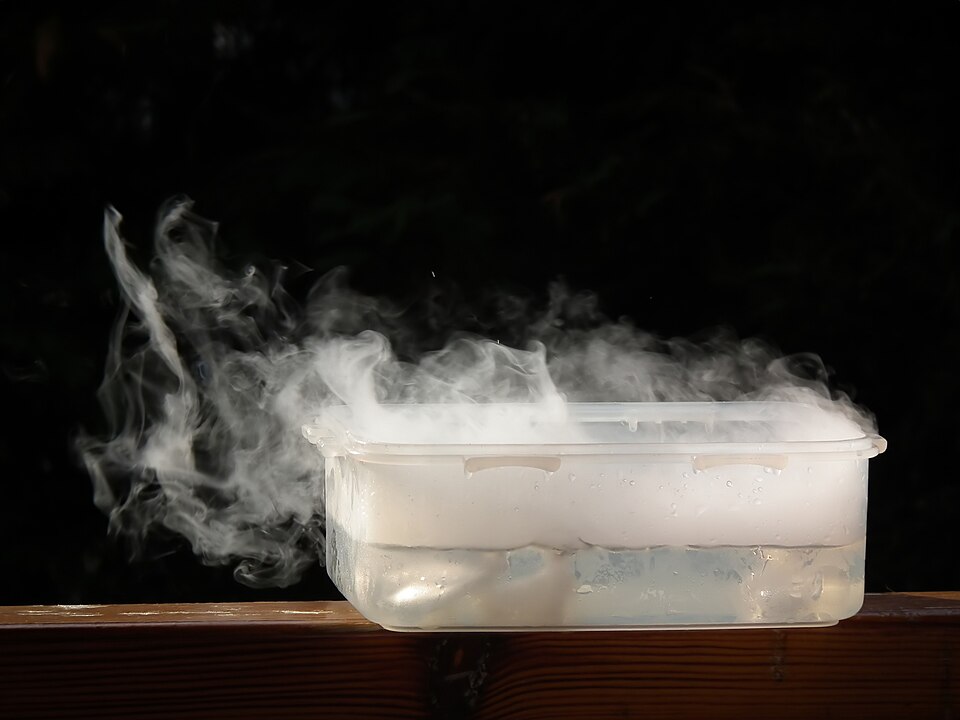
The four options are all cold things, and the discriminating word in the stem is 'ice', which means a solid. That alone removes the three liquids and leaves only one answer, without needing any thermodynamics. The thermodynamics is worth carrying anyway, because the same fact is asked in other clothes: the white mist that rolls across a stage or out of an ice-cream box is not the carbon dioxide itself, which is colourless, but water vapour from the surrounding air condensing in the cold gas as the block sublimes.
Key facts
- Dry ice is solid carbon dioxide; at 1 atmosphere it sublimes at about −78·5 °C without melting.
- Carbon dioxide's triple point lies at about 5·1 atmospheres, which is why liquid carbon dioxide cannot exist at ordinary atmospheric pressure.
- The visible fog around dry ice is condensed water vapour from the air, not carbon dioxide, which is colourless.
- Liquid nitrogen boils at about −196 °C and is the standard cryogenic liquid for deep freezing.
Study next
Common traps
- Reading 'dry ice' as a kind of water ice. It contains no water at all.
- Attributing the white fog to carbon dioxide gas. The gas is invisible; the fog is condensed atmospheric moisture.
- Assuming dry ice is milder than ordinary ice because it is 'dry'. It is colder by nearly eighty degrees and will burn bare skin.
NDA asks either what dry ice is, or names the change of state involved when a block of it disappears on a stage.
Related PYQs
Which one of the following is termed as 'Dry ice'?
- (a) Ice present in ice-cream
- (b) Solid water at Antarctica
- (c) Solid state of carbon dioxide
- (d) Solid water of ionosphere
Answer(c) Solid state of carbon dioxide
The identical fact asked one year later, testing whether the student thinks dry ice has anything to do with water.
Dry ice is used on a performing stage to produce mist in air. The process involved is an example of
- (a) sublimation
- (b) evaporation
- (c) condensation
- (d) precipitation
Answer(a) sublimation
Takes the same substance one step further, naming the change of state that gives dry ice its 'dry' behaviour.
Practice
- practice, not a real PYQ
When a block of dry ice is left in the open at room temperature, it
- (a)melts into a colourless liquid
- (b)sublimes directly into a gas
- (c)dissolves in atmospheric moisture
- (d)decomposes into carbon and oxygen
Answer(b) sublimes directly into a gas: the liquid state is impossible at atmospheric pressure, so the solid goes straight to vapour. - practice, not a real PYQ
Which one of the following pairs of substances both sublime at ordinary pressure?
- (a)Common salt and sugar
- (b)Camphor and naphthalene
- (c)Copper sulphate and washing soda
- (d)Wax and butter
Answer(b) Camphor and naphthalene: both pass from solid to vapour without melting, which is why they are used for the sublimation experiment in school laboratories.