
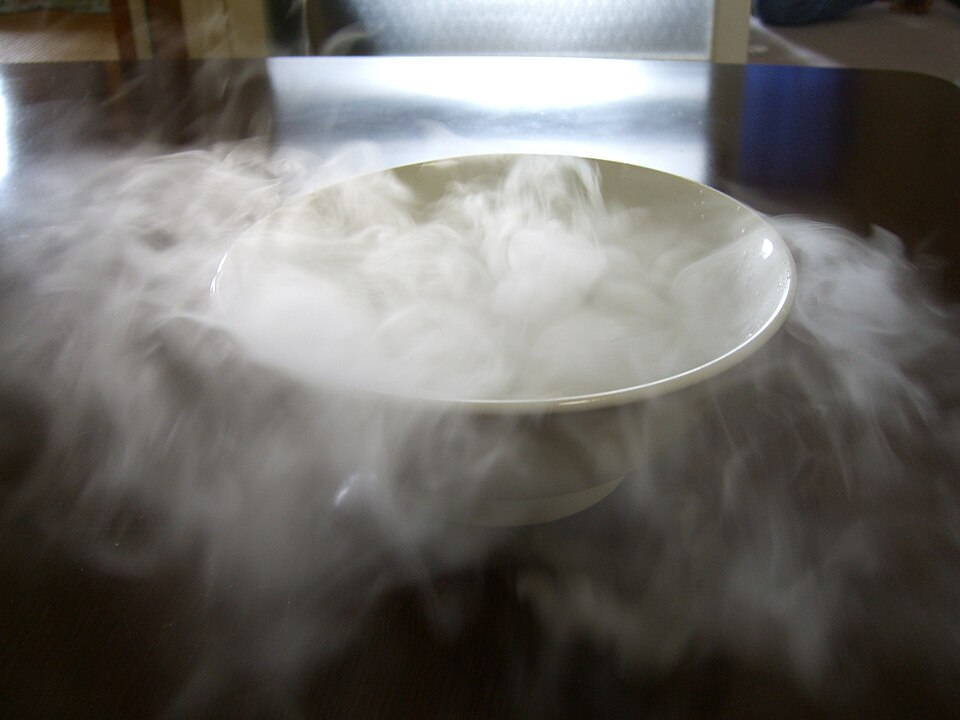
Dry ice is used on a performing stage to produce mist in air. The process involved is an example of
- (a)sublimation
- (b)evaporation
- (c)condensation
- (d)precipitation
Answer
Why
Correct — A, sublimation. Dry ice is solid carbon dioxide, and at ordinary atmospheric pressure it has no liquid state at all — on warming it passes straight from solid to gas at about −78.5 °C, which is sublimation by definition. The cold carbon dioxide gas pouring off the block chills the air immediately around it, and the low-lying white mist seen on stage is water vapour from that chilled air turning into tiny droplets.
Why the others are wrong
- (b)evaporation — Evaporation is a liquid turning into vapour at its surface. Dry ice never becomes liquid carbon dioxide at atmospheric pressure, so there is no liquid for anything to evaporate from.
- (c)condensation — Condensation is what happens to the water vapour already present in the air once the cold gas chills it, and it is why the mist is visible at all. But the question asks about the process the dry ice itself undergoes, and that is sublimation.
- (d)precipitation — Precipitation means an insoluble solid separating out of a solution, or rain and snow falling from the atmosphere. Neither applies to a block of solid carbon dioxide warming up in a room.
Concept
Sublimation is the change of a substance directly from the solid state to the gaseous state without becoming a liquid on the way. Whether a substance can melt at all depends on pressure: carbon dioxide's triple point lies above one atmosphere, so at ordinary pressure solid carbon dioxide simply cannot melt and can only sublime. Other substances that sublime readily under room conditions include camphor, naphthalene, iodine, ammonium chloride and anthracene.
The item rewards separating what happens to the dry ice from what the audience actually sees. Two changes run at once — the solid carbon dioxide sublimes, and the water vapour in the surrounding air condenses into the visible fog. Since the question asks about the process involved with the dry ice, sublimation is the answer, and the fact that the mist is condensed water rather than carbon dioxide is a valuable extra to carry, because carbon dioxide gas is colourless. Dry ice earns the word 'dry' for exactly this reason — it leaves no puddle behind, which is why it is used to keep ice cream, frozen food and vaccines cold in transit.
Key facts
- Dry ice is solid carbon dioxide; at atmospheric pressure it sublimes at about −78.5 °C instead of melting.
- Sublimation is the direct solid-to-gas change, and deposition is its reverse.
- Carbon dioxide has no liquid phase at one atmosphere because its triple point lies at a higher pressure.
- Camphor, naphthalene, iodine and ammonium chloride also sublime, and sublimation is used to separate them from non-volatile impurities.
- The white mist above dry ice is condensed water vapour from the air, not carbon dioxide, which is colourless.
Study next
Common traps
- Choosing condensation because the visible mist genuinely is condensed water.
- Assuming dry ice melts the way ordinary ice does — it cannot, at atmospheric pressure.
- Believing the white fog is carbon dioxide gas, which is in fact colourless.
Through a real situation like this one, or as a list item asking which of the given substances sublimes.
Related PYQs
Which one of the following methods can be used to separate anthracene from a mixture of salt and anthracene?
- (a) Distillation
- (b) Sublimation
- (c) Evaporation
- (d) Chromatography
Answer(b) Sublimation
NDA-II 2021 tested the same change of state as a laboratory technique — knowing which substances go straight from solid to gas answers both the separation question and this stage-fog one.
Practice
- practice — not a real PYQ
Dry ice is
- (a)solid water at a very low temperature
- (b)solid carbon dioxide
- (c)a freezing mixture of ice and salt
- (d)solid nitrogen
Answer(b) solid carbon dioxide — it sublimes rather than melts, which is why it leaves no liquid behind. - practice — not a real PYQ
Which one of the following pairs of substances can be separated by sublimation?
- (a)Sand and common salt
- (b)Ammonium chloride and common salt
- (c)Water and alcohol
- (d)Iron filings and sulphur powder
Answer(b) Ammonium chloride and common salt — ammonium chloride sublimes on heating and leaves the salt behind.