
Which one of the following is termed as 'Dry ice'?
- (a)Ice present in ice-cream
- (b)Solid water at Antarctica
- (c)Solid state of carbon dioxide
- (d)Solid water of ionosphere
Answer
Why
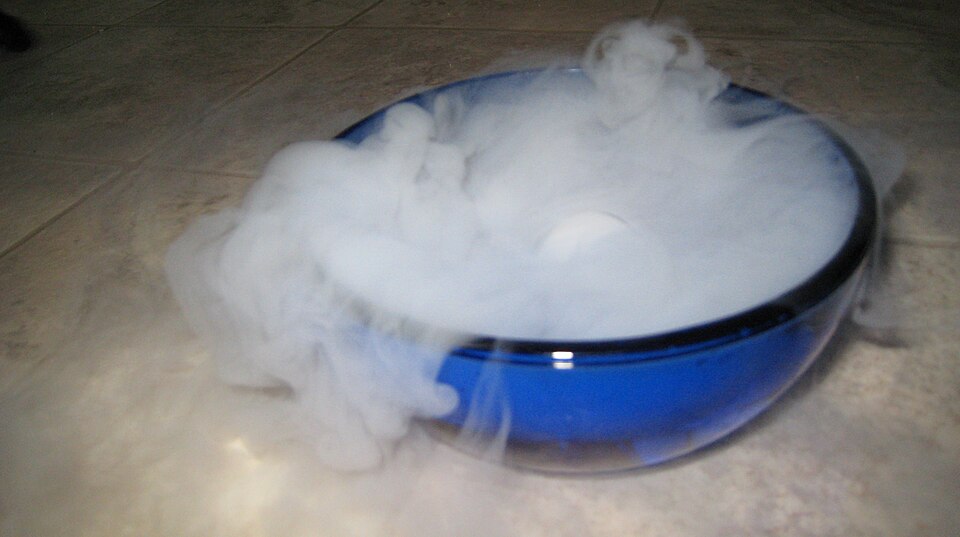
Correct - C, the solid state of carbon dioxide. 'Dry ice' is solid carbon dioxide (CO2). It is called 'dry' because, at ordinary atmospheric pressure, it does not melt into a liquid but sublimes - passing directly from solid to gas - leaving no wet residue. It is very cold, about -78.5 C, and is used for refrigeration, for cold transport of frozen goods and for creating stage fog.
Why the others are wrong
- (a)Ice present in ice-cream — The ice in ice-cream is ordinary frozen water, not dry ice.
- (b)Solid water at Antarctica — Polar ice is frozen water (H2O), not solid carbon dioxide.
- (d)Solid water of ionosphere — This is a nonsensical description; the ionosphere is a layer of ionised gas, and the phrase again refers to water, not carbon dioxide.
Concept
Dry ice is solid carbon dioxide. Because carbon dioxide has no liquid phase at normal atmospheric pressure, solid CO2 sublimes straight into gas, so it keeps things cold without leaving any liquid behind. Its very low temperature, about -78.5 C, makes it a convenient refrigerant.
The word 'dry' signals that there is no liquid - the substance sublimes. That rules out any form of frozen water, which melts to a liquid, and points to solid carbon dioxide.
Key facts
- Dry ice is solid carbon dioxide (CO2).
- At atmospheric pressure carbon dioxide sublimes from solid to gas at about -78.5 C, leaving no liquid.
- It is used for refrigeration, cold transport and stage or fog effects.
- Ordinary ice is frozen water (H2O) and melts into a liquid.
Study next
Common traps
- Thinking dry ice is a form of frozen water - it is solid carbon dioxide.
- Assuming it melts; at normal pressure it sublimes instead.
Asked by identifying dry ice as solid carbon dioxide, or by naming a common substance that sublimes.
Related PYQs
Which one of the following is also known as Dry ice in its solid form?
- (a) SiO2
- (b) CO2
- (c) CaO
- (d) MgO
Answer(b) CO2
Identical concept — dry ice is solid carbon dioxide (CO2). Both questions test that solid CO2 sublimes without melting, hence the name 'dry' ice.
Practice
- practice — not a real PYQ
Dry ice sublimes at atmospheric pressure at a temperature of about
- (a)0 C
- (b)-78.5 C
- (c)-40 C
- (d)-273 C
Answer(b) -78.5 C - the sublimation point of solid carbon dioxide. - practice — not a real PYQ
Solid carbon dioxide is called 'dry ice' because it
- (a)is very hard
- (b)turns directly into gas without melting
- (c)contains no carbon
- (d)floats on water
Answer(b) turns directly into gas (sublimes) without melting, leaving no liquid.