
Which of the following kingdoms has/have only unicellular organisms?
- (a)Monera only
- (b)Protista only
- (c)Monera and Protista both
- (d)Protista and Fungi both
Answer
Why
Correct: C, Monera and Protista both. In Whittaker's five-kingdom scheme as school biology sets it out, Monera is the kingdom of prokaryotes (bacteria, cyanobacteria, mycoplasma, archaebacteria) and every member of it is a single cell without a true nucleus. Protista is defined as the kingdom of single-celled eukaryotes, taking in the protozoans, diatoms, dinoflagellates and euglenoids, so it too is wholly unicellular by definition. The remaining three kingdoms all contain multicellular members: Fungi are mostly built of thread-like hyphae woven into a mycelium, and Plantae and Animalia are multicellular throughout. Only option (c) names both of the unicellular kingdoms and excludes Fungi.
Why the others are wrong
- (a)Monera only: True as far as it goes (every organism in Monera is one prokaryotic cell) but it leaves out Protista, which the same classification defines as the kingdom of single-celled eukaryotes. 'Only' is what makes the option wrong.
- (b)Protista only: The same mistake in the other direction. Protista is indeed entirely unicellular, but so is Monera, so restricting the answer to one of the two loses half of it.
- (d)Protista and Fungi both: Fungi cannot be called unicellular. The great majority are multicellular, made of hyphae that mass into a mycelium: moulds, mushrooms and bread mould among them. Yeast is the well-known single-celled exception, and an exception does not make the kingdom unicellular.
Concept
R. H. Whittaker's five-kingdom classification of 1969 sorts living things by cell structure: prokaryotic or eukaryotic, by body organisation: unicellular or multicellular, by mode of nutrition: autotrophic or heterotrophic, and by reproduction and phylogenetic relationship. Monera holds all prokaryotes. Protista holds the single-celled eukaryotes and forms the link between Monera and the three higher kingdoms. Fungi are heterotrophs that absorb their food and have cell walls of chitin. Plantae are multicellular autotrophs with cellulose walls, and Animalia multicellular heterotrophs without cell walls.
There is one honest qualification worth carrying, and textbooks themselves warn that the boundaries of Protista are not sharply drawn, and some schemes place colonial and even multicellular algae inside it, in which case 'only unicellular' would not hold. Answer the item on the definition the syllabus gives (Monera is all prokaryotes, Protista is all single-celled eukaryotes) because that is the definition being tested. It also gives a cleaner way of rejecting option (d): throw it out on Fungi, which are indisputably mostly multicellular, rather than on any argument about Protista's edges.
Key facts
- Whittaker's five kingdoms are Monera, Protista, Fungi, Plantae and Animalia.
- Monera covers all prokaryotes; their cells have no true nucleus and no membrane-bound organelles.
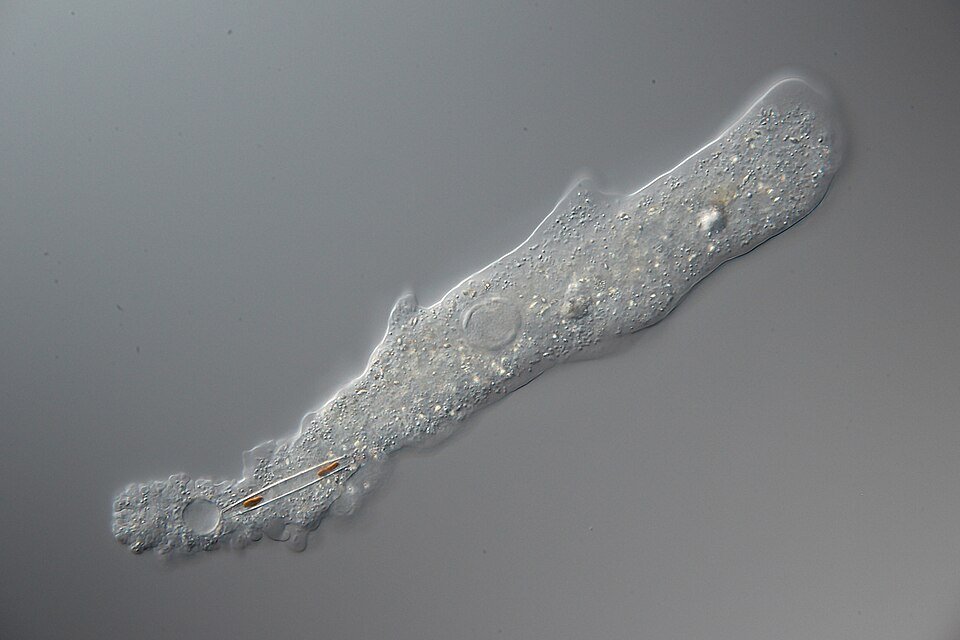
- Protista is the kingdom of single-celled eukaryotes and includes Amoeba, Paramecium, Euglena, diatoms and dinoflagellates.
- Fungi are heterotrophic, absorb their nutrition, have chitin cell walls and are largely multicellular; yeast is the unicellular exception.
- Euglena is the standard boundary case, photosynthesising like a plant in light and feeding heterotrophically in the dark.
Study next
Common traps
- Calling Fungi unicellular because yeast is; the kingdom as a whole is not.
- Choosing 'Monera only' out of caution about Protista's fuzzy boundaries.
- Confusing prokaryotic with unicellular: all prokaryotes are unicellular, but not all unicellular organisms are prokaryotes.
Classification items ask which kingdom fits a stated criterion (unicellular, prokaryotic, autotrophic, cell wall present) so learn each kingdom by its defining set of characters rather than by its examples alone.
Related PYQs
No directly related past PYQ was found.
Practice
- practice, not a real PYQ
All members of which one of the following kingdoms are prokaryotic?
- (a)Protista
- (b)Monera
- (c)Fungi
- (d)Plantae
Answer(b) Monera: it is defined as the kingdom of prokaryotes, whose cells have no true nucleus and no membrane-bound organelles. - practice, not a real PYQ
Yeast is an exception among the fungi because it is
- (a)autotrophic
- (b)prokaryotic
- (c)unicellular
- (d)without a cell wall
Answer(c) unicellular: most fungi are multicellular masses of hyphae, while yeast exists as a single cell.