
Which one of the following crops was introduced by the Portuguese in India?
- (a)Opium
- (b)Coffee
- (c)Betel leaf
- (d)Chili
Answer
Why
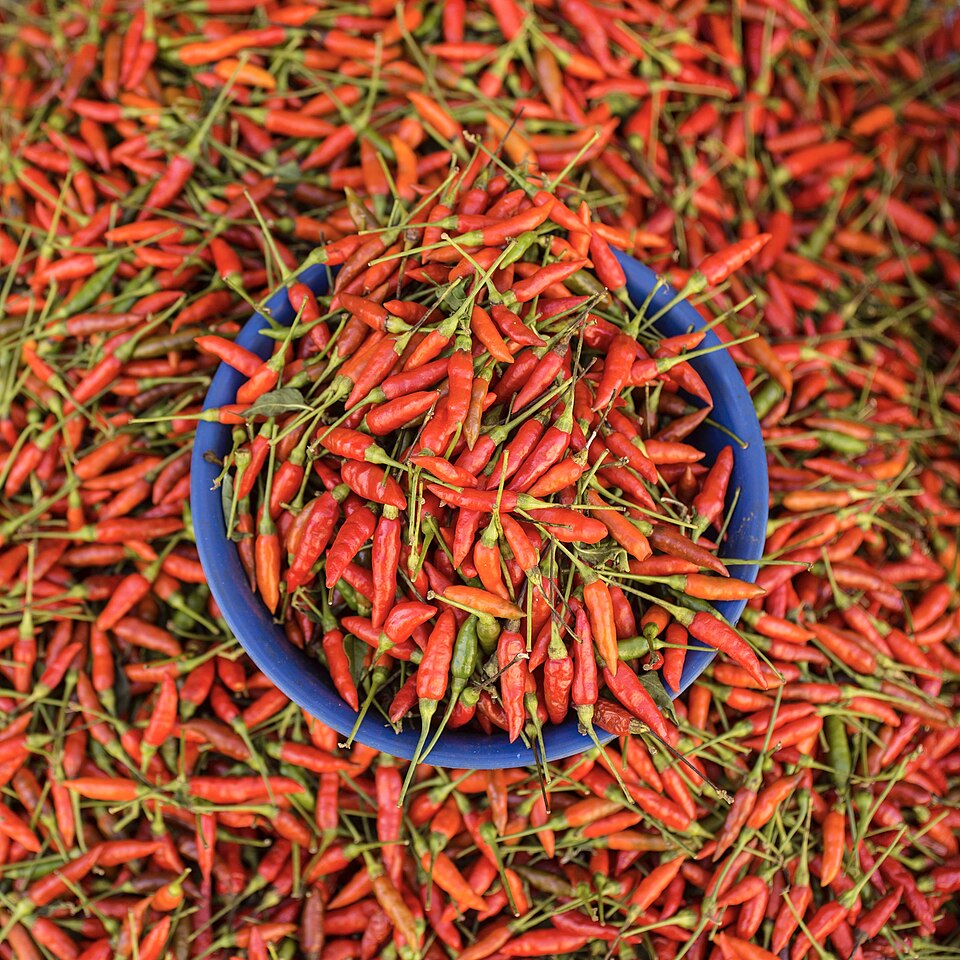
Correct: D, Chili. The chilli is a New World plant. It reached Europe only after Columbus, and it was the Portuguese who then carried it outward along their sea routes: first to Africa and Arabia, and then to their colonies and trading posts in Asia, among them Goa, Sri Lanka and Malacca. That is how the sixteenth century put chilli into an Indian kitchen that had until then relied on black pepper and long pepper for pungency, and how a plant unknown in India before 1500 became the defining note of its cooking. The other three options were all present in India long before a Portuguese ship reached Calicut.
Why the others are wrong
- (a)Opium: Opium was already an established crop in India well before the Portuguese arrived. It was a significant revenue crop under the Mughals, and later became the mainstay of the East India Company's trade with China, so its Indian history has nothing to do with the Columbian exchange.
- (b)Coffee: Coffee is an Old World plant of Ethiopian origin that reached India from Arabia, not from the Americas. Tradition credits Baba Budan, who is said to have brought seeds from Yemen to the hills of Karnataka in the seventeenth century: a route and a period quite separate from the Portuguese crop transfers.
- (c)Betel leaf: Betel is a plant of South and Southeast Asia, and the chewing of paan is attested in Indian literature and travellers' accounts many centuries before the sixteenth. It could not have been an introduction of the Portuguese.
Concept
The voyages of the late fifteenth century set off the Columbian exchange, a two-way transfer of plants, animals and diseases between the Americas and the Old World. The Portuguese, who held the sea route round the Cape and a chain of Asian posts, were the principal carriers into India. The crops they brought include chilli, potato, tomato, maize, tobacco, papaya, pineapple, guava and cashew: a list that quietly rewrote Indian agriculture and cooking within a couple of generations.
The way into this question is to ask which of the four plants is American. Opium, coffee and betel are all Old World crops with long Asian or African histories, and only the chilli comes from the Americas, so only the chilli could have arrived by the Portuguese route. It is a good habit to test any 'introduced by the Portuguese' claim against that single criterion. One printing note is that the paper spells the crop 'Chili', the American form, where Indian usage is normally chilli or chillies; the spelling has no bearing on the answer. It is also worth remembering that spice does not equal chilli: black pepper is indigenous to the Malabar coast and was the very commodity that brought the Portuguese to India in the first place.
Key facts
- The chilli is a New World crop; the Portuguese introduced it first to Africa and Arabia and then to their Asian colonies and trading posts, including Goa.
- Other Portuguese introductions to India include the potato, tomato, maize, tobacco, papaya, pineapple, guava and cashew.
- Black pepper, by contrast, is indigenous to the Malabar coast and was the spice that drew European traders to India.
- Vasco da Gama reached Calicut in 1498 and the Portuguese took Goa in 1510, which became the hub of these transfers.
Study next
Common traps
- Assuming that anything hot or spicy in Indian cooking must be ancient; chilli is a late arrival and pepper is the older spice.
- Crediting the Portuguese with coffee because both stories involve long-distance sea trade; coffee came overland and by sea from Arabia.
- Confusing the arrival of a crop with the arrival of a European power; opium and betel long predate 1498.
Asked as a one-from-four in which three options are Old World crops and only the American one fits the Portuguese route.
Related PYQs
Consider the following fruits: I. Papaya II. Pineapple III. Guava. How many of the above were introduced in India by the Portuguese in the sixteenth and seventeenth centuries?
- (a) Only one
- (b) Only two
- (c) All the three
- (d) None
Answer(c) All the three
The same theme extended to fruit. Papaya, pineapple and guava travelled by the same Portuguese route as chilli, which shows how wide the sixteenth-century transfer really was.
Practice
- practice, not a real PYQ
Which one of the following crops is NOT of American origin?
- (a)Maize
- (b)Potato
- (c)Black pepper
- (d)Tomato
Answer(c) Black pepper: it is indigenous to the Malabar coast of India, while maize, potato and tomato are all New World crops brought across after 1492. - practice, not a real PYQ
The two-way transfer of crops, animals and diseases between the Americas and the Old World after 1492 is known as the
- (a)Columbian exchange
- (b)Green revolution
- (c)Triangular trade
- (d)Silk route exchange
Answer(a) Columbian exchange: the process that brought chilli, potato, maize and tobacco to India and carried rice, sugarcane and wheat westward.