
Which one of the following is an oxidation-reduction reaction?
- (a)NaOH + HCl → NaCl + H₂O
- (b)CaO + H₂O → Ca(OH)₂
- (c)2Mg + O₂ → 2MgO
- (d)Na₂SO₄ + BaCl₂ → BaSO₄ + 2NaCl
Answer
Why
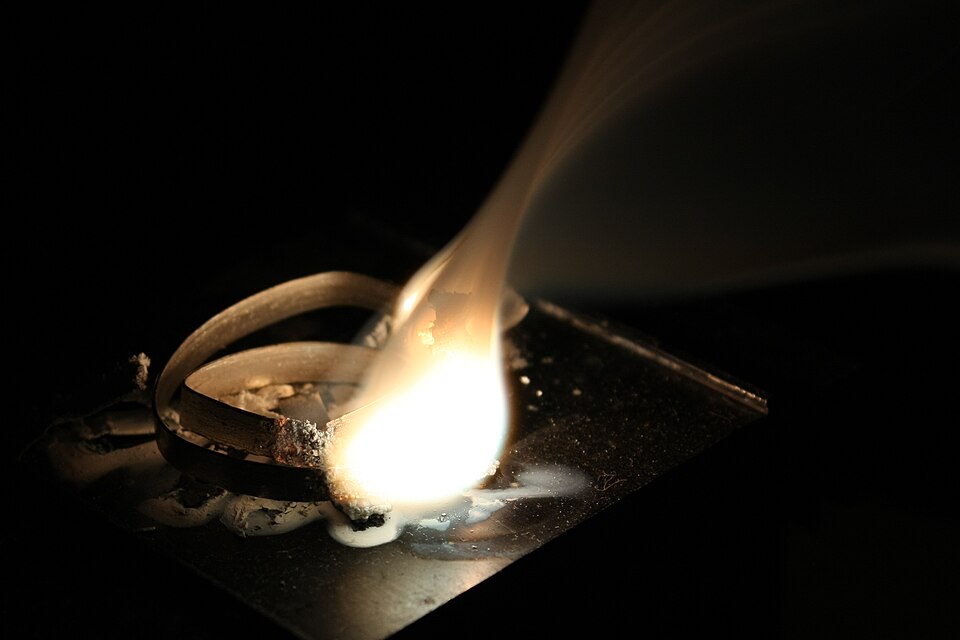
Correct: C, 2Mg + O₂ → 2MgO. This is the only equation in which oxidation numbers change. Magnesium starts as the free element at 0 and ends up at +2 in magnesium oxide, so it loses electrons and is oxidised; oxygen starts at 0 in the O₂ molecule and ends at −2, so it gains those electrons and is reduced. Because one species is oxidised and another reduced in the same step, the reaction is a redox reaction, and it is the textbook example of it, the bright combustion of a magnesium ribbon in air. In the other three equations every element keeps the oxidation number it began with; ions merely change partners.
Why the others are wrong
- (a)NaOH + HCl → NaCl + H₂O: This is neutralisation. Sodium stays at +1, chlorine at −1, hydrogen at +1 and oxygen at −2 throughout. An H⁺ and an OH⁻ combine to give water; no electron is transferred.
- (b)CaO + H₂O → Ca(OH)₂: This is a combination reaction that produces slaked lime, and it releases a good deal of heat, which is often mistaken for evidence of a redox change. But calcium remains +2, oxygen −2 and hydrogen +1 on both sides, so nothing is oxidised or reduced.
- (d)Na₂SO₄ + BaCl₂ → BaSO₄ + 2NaCl: This is a double displacement or precipitation reaction: barium sulphate drops out as a white solid. Every ion keeps its charge and simply swaps its partner, so there is no transfer of electrons.
Concept
A redox reaction is defined by the movement of electrons, which shows up as a change in oxidation number. Oxidation is a loss of electrons and a rise in oxidation number; reduction is a gain of electrons and a fall in it. The two always happen together, because the electrons one species loses have to go somewhere. The substance oxidised is the reducing agent, and the substance reduced is the oxidising agent.
The fastest way to sort a list like this is to assign oxidation numbers to every element on both sides and look for a single change. Reactions in which a free element appears on one side (here, Mg and O₂) are almost always redox, because an element in its free state has an oxidation number of 0 and can hardly stay there once it has combined. Neutralisation, precipitation and simple combination of oxides with water are the three commonest non-redox types, and this question has planted one of each. Watch out for the intuition that heat means redox: slaking lime is strongly exothermic yet involves no electron transfer at all.
Key facts
- An element in its free, uncombined state has an oxidation number of 0; magnesium goes from 0 to +2 and oxygen from 0 to −2 in this reaction.
- Oxidation and reduction always occur together: the species oxidised is the reducing agent and the species reduced is the oxidising agent.
- Neutralisation of an acid by a base, and double displacement reactions that form a precipitate, are never redox reactions.
- Rusting, respiration, photosynthesis, combustion and the working of a dry cell are all everyday redox processes.
Study next
Common traps
- Treating any reaction that involves oxygen as redox and any that does not as non-redox: the definition is electron transfer, not the presence of the element oxygen.
- Assuming a strongly exothermic reaction such as slaking of lime must be redox.
- Confusing double displacement with displacement; only the latter, where a free metal turns up, involves electron transfer.
Asked as a one-from-four in which four balanced equations are given and only one shows a change in oxidation number.
Related PYQs
Which one of the following is not an example of a redox reaction?
- (a) AlCl₃ + 3H₂O → Al(OH)₃ + 3HCl
- (b) 2NaH → 2Na + H₂
- (c) 4Fe + 3O₂ → 2Fe₂O₃
- (d) CuSO₄ + Zn → Cu + ZnSO₄
Answer(a) AlCl₃ + 3H₂O → Al(OH)₃ + 3HCl
The same test with the polarity reversed: here three of the four are redox and the hydrolysis of aluminium chloride is the exception. Between the two items you meet both directions of the same oxidation-number check.
Which one of the following compounds does not exhibit a different oxidation number of the same element?
- (a) Pb3O4
- (b) Fe3O4
- (c) Fe2O3
- (d) Mn3O4
Answer(c) Fe2O3
Drills the oxidation-number arithmetic that decides whether a reaction is redox at all. Fe₂O₃ has all its iron at +3, while the mixed oxides carry the same element in two states at once.
Practice
- practice, not a real PYQ
In the reaction Zn + CuSO₄ → ZnSO₄ + Cu, which species is oxidised?
- (a)Zinc
- (b)Copper
- (c)Sulphate ion
- (d)No species is oxidised
Answer(a) Zinc: it goes from 0 in the free metal to +2 in zinc sulphate, losing electrons, while Cu²⁺ gains them and is reduced to copper metal. - practice, not a real PYQ
Which one of the following reactions is not a redox reaction?
- (a)2H₂ + O₂ → 2H₂O
- (b)AgNO₃ + NaCl → AgCl + NaNO₃
- (c)Fe + CuSO₄ → FeSO₄ + Cu
- (d)2KClO₃ → 2KCl + 3O₂
Answer(b) AgNO₃ + NaCl → AgCl + NaNO₃: a precipitation reaction in which every ion keeps its charge; the other three all involve a change in oxidation number.