
Which one of the following compounds does not exhibit a different oxidation number of the same element?
- (a)Pb3O4
- (b)Fe3O4
- (c)Fe2O3
- (d)Mn3O4
Answer
Why
Correct — C, Fe₂O₃. In Fe₂O₃ every iron atom is in the same +3 oxidation state (two Fe at +3 balance three O at −2), so iron shows a single oxidation number. Each of the other three is a mixed-oxidation-state oxide: Pb₃O₄ has lead as +2 and +4, Fe₃O₄ (magnetite) has iron as +2 and +3, and Mn₃O₄ has manganese as +2 and +3. Only Fe₂O₃ does not exhibit two different oxidation numbers of the same element.
Why the others are wrong
- (a)Pb3O4 — Red lead, Pb₃O₄, is 2PbO·PbO₂ — two lead atoms are +2 and one is +4, so lead exists in two oxidation states; it does exhibit the difference.
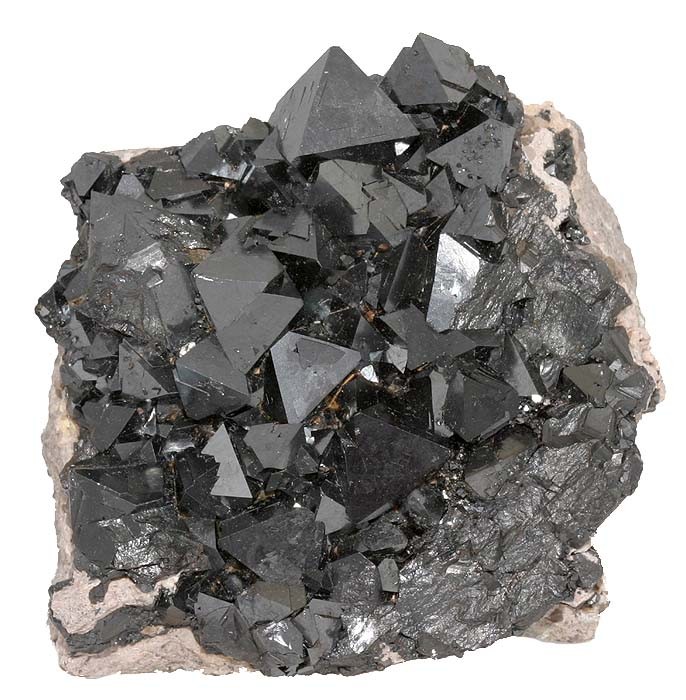
- (b)Fe3O4 — Magnetite, Fe₃O₄, is FeO·Fe₂O₃ — iron is present as both +2 and +3, a mixed oxidation state.
- (d)Mn3O4 — Mn₃O₄ is MnO·Mn₂O₃ — manganese is present as +2 and +3, again two oxidation states of the same element.
Concept
The oxidation number is the charge an atom would carry if every bond were treated as fully ionic; oxygen is normally −2. In certain 'mixed' oxides — the M₃O₄ spinels and red lead Pb₃O₄ — the same metal sits in two oxidation states at once, whereas a simple oxide such as Fe₂O₃ has the metal in a single state.
Test each formula by fixing oxygen at −2 and solving for the metal. An average that comes out fractional (as in Fe₃O₄, where the mean is +8/3) is the giveaway that two integer states are mixed; a whole-number result across all atoms (Fe₂O₃ → +3) means a single state.
Key facts
- Oxygen is taken as −2 in ordinary oxides.
- Fe₂O₃: all iron is +3 — a single oxidation state.
- Fe₃O₄ = FeO·Fe₂O₃ (iron +2 and +3); Pb₃O₄ has lead +2 and +4.
- Mn₃O₄ = MnO·Mn₂O₃ (manganese +2 and +3).
Study next
Common traps
- Reading Fe₃O₄ as a single +8/3 state instead of a mix of +2 and +3.
- Assuming every oxide with a subscript-3 metal must be mixed — check the actual arithmetic.
Asked as 'which compound has the element in two oxidation states' — solve each with oxygen = −2 and look for a fractional average.
Related PYQs
Match List I (Oxidation number) with List II (The element) and select the correct answer: A. 2 — 1. Oxidation number of Mn in MnO₂; B. 3 — 2. Oxidation number of S in H₂S₂O₇; C. 4 — 3. Oxidation number of Ca in CaO₂; D. 6 — 4. Oxidation number of Al in NaAlH₄
- (a) A-3, B-4, C-1, D-2
- (b) A-4, B-3, C-1, D-2
- (c) A-3, B-4, C-2, D-1
- (d) A-4, B-3, C-2, D-1
Answer(a) A-3, B-4, C-1, D-2
Same skill — assigning oxidation numbers from a formula. UPSC makes you compute the state of Mn, S, Ca and Al in given compounds; this NDA item asks which oxide holds its metal in two oxidation states at once.
What is the oxidation state of Vanadium in V₂O₅?
- (a) +2
- (b) +4
- (c) +3
- (d) +5
Answer(d) +5
Same concept — finding an element's oxidation state by fixing oxygen at −2. That NDA item asks for vanadium in V₂O₅ (+5); this one asks which oxide has its metal in two different states.
Practice
- practice — not a real PYQ
The oxidation states of lead in Pb₃O₄ are
- (a)only +2
- (b)only +4
- (c)+2 and +4
- (d)+2 and +3
Answer(c) +2 and +4 — red lead is 2PbO·PbO₂, a mixed-oxidation-state oxide. - practice — not a real PYQ
The oxidation number of iron in Fe₂O₃ is
- (a)+2
- (b)+3
- (c)+8/3
- (d)+4
Answer(b) +3 — two iron atoms balance three oxide ions at −2 each.