
Which one of the following is not an agent of metamorphism?
- (a)Heat
- (b)Compression
- (c)Decomposition
- (d)Solution
Answer
Why
Correct: C, Decomposition. Metamorphism is driven by three things, and the paper has simply given them their older textbook names: heat, compression (pressure) and solution (chemically active fluids). Decomposition is not one of them. It is the chemical breakdown of minerals at or near the land surface, where water, oxygen and weak acids attack a rock and take it apart; it belongs to the vocabulary of weathering, not of metamorphism. The two processes even pull in opposite directions. Decomposition loosens and destroys a rock at the surface, whereas metamorphism, working deep in the crust at temperatures above roughly 150 °C, recrystallises a rock that stays solid throughout and generally makes it harder and denser.
Why the others are wrong
- (a)Heat: Heat is the primary agent. Metamorphism is regarded as beginning at about 100 to 200 °C, and the heat may come from burial along the geothermal gradient or from a body of magma pushing into cooler crustal rock beside it.
- (b)Compression: Compression is the pressure term. Confining pressure from the weight of overlying rock, and directed pressure from tectonic squeezing, both drive recrystallisation; directed pressure is what lines the new minerals up into the bands and sheets called foliation.
- (d)Solution: Solution stands for the chemically active fluids: hot, mineral-charged water moving along grain boundaries. These fluids carry ions in and out, speed up reactions and allow the rock's chemistry to change without it ever melting.
Concept
Metamorphism changes an existing rock in the solid state. Heat supplies the energy for atoms to move and regroup, pressure controls how the new grains pack and align, and chemically active fluids carry material about so that reactions can run to completion. What comes out has new minerals, a new texture, or both, but was never molten: the moment a rock melts, it leaves metamorphism behind and enters the igneous story.
The trap is that all four words are real geological terms, so the question is not testing whether you recognise them but whether you know which family each belongs to. Sort the options by depth. Heat, compression and solution are all things that happen inside the crust; decomposition happens on the outside of it. A useful cross-check is that the same paper asks separately, at Q119, which process is not chemical weathering, and decomposition would sit comfortably inside that other list. Note also that the paper's names are the older ones; a modern geology text would say pressure and chemically active fluids rather than compression and solution.
Key facts
- Metamorphism operates at temperatures above about 150 °C, and is generally regarded as beginning between roughly 100 and 200 °C.
- The rock stays solid throughout; melting takes the material out of metamorphism and into igneous processes.
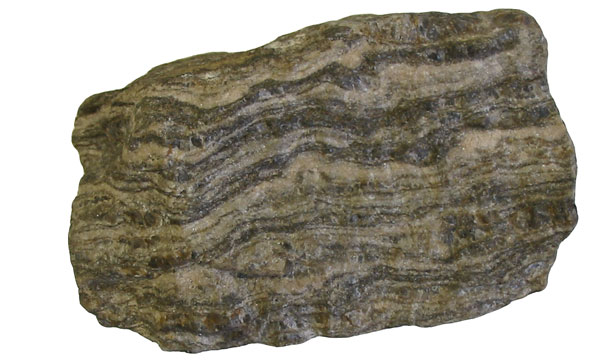
- Directed pressure aligns newly grown minerals into layers, producing the foliation seen in slate, schist and gneiss.
- Slate forms from mudstone at very low grade, gneiss from the same parent at high grade, and marble from limestone or chalk.
Study next
Common traps
- Treating 'compression' and 'solution' as unfamiliar words and rejecting them, when they are simply the older names for pressure and chemically active fluids.
- Confusing metamorphism with melting: metamorphic change happens with the rock still solid.
- Mixing up the surface processes of weathering with the deep-crustal processes of metamorphism because both 'change' a rock.
Asked as an odd-one-out where three options belong to one process family and the fourth has been imported from a neighbouring topic.
Related PYQs
Which one of the following statements about metamorphic rocks is not correct?
- (a) Due to segregation of minerals into wavy bands or platy surfaces, some metamorphic rocks develop foliations.
- (b) Where the foliations develop into broad mineral bands, the metamorphic rock is extremely hard.
- (c) Where the foliations are moderately thin, the metamorphic rock tends to flake apart.
- (d) Rocks that originally were composed of one dominant mineral are often foliated by metamorphism.
Answer(d) Rocks that originally were composed of one dominant mineral are often foliated by metamorphism.
Takes the same topic one step further, into what the agents of metamorphism actually produce. A single-mineral parent such as pure limestone gives unfoliated marble, so foliation needs a mixed mineralogy plus directed pressure.
Which one of the following is not an igneous rock ?
- (a) Granite
- (b) Slate
- (c) Basalt
- (d) Gabbro
Answer(b) Slate
The same odd-one-out design applied to rock families rather than to processes. Slate is the low-grade metamorphic product of mudstone, so placing it correctly is the flip side of knowing what metamorphism does.
Practice
- practice, not a real PYQ
The alignment of newly grown minerals into parallel bands in a metamorphic rock is called
- (a)bedding
- (b)foliation
- (c)vesicularity
- (d)cross-bedding
Answer(b) foliation: directed pressure during metamorphism lines the mineral grains up into layers or sheets, which is why slate splits so cleanly. - practice, not a real PYQ
Which one of the following pairs of parent rock and metamorphic rock is correctly matched?
- (a)Limestone — quartzite
- (b)Sandstone — marble
- (c)Mudstone — slate
- (d)Granite — basalt
Answer(c) Mudstone (slate) mudstone metamorphosed at very low grade gives slate; limestone gives marble, sandstone gives quartzite, and granite and basalt are both igneous.