
Which one of the following statements about metamorphic rocks is not correct?
- (a)Due to segregation of minerals into wavy bands or platy surfaces, some metamorphic rocks develop foliations.
- (b)Where the foliations develop into broad mineral bands, the metamorphic rock is extremely hard.
- (c)Where the foliations are moderately thin, the metamorphic rock tends to flake apart.
- (d)Rocks that originally were composed of one dominant mineral are often foliated by metamorphism.
Answer
Why
Correct — D, Rocks that originally were composed of one dominant mineral are often foliated by metamorphism. This is the statement that does not hold, and the question asks for the incorrect one. Foliation is a layering produced when different minerals separate into bands or when platy grains such as mica line up. A parent rock made of essentially one mineral has nothing to segregate, so it recrystallises into a massive, non-foliated rock — quartz sandstone becomes quartzite and pure limestone becomes marble, neither of which is foliated.
Why the others are wrong
- (a)Due to segregation of minerals into wavy bands or platy surfaces, some metamorphic rocks develop foliations. — This is a correct description of how foliation forms, so it cannot be the answer to a question that asks which statement is not correct.
- (b)Where the foliations develop into broad mineral bands, the metamorphic rock is extremely hard. — Also correct — coarse banding, as in gneiss, goes with a hard, resistant rock, so this statement is not the odd one out.
- (c)Where the foliations are moderately thin, the metamorphic rock tends to flake apart. — Correct as well — thin, closely spaced foliation is why slate and schist split into sheets or flakes along those planes.
Concept
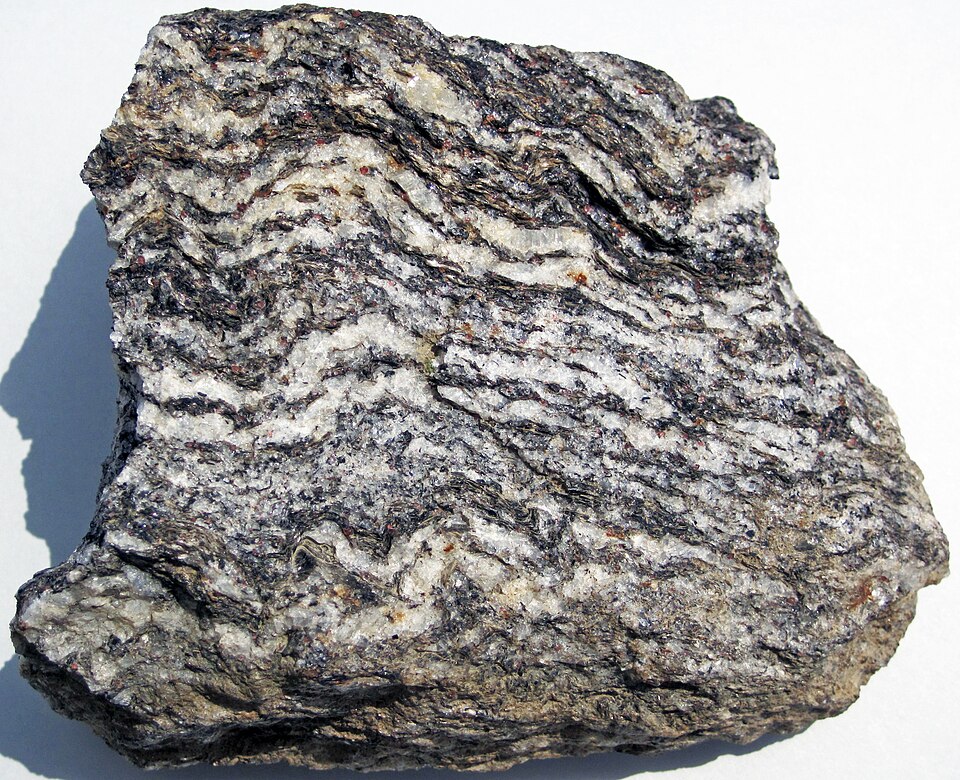
Metamorphic rocks form when existing rocks are recrystallised in the solid state by heat, pressure and chemically active fluids. They fall into two families. Foliated rocks such as slate, schist and gneiss have a directional layering created by aligned platy minerals or segregated mineral bands. Non-foliated rocks such as quartzite and marble have no such layering, because their parent rock was dominated by a single mineral.
The trap in this item is that three of the four statements are textbook-true, so the eye slides past them. The test is whether you know the one condition foliation needs — a mixture of minerals, especially platy ones like mica, that can separate and align. Remove that variety and you remove foliation, which is why the monomineralic case in option (d) is exactly backwards.
Key facts
- Foliation requires platy or elongate minerals, such as micas and chlorite, that can align under directed pressure.
- Quartz sandstone metamorphoses to quartzite and limestone to marble; both are non-foliated because the parent rock is dominated by one mineral.
- The common foliated series from low to high grade runs slate, phyllite, schist, gneiss.
- Slate splits into thin sheets along its foliation, while coarsely banded gneiss is hard and resistant.
Study next
Common traps
- Missing the word 'not' and picking a statement that is true.
- Assuming all metamorphic rocks are layered — marble and quartzite are not.
A find-the-wrong-statement item on foliation; the wrong statement is the one that claims single-mineral rocks become foliated.
Related PYQs
Quartzite is metamorphosed from
- (a) Limestone
- (b) Obsidian
- (c) Sandstone
- (d) Shale
Answer(c) Sandstone
Quartzite is the textbook case this question turns on — a nearly single-mineral parent rock that metamorphoses into a hard, non-foliated rock.
Which one of the following is not an igneous rock ?
- (a) Granite
- (b) Slate
- (c) Basalt
- (d) Gabbro
Answer(b) Slate
Slate is the odd one out there because it is metamorphic — and it is the foliated rock that splits into sheets, the behaviour option (c) describes here.
Practice
- practice — not a real PYQ
Which one of the following is a non-foliated metamorphic rock?
- (a)Slate
- (b)Schist
- (c)Marble
- (d)Gneiss
Answer(c) Marble — metamorphosed limestone, dominated by one mineral, so it has no foliation. - practice — not a real PYQ
The alignment of platy minerals such as mica under directed pressure in a metamorphic rock produces
- (a)Foliation
- (b)Vesicles
- (c)Stratification
- (d)Cross-bedding
Answer(a) Foliation — vesicles are igneous, and stratification and cross-bedding are sedimentary features.