
Which compound, when dissolved in water, conducts electricity and forms a basic solution ?
- (a)HCl
- (b)CH₃COOH
- (c)CH₃OH
- (d)NaOH
Answer
Why
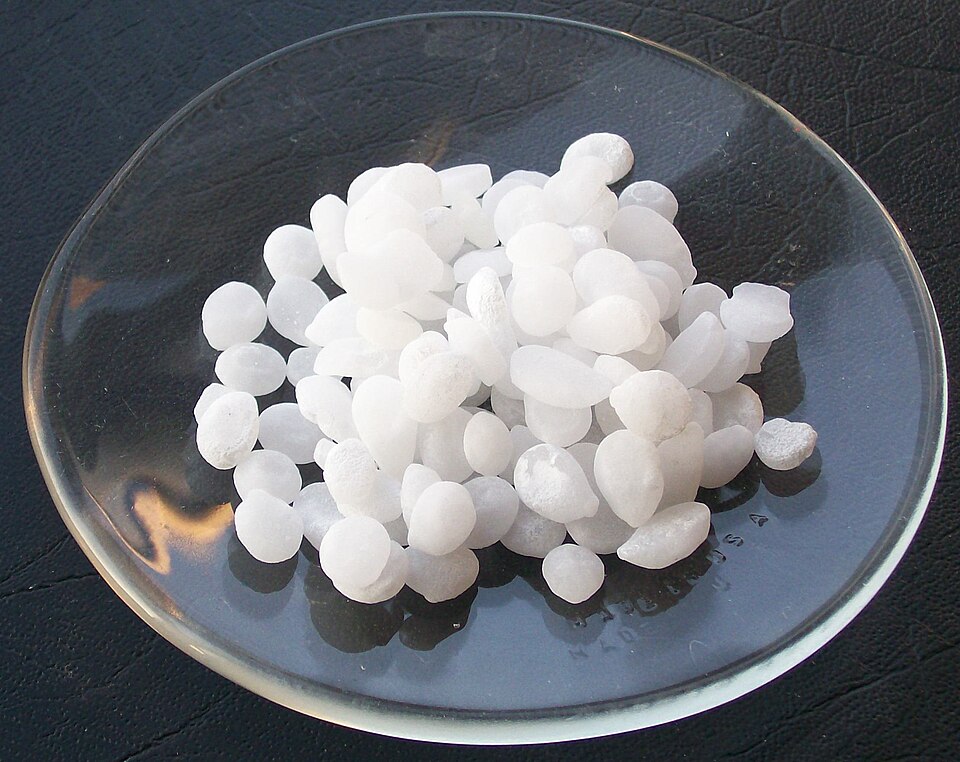
Correct: D, NaOH. Sodium hydroxide is an ionic solid. Water pulls the lattice apart completely, so the solution is full of mobile Na⁺ and OH⁻ ions and conducts electricity well: it is a strong electrolyte. The ion released is the hydroxide ion, which is what makes a solution basic, so the pH rises well above 7 and red litmus turns blue. The question sets two conditions at once, and NaOH is the only option that meets both: it conducts, and what it conducts with is a base.
Why the others are wrong
- (a)HCl: Hydrogen chloride dissolves and ionises completely, so it conducts electricity as well as sodium hydroxide does. It fails the second condition: it releases H⁺, giving hydrochloric acid, whose solution is strongly acidic with a pH well below 7.
- (b)CH₃COOH: Acetic acid, the acid of vinegar, is a weak acid. It only partly ionises, so it conducts feebly, and what it releases is again H⁺: its solution is acidic, not basic. It fails both halves of the question.
- (c)CH₃OH: Methanol is an alcohol, not a base. Although it carries an -OH group, that group stays bonded to carbon and is not released as a free hydroxide ion, so a methanol solution is close to neutral and is a non-electrolyte that barely conducts at all. The -OH written in the formula is the trap in this option.
Concept
A solution conducts electricity only when it contains ions free to move. Ionic compounds and strong acids and bases give plenty of them and are strong electrolytes; weak acids and bases ionise only partly and conduct feebly; covalent molecular substances such as sugar and alcohol give no ions at all. Whether the solution is acidic or basic then depends on which ion is set free: H⁺ for an acid, OH⁻ for a base.
Read a two-condition question as two filters applied in turn. Filter one, does it give ions, removes methanol. Filter two, are those ions hydroxide, removes hydrochloric and acetic acid. Notice too that an -OH written in a formula does not by itself mean a base; in NaOH the group is bound to a metal and comes off as a hydroxide ion, while in CH₃OH it is bound to carbon and stays put. That single distinction separates the whole family of alcohols from the family of alkalis.
Key facts
- Ionic compounds do not conduct in the solid state, because the ions are fixed in the lattice; they conduct when molten or dissolved, when the ions become mobile.
- Sodium hydroxide, also called caustic soda, is a strong base used in soap making, paper making and the treatment of bauxite.
- A basic solution has a pH above 7, turns red litmus blue and turns phenolphthalein pink.
- Acetic acid is a weak acid, ionising only partly, which is why vinegar is a poor conductor compared with an equally concentrated solution of hydrochloric acid.
- Methanol and other alcohols are non-electrolytes, despite carrying an -OH group in the formula.
Study next
Common traps
- Treating any formula containing OH as a base: methanol is the standard trap.
- Assuming a good conductor must be basic; hydrochloric acid conducts just as well and is strongly acidic.
- Forgetting that solid sodium hydroxide does not conduct: the ions must be free to move first.
NDA sets this either as this kind of double-condition item or as a straight question about which solution turns litmus which colour.
Related PYQs
With reference to ionic compounds, consider the following statements: 1. Ionic compounds are insoluble in alcohol. 2. Ionic compounds in the solid state are good conductors of electricity. Which of these statements is/are correct?
- (a) Only 1
- (b) Only 2
- (c) Both 1 and 2
- (d) Neither 1 nor 2
Answer(a) Only 1
Sharpens the conductivity half of this question: an ionic compound such as sodium hydroxide conducts only once its ions are free to move, which happens when it dissolves or melts and not while it is a solid.
Which one of the following gases gives acidic solution on dissolving in water ?
- (a) Hydrogen
- (b) Carbondioxide
- (c) Nitrogen
- (d) Oxygen
Answer(b) Carbondioxide
The mirror image of this item: there the substance dissolves to give an acidic solution, here to give a basic one, and both turn on which ion the dissolved substance releases into the water.
Practice
- practice, not a real PYQ
Which one of the following aqueous solutions would be the poorest conductor of electricity?
- (a)Sodium chloride solution
- (b)Dilute hydrochloric acid
- (c)Sugar solution
- (d)Sodium hydroxide solution
Answer(c) Sugar solution: sugar dissolves as neutral molecules and gives no ions, so it is a non-electrolyte. - practice, not a real PYQ
An aqueous solution turns red litmus blue. The solution most likely contains
- (a)an excess of H⁺ ions
- (b)an excess of OH⁻ ions
- (c)equal numbers of H⁺ and OH⁻ ions
- (d)no ions at all
Answer(b) an excess of OH⁻ ions: hydroxide ions in excess make a solution basic.