
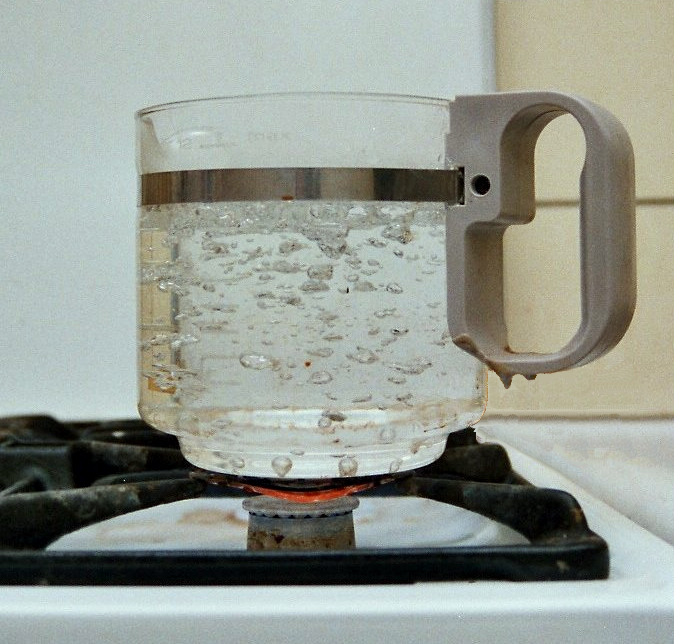
When pure water boils vigorously, the bubbles that rise to the surface are composed primarily of
- (a)air
- (b)hydrogen
- (c)hydrogen and oxygen
- (d)water vapour
Answer
Why
Correct: D, water vapour. Boiling begins when the vapour pressure of the liquid rises to match the pressure pressing down on it, so that a bubble of vapour can form inside the body of the liquid and hold itself open against the surrounding water and atmosphere. Every one of those bubbles is steam: water that has changed phase without changing its chemical identity. The word 'pure' in the question rules out dissolved gases, and the word 'vigorously' rules out the small bubbles that appear early on. Boiling is a physical change, so nothing new is made; the H₂O simply moves from the liquid state to the gaseous one and rises because vapour is far less dense than water.
Why the others are wrong
- (a)air: Air is what escapes in the small bubbles that cling to the sides of the pan long before the water is anywhere near boiling. Cold water holds dissolved nitrogen and oxygen, and their solubility falls as the temperature rises, so they come out first. By the time the water is boiling vigorously that dissolved air has already gone, and in pure water there is little of it to begin with.
- (b)hydrogen: Getting hydrogen out of water means breaking the O-H bonds, which is chemical decomposition and needs electrolysis or a temperature of thousands of degrees. Boiling at a hundred degrees does no such thing: it only separates whole water molecules from one another.
- (c)hydrogen and oxygen: This is the same mistake as option (b), and it also imagines an explosive mixture forming in every kettle. Splitting water into hydrogen and oxygen is a chemical change that boiling cannot bring about; the molecules leaving the liquid are still H₂O.
Concept
Evaporation happens only at the free surface of a liquid and at any temperature. Boiling happens throughout the bulk of the liquid and only at one temperature for a given pressure: the temperature at which the saturated vapour pressure equals the external pressure. A bubble can survive inside the liquid only when the vapour inside it can push back against the water and the atmosphere above, which is why bubbles of steam appear all at once when that condition is met.
Because boiling depends on the outside pressure, the boiling point falls at high altitude, where the atmosphere presses less, and rises inside a pressure cooker, where it presses more. That is why food takes longer to cook on a hill and less time in a cooker. Note also that the temperature of boiling water does not rise while it boils: the heat supplied goes into the latent heat of vaporisation, the energy needed to pull molecules out of the liquid, rather than into raising the temperature.
Key facts
- Boiling occurs when the saturated vapour pressure of the liquid becomes equal to the external pressure on it.
- Pure water boils at 100 degrees Celsius at standard atmospheric pressure, and at a lower temperature where the pressure is lower.
- The latent heat of vaporisation of water is about 2260 kilojoules per kilogram, far larger than the latent heat of fusion of ice at about 334 kilojoules per kilogram.
- The early small bubbles in heated water are dissolved air, whose solubility falls as temperature rises.
- Boiling is a physical change: the substance leaving the liquid is still H₂O.
Study next
Common traps
- Calling the early small bubbles proof that boiling gives off air: those bubbles appear well before boiling starts.
- Assuming heat can split water into hydrogen and oxygen at kitchen temperatures.
- Thinking the water gets hotter the longer it boils; once boiling starts the temperature holds steady while the latent heat is absorbed.
NDA frames this either as this kind of observation question or as a statement item about the condition for boiling and the role of pressure.
Related PYQs
Assertion (A): The boiling point of water decreases as the altitude increases. Reason (R): The atmospheric pressure increases with altitude.
- (a) Both A and R are individually true and R is the correct explanation of A
- (b) Both A and R are individually true but R is NOT a correct explanation of A
- (c) A is true but R is false
- (d) A is false but R is true
Answer(c) A is true but R is false
Tests the same definition of boiling from the pressure side: water boils when its vapour pressure matches the surrounding pressure, which is why the boiling point falls where the atmosphere is thinner.
A liquid is heated up to a certain temperature. Which one of the following situation would correspond to the boiling of the liquid ?
- (a) When atmospheric pressure becomes equal to the vapour pressure
- (b) When atmospheric pressure becomes less than vapour pressure
- (c) When atmospheric pressure becomes higher than the vapour pressure
- (d) When vapour pressure becomes equal to the air pressure
Answer(a) When atmospheric pressure becomes equal to the vapour pressure
States outright the condition that explains the 2017 answer: bubbles of vapour can form and survive inside the liquid only once the vapour pressure has risen to meet the pressure outside.
Practice
- practice, not a real PYQ
Water boils at a lower temperature on a high mountain because
- (a)the air there is colder
- (b)the atmospheric pressure there is lower
- (c)the water there is less pure
- (d)the latent heat of vaporisation is smaller there
Answer(b) the atmospheric pressure there is lower, so the vapour pressure matches it at a lower temperature. - practice, not a real PYQ
While pure water is boiling steadily at atmospheric pressure, the heat supplied to it is used mainly to
- (a)raise its temperature
- (b)supply the latent heat of vaporisation
- (c)break water into hydrogen and oxygen
- (d)dissolve more air in it
Answer(b) supply the latent heat of vaporisation: the temperature stays at the boiling point while the change of state goes on.