
An object is placed in front of a convex mirror. Which one of the following statements is correct?
- (a)It will never form an inverted image.
- (b)The image moves towards the focus when the object moves towards the mirror.
- (c)Depending on the position of the object with respect to the mirror, the image can be inverted and real.
- (d)The size of the image becomes larger than that of the object when the object is placed at a distance equal to half the focal length.
Answer
Why
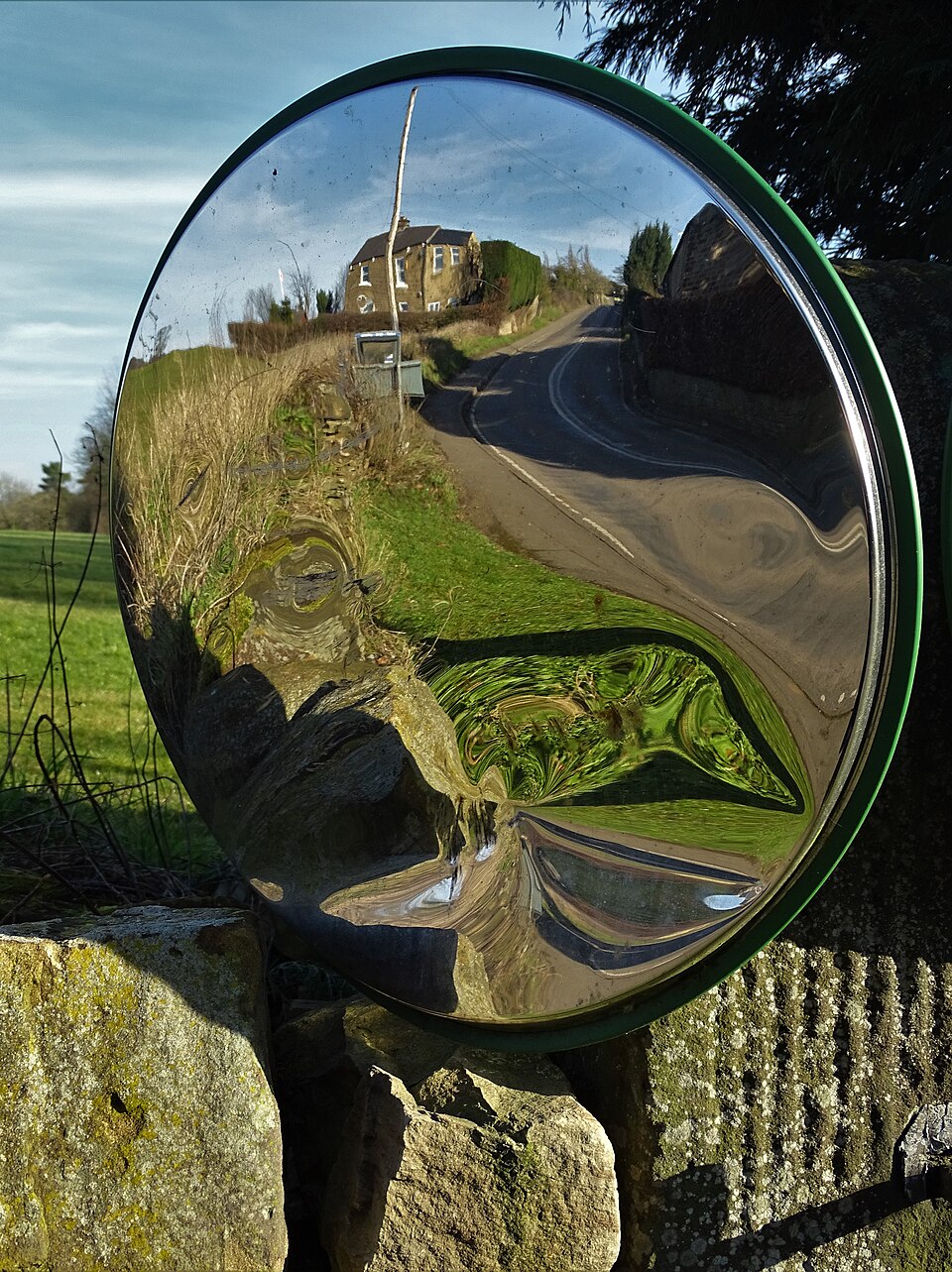
Correct: A, It will never form an inverted image. A convex mirror bulges towards the object and so diverges every ray that strikes it. The reflected rays spread apart and never actually meet, so they can only be traced backwards to an apparent meeting point behind the mirror. The result is always the same, a virtual, erect and diminished image lying between the pole and the focus, and it stays that way wherever the object is put. Since an inverted image would have to be a real one formed by rays that genuinely converge, a convex mirror cannot produce it. That unchanging behaviour is exactly why convex mirrors are used as rear-view mirrors and at blind corners: the picture is always the right way up and always shows a wide field.
Why the others are wrong
- (b)The image moves towards the focus when the object moves towards the mirror.: The movement is the other way round. As the object comes closer to the mirror the image moves towards the pole and grows towards full size; it approaches the focus when the object recedes towards infinity, where the image shrinks to a point at F.
- (c)Depending on the position of the object with respect to the mirror, the image can be inverted and real.: There is no such position for a real object. A convex mirror diverges light for every object distance, so a real, inverted image is impossible: this is precisely what makes it different from a concave mirror.
- (d)The size of the image becomes larger than that of the object when the object is placed at a distance equal to half the focal length.: A convex mirror always diminishes. Its magnification is less than one for every object position, and it approaches one only in the limit where the object is pressed right up against the mirror; it never exceeds it.
Concept
Mirrors are classified by which way the reflecting surface curves. A concave mirror curves inward and converges light, so its image can be real or virtual, inverted or erect, magnified or diminished, all depending on where the object sits relative to the focus and the centre of curvature. A convex mirror curves outward and diverges light, and its behaviour is far simpler: the image is always virtual, always erect, always smaller than the object, and always located between the pole and the focus.
The whole item can be settled from one remembered sentence about convex mirrors, since options (a) and (c) directly contradict each other and one of them must be true. Option (c) claims the image can be real and inverted, which is the concave mirror's behaviour transplanted, and option (a) denies it, so the candidate only has to know which mirror diverges. Options (b) and (d) then fall to the same rule. It is worth thinking about why the convex mirror is chosen for a vehicle: a diverging mirror gathers rays from a much wider angle than a plane one of the same size, so the driver sees a broader field, and the price paid is that everything looks smaller and therefore further away, which is the reason for the warning printed on such mirrors.
Key facts
- A convex mirror always forms a virtual, erect and diminished image, located between the pole and the focus.
- Its magnification is always less than one, for every position of a real object.
- As the object moves from the mirror towards infinity, the image shrinks and moves from near the pole towards the focus.
- Convex mirrors are used as vehicle rear-view mirrors, at blind corners and in shops because of their wide field of view.
Study next
Common traps
- Carrying over concave-mirror behaviour, where the image can be real and inverted, to the convex case.
- Assuming that bringing an object very close to a convex mirror magnifies it; the magnification rises towards one but never past it.
- Confusing the direction in which the image travels as the object moves; it approaches the focus as the object recedes, not as it approaches.
Asked as a single-correct-statement item in which two options are direct contradictions of each other, so one of them must be the answer.
Related PYQs
The mirrors used as rear-view mirrors in vehicles are
- (a) concave
- (b) convex
- (c) cylindrical
- (d) plane
Answer(b) convex
The everyday consequence of the property this question tests. A mirror that always gives an erect image over a wide field is precisely what a driver needs behind him.
In case of a concave mirror, if an object is placed between the principal focus F and pole P of the mirror, which one of the following statements about the image is NOT correct?
- (a) The image will be virtual
- (b) The image will be enlarged or magnified
- (c) The image will be formed at infinity
- (d) The image will be erect
Answer(c) The image will be formed at infinity
Shows the contrast that matters. A concave mirror gives a virtual erect image only for one narrow range of object positions, whereas a convex mirror gives it for all of them.
Practice
- practice, not a real PYQ
The image formed by a convex mirror of a real object is always
- (a)real, inverted and magnified
- (b)virtual, erect and diminished
- (c)real, erect and of the same size
- (d)virtual, inverted and magnified
Answer(b) virtual, erect and diminished, and it lies between the pole and the focus for every position of the object. - practice, not a real PYQ
A convex mirror is preferred to a plane mirror as a vehicle rear-view mirror because it
- (a)forms a magnified image of following traffic
- (b)gives a wider field of view
- (c)forms a real image that is easier to see
- (d)shows objects closer than they really are
Answer(b) gives a wider field of view: the diverging surface gathers rays from a larger angle, though the image is diminished and so looks further away.