
In which of the following phenomena do heat waves travel along a straight line with the speed of light?
- (a)Thermal conduction
- (b)Thermal convection
- (c)Thermal radiation
- (d)Both, thermal conduction and radiation
Answer
Why
Correct — C, thermal radiation. Radiation transfers heat as electromagnetic waves (mainly infrared) that travel in straight lines at the speed of light and need no material medium — which is how the Sun's heat crosses empty space to reach Earth. Conduction and convection both require a medium and move heat far more slowly, so only thermal radiation fits 'straight line at the speed of light'.
Why the others are wrong
- (a)Thermal conduction — Conduction passes heat through a material by molecular collisions and vibrations from hotter to cooler regions; it needs a medium and is slow, not light-speed travel in a straight line.
- (b)Thermal convection — Convection carries heat by the bulk movement of a heated fluid; it needs a fluid medium and is slower still — nothing here travels at the speed of light.
- (d)Both, thermal conduction and radiation — Conduction does not travel at the speed of light, so pairing it with radiation is wrong; only radiation qualifies.
Concept
Heat moves by three modes — conduction (through a medium, no bulk motion), convection (bulk movement of a heated fluid) and radiation (electromagnetic waves, no medium needed). Only radiation propagates as electromagnetic waves in straight lines at the speed of light, which is why it alone can cross a vacuum.
The phrase 'straight line at the speed of light' is a direct pointer to electromagnetic waves, and among heat-transfer modes only radiation is electromagnetic. Conduction and convection both depend on matter and cannot cross empty space.
Key facts
- Thermal radiation is carried by electromagnetic waves, mostly infrared.
- It travels at about 3×10⁸ m/s (the speed of light) in a straight line.
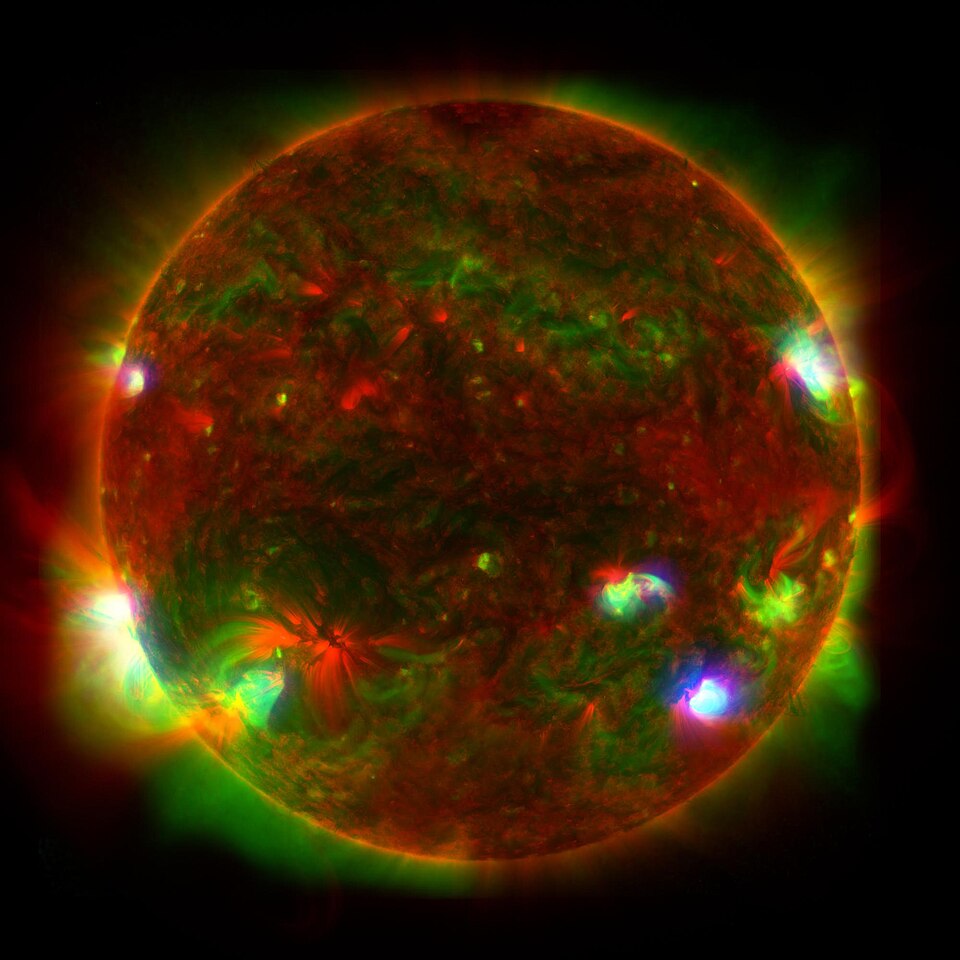
- Radiation needs no medium — the Sun's heat reaches Earth through the vacuum of space.
- Conduction and convection both require a material medium.
Study next
Common traps
- Thinking conduction or convection can occur through a vacuum — both need a medium.
- Confusing the slow drift of convection currents with the light-speed travel of radiation.
Asked as 'which mode needs no medium / travels at the speed of light' — answer is always radiation, the only electromagnetic mode.
Related PYQs
Given below are the four cases in which certain heat transfer is taking place: 1. Ice is melting in a glass full of water 2. Water is boiling in an open container 3. A metal rod is heated in a furnace 4. A cup of coffee is allowed to cool on a table In which of the above cases, the Newton's Law of Cooling is applicable?
- (a) 1 only
- (b) 4 only
- (c) 1 and 4 only
- (d) 1, 2 and 3
Answer(b) 4 only
Same topic — how a body exchanges heat with its surroundings. That NDA item tests Newton's law of cooling (a body losing heat by radiation and convection as it cools); this one tests which mode travels as radiation at the speed of light.
Practice
- practice — not a real PYQ
Which mode of heat transfer can take place through a vacuum?
- (a)Conduction
- (b)Convection
- (c)Radiation
- (d)All three
Answer(c) Radiation — it is carried by electromagnetic waves that need no medium. - practice — not a real PYQ
Heat transfer by the actual movement of heated fluid is called
- (a)Conduction
- (b)Convection
- (c)Radiation
- (d)Diffusion
Answer(b) Convection — heat is carried by the bulk motion of a heated fluid.