
Which one of the following statements is correct about the magnification of an optical microscope ?
- (a)Magnification increases with the increase in focal length of eyepiece
- (b)Magnification increases with the increase in focal length of objective
- (c)Magnification does not depend upon the focal length of eyepiece
- (d)Magnification decreases with the increase in focal length of eyepiece
Answer
Why
Correct — D, Magnification decreases with the increase in focal length of eyepiece. A compound microscope magnifies in two stages: the objective forms a real, enlarged image inside the tube, and the eyepiece then works as a simple magnifier on that image. The total magnification is the product of the two, and for a microscope adjusted for the image at the least distance of distinct vision it is close to (L/f₀) × (D/fₑ), where f₀ and fₑ are the focal lengths of objective and eyepiece, L the tube length and D the least distance of distinct vision. Both focal lengths sit in the denominator, so a longer-focal-length eyepiece gives a smaller magnification — which is why microscope lenses are made with very short focal lengths.
Why the others are wrong
- (a)Magnification increases with the increase in focal length of eyepiece — This reverses the relation. The eyepiece acts as a magnifying glass, whose angular magnification D/fₑ grows as its focal length shrinks, not as it grows.
- (b)Magnification increases with the increase in focal length of objective — The objective's focal length is also in the denominator, so lengthening it lowers the magnification. High-power objectives are the ones with the shortest focal lengths.
- (c)Magnification does not depend upon the focal length of eyepiece — The eyepiece supplies the second stage of magnification, so its focal length is one of the two quantities that decide the final value. If it did not matter, microscopes would not be sold with interchangeable eyepieces of different powers.
Concept
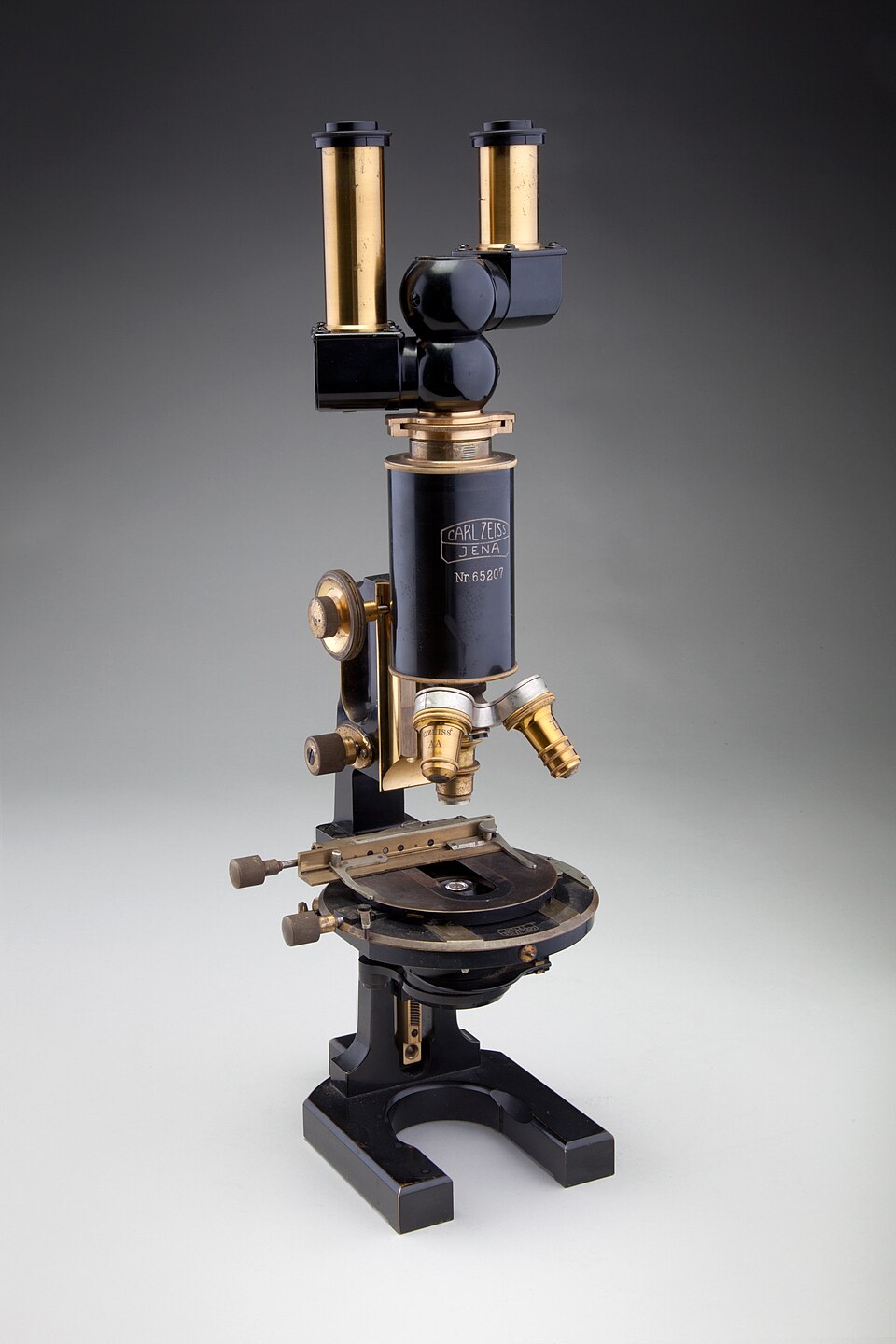
A compound microscope uses two converging lenses a fixed distance apart. The object is placed just beyond the focus of the short-focus objective, which forms a real, inverted and enlarged image within the tube; that image lies within the focal length of the eyepiece, which produces a much enlarged virtual image for the eye. Magnification multiplies across the two stages, so the instrument's power rises as both focal lengths are made shorter and as the tube is made longer.
Questions of this shape are testing whether you know which quantity lives in the numerator and which in the denominator. Anchor it on the simple magnifying glass you have handled: a strong lens is a fat, short-focus one, and a weak lens is a flat, long-focus one. The same rule then reads across to the microscope and to the eyepiece in particular. Note the contrast with the astronomical telescope, where magnification is f₀/fₑ, so there the objective's focal length must be long — the exact opposite requirement to the microscope's objective.
Key facts
- A compound microscope magnifies twice over — once at the objective and again at the eyepiece — and the two magnifications multiply.
- Magnification rises as the focal lengths of the objective and the eyepiece are made shorter.
- The power of a lens in dioptres is the reciprocal of its focal length in metres, so a short focal length means a powerful lens.
- In an astronomical telescope the magnification is the ratio of objective to eyepiece focal length, so its objective is long-focus, unlike the microscope's.
Study next
Common traps
- Assuming a bigger lens or a longer focal length means a more powerful lens — the opposite is true.
- Carrying the telescope's rule, where a long-focus objective is wanted, into the microscope.
- Confusing magnification with resolving power; making an image larger does not make finer detail visible.
NDA asks which statement about the magnification of a microscope or telescope is correct, or sets a one-step numerical on the magnification of a single lens.
Related PYQs
What is the magnification produced by a concave lens of focal length 10 cm, when an image is formed at a distance of 5 cm from the lens?
- (a) 2.0
- (b) 1.0
- (c) 0.5
- (d) 0.33
Answer(c) 0.5
Works the same quantity numerically for a single lens, showing how focal length fixes the magnification an optical element can deliver.
Practice
- practice — not a real PYQ
To increase the magnifying power of a compound microscope, one should use
- (a)an objective and an eyepiece of long focal length
- (b)an objective and an eyepiece of short focal length
- (c)a long-focus objective with a short-focus eyepiece
- (d)a plane mirror in place of the objective
Answer(b) an objective and an eyepiece of short focal length — both focal lengths sit in the denominator of the magnification. - practice — not a real PYQ
The magnifying power of an astronomical telescope in normal adjustment is
- (a)the product of the two focal lengths
- (b)the focal length of the objective divided by that of the eyepiece
- (c)the focal length of the eyepiece divided by that of the objective
- (d)independent of both focal lengths
Answer(b) the focal length of the objective divided by that of the eyepiece — hence a telescope wants a long-focus objective, unlike a microscope.